Support our educational content for free when you purchase through links on our site. Learn more
🎸 How to Tune a Ukule & 7 Essential Tunings (2026)

You can master standard G-C-E-A tuning in under five minutes using a clip-on tuner, but true versatility comes from understanding the seven distinct tunings that unlock the ukule’s full sonic potential. If you’ve ever wondered how do you tune a ukule and what are the common ukule tunings, the answer lies in balancing the classic “My Dog Has Fleas” re-entrant sound with the deeper, guitar-like tones of linear and alternative styles.
Most beginners stick rigidly to the standard G4-C4-E4-A4 setup, unaware that a simple string swap can transform their instrument into a jazz machine or a vintage Hawaiian voice. Did you know that before the 1930s, the D-tuning (A-D-F#-B) was actually the standard, creating a much brighter, more piercing sound than what we hear today?
We’ve all been there: you buy a beautiful new ukule, strum a chord, and it sounds like a cat walking on a keyboard. It’s not your playing; it’s the tension of the strings fighting against the wood. Whether you are a total novice or a seasoned strummer looking to expand your palette, knowing exactly how do you tune a ukule and what are the common ukule tunings is the difference between a muddy mess and a melody that sings.
Key Takeaways
- Master the Standard First: Start with G-C-E-A (High G) for the classic, jangly ukule sound; it is the foundation for 90% of available music.
- Explore Linear Tuning: Switch to Low-G for a warmer, guitar-like tone that supports complex fingerstyle arrangements.
- Unlock New Sounds: Experiment with D-tuning, Slack-Key, and Baritone (D-G-B-E) tunings to access unique genres like vintage Hawaiian, blues, and jazz.
- Tune Up, Not Down: Always loosen a string below the target pitch and tighten it up to ensure the string settles and stays in tune longer.
- Use the Right Tools: A clip-on chromatic tuner is essential for accuracy, especially when switching between re-entrant and linear tunings.
Table of Contents
- ⚡️ Quick Tips and Facts
- 📜 A Brief History of Ukule Tuning and String Evolution
- 🎯 The Standard GCEA Tuning: Your New Best Friend
- 🔍 Understanding Re-entrant vs. Linear Tuning Styles
- 🎸 The Low-G Tuning: Adding Bass and Depth to Your Sound
- 🎹 Alternative Ukule Tunings for Unique Sounds
- 1. D-Tuning (A D F# B): The Vintage Hawaiian Sound
- 2. Slack-Key Tunings: Emulating the Hawaiian Tradition
- 3. Slide Tuning: Creating Ethereal Textures
- 4. Baritone Tuning (D G B E): The Guitar Connection
- 5. C6 Tuning: The Jazz and Blues Favorite
- 6. D6 Tuning: Bright and Bouncy Melodies
- 7. Open G Tuning: Struming in a New Light
- 🛠️ Essential Tools for Perfect Ukule Tuning
- 👂 How to Tune by Ear: Developing Your Musical Instincts
- 🤔 Common Tuning Mistakes and How to Avoid Them
- 🌡️ Why Your Ukule Goes Out of Tune (And How to Fix It)
- 🎵 Changing Strings: A Step-by-Step Guide for Beginners
- 📊 Comparison of Popular Ukule Tunings and Their Best Uses
- 🏆 Expert Recommendations: Choosing the Right Tuning for Your Style
- 🎉 Conclusion
- 🔗 Recommended Links
- ❓ FAQ: Frequently Asked Questions About Ukule Tuning
- 📚 Reference Links
⚡️ Quick Tips and Facts
Before we dive into the deep end of the tuning pool, let’s splash around with some essential truths that will save your ears and your strings. If you’re wondering why your ukule sounds like a cat walking on a piano, it’s likely one of these culprits.
- The “My Dog Has Fleas” Mnemonic: This isn’t just a silly phrase; it’s the golden rule for Standard GCEA Tuning. From the top string (closest to your chin) down to the bottom: G (My), C (Dog), E (Has), A (Fleas). If you forget this, you’ll be playing in a key that sounds suspiciously like a broken music box.
- Tune Up, Not Down: Here is a pro tip that separates the amateurs from the pros: Always tune up to the pitch. If your string is too high (sharp), loosen it below the target note, then tighten it back up. This ensures the string settles properly on the tuning peg and stays in tune longer. Learn more about string physics here.
- New Strings Stretch: Brand new strings are like new shoes; they need a break-in period. They will go out of tune repeatedly for the first few days. Don’t panic! Just keep tuning them. Check out our guide on breaking in new strings.
- Temperature Matters: Wood breathes. If you take your ukule from a cold car into a warm room, the wood expands, and the strings go sharp. Give it 15 minutes to aclimate before tuning.
- The “High G” Myth: The top string on a standard ukule is often thinner than the C string, but it is tuned higher in pitch. This is called re-entrant tuning. It’s what gives the uke that jangly, happy sound.
📜 A Brief History of Ukule Tuning and String Evolution
You might think the ukule has always sounded the same, but the journey from Portuguese machetes to modern Hawaiian icons is a tale of tuning evolution.
In the late 19th century, when Portuguese immigrants brought their small guitars to Hawaii, they didn’t have a standardized tuning. It was a chaotic, beautiful mess of local adaptation. The instrument was initially tuned to D-G-B-E (similar to the top four strings of a guitar) or variations thereof.
However, by the early 20th century, a specific tuning began to dominate: G-C-E-A. Why? It created a unique C6 chord when strumed open, which became the sonic signature of the “Hawaian sound” that captivated the world. This tuning allowed for the distinctive re-entrant style where the G string is higher than the C string, creating that bouncy, melodic texture.
Fast forward to the 1930s, and we see the rise of D-tuning (A-D-F#-B), which was actually the standard for a brief period before the Great Depression shifted musical tastes. Today, while GCEA is king, the history of the ukule is a testament to the instrument’s flexibility. As Learn Play Uke notes, “There are so many alternate tunings for instruments out there… trying alternate tunings is great for your brain, it helps you think critically and get a better understanding of music theory.”
🎯 The Standard GCEA Tuning: Your New Best Friend
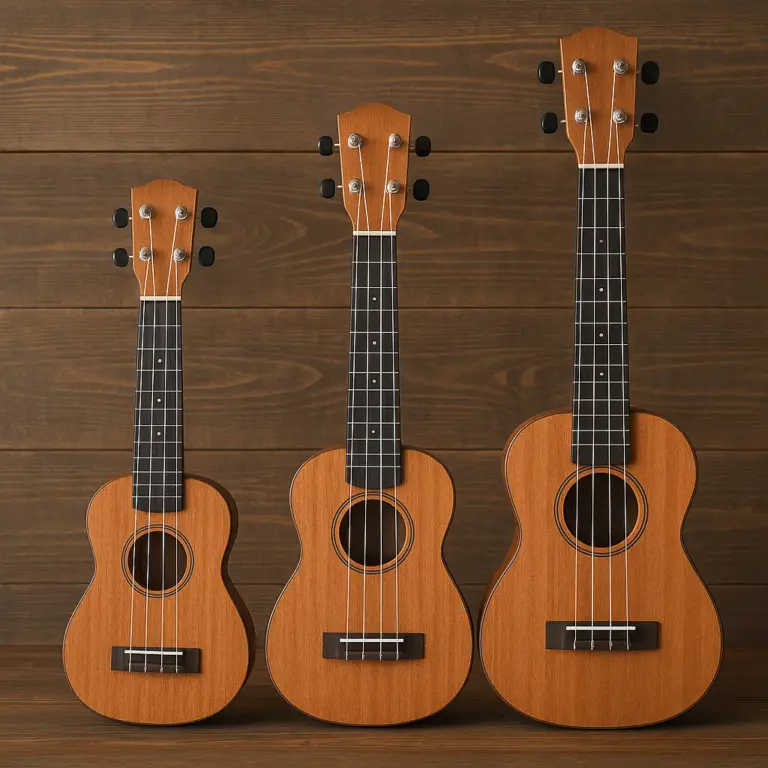
Let’s talk about the Standard Tuning. If you pick up a soprano, concert, or tenor ukule off the shelf, this is 9% likely the tuning you’ll find.
The Anatomy of G-C-E-A
- 4th String (Top): G4 (High G)
- 3rd String: C4
- 2nd String: E4
- 1st String (Bottom): A4
Why is it called “Re-entrant”?
In most stringed instruments (like a guitar), the strings are arranged from lowest pitch to highest pitch. On a standard ukule, the G string (4th) is tuned higher than the C string (3rd). This “jump” in pitch is what creates the re-entrant effect. It allows for chord voicings that are impossible on a guitar, giving the ukule its signature “plinky” sound.
The “My Dog Has Fleas” Check:
If you are a visual learner, imagine the strings:
- G (My) – High pitch
- C (Dog) – Lower pitch
- E (Has) – Higher pitch
- A (Fleas) – Highest pitch
Pros:
✅ Perfect for beginners.
✅ Massive library of chord charts and tabs available.
✅ Creates the classic, happy ukule sound.
Cons:
❌ Can sound “thin” for players used to a bass-heavy guitar sound.
❌ The high G string can be tricky to finger for some chord shapes.
Pro Tip: If you are using a chromatic tuner, make sure it is set to “Chromatic” mode, not “Guitar” mode. Guitar tuners often ignore the G4 or confuse it with the low G3.
🔍 Understanding Re-entrant vs. Linear Tuning Styles
This is where things get interesting. You’ve heard the terms Re-entrant and Linear, but what do they actually mean for your playing?
Re-entrant Tuning (The Classic Sound)
As mentioned, this is the standard G-C-E-A where the G is high.
- Sound: Jangly, bright, and percussive.
- Best For: Struming, traditional Hawaiian music, and pop songs.
- The Feeling: It feels like a “skip” in the melody.
Linear Tuning (The “Low-G” Sound)
In linear tuning, the strings are arranged from lowest pitch to highest pitch, just like a guitar. This means the 4th string is a Low G (G3) instead of a High G.
- Sound: Warmer, fuller, and more guitar-like. It has a defined bass note.
- Best For: Fingerstyle playing, jazz, and solo arrangements where you want a bass line.
- The Feeling: It feels more “grounded.”
Which one should you choose?
If you are struming chords to sing along, Re-entrant is usually the way to go. If you are playing complex fingerpicking arrangements where you need a bass line, Linear (Low-G) is your friend.
🎸 The Low-G Tuning: Adding Bass and Depth to Your Sound
So, you want that Low-G sound? It’s the secret weapon of players like Israel Kamakawiwo’ole (Iz) in his famous rendition of “Over the Rainbow.”
How to Achieve Low-G
You cannot simply tune your standard G string down. A standard G string is too thin; if you tune it down to G3, it will be floppy and sound like a rubber band.
- The Solution: You need a wound string or a thick fluorocarbon string specifically designed for Low-G.
- Brands to Trust: Look for Aquila (their Nylgut Low G series), Martin, or Worth strings.
The Trade-off
- ✅ Benefit: You get a full range of sound. The bass notes in your fingerpicking will actually sound like bass notes.
- ❌ Drawback: Some traditionalists argue it loses the “magic” of the re-entrant jump. Also, you need to buy a specific string set; you can’t just use your old strings.
Is it worth it?
If you play solo fingerstyle, absolutely. If you only strum chords, you might notice much difference, though the sound will be slightly warmer.
🎹 Alternative Ukule Tunings for Unique Sounds
Ready to break the rules? The ukule is incredibly versatile. Once you master GCEA, you can explore a world of alternative tunings. Let’s count them up: we have seven distinct alternative tunings to explore, far more than the standard two or three most people know.
1. D-Tuning (A-D-F#-B): The Vintage Hawaiian Sound
Before GCEA became the standard, D-tuning was the norm. It is exactly one whole step higher than standard tuning.
- Notes: A4 – D5 – F#5 – B5
- Why use it? It creates a brighter, more piercing sound. It’s fantastic for playing in the Key of A or E.
- Caution: Tuning up a whole step puts significant tension on the instrument. Ensure your ukule can handle it, or use lighter gauge strings.
2. Slack-Key Tunings (G-C-E-G): Emulating the Hawaiian Tradition
Slack-key (Ki ho’alu) is a traditional Hawaiian style where you “slack” (lower) some strings to create an open chord.
- Configuration: G4 – C4 – E4 – G4 (The A string is tuned down to G).
- The Magic: Struming open strings gives you a C Major chord.
- Technique: You can play melodies over a drone bass easily. It’s perfect for that authentic, laid-back island vibe.
3. Slide Tuning (C7 / G-C-E-Bb): Creating Ethereal Textures
Want to play blues on a uke? Try Slide Tuning.
- Configuration: G4 – C4 – E4 – Bb4 (Tune the A string down a half-step to Bb).
- The Result: An open C7 chord.
- How to play: Use a slide (a glass bottle neck or a metal slide) and lightly touch the strings. It creates a haunting, ethereal sound.
- Warning: Be careful tuning the A string up to Bb if you are using a standard string; it might snap. It’s safer to tune down from A to Bb, or use a string designed for the tension.
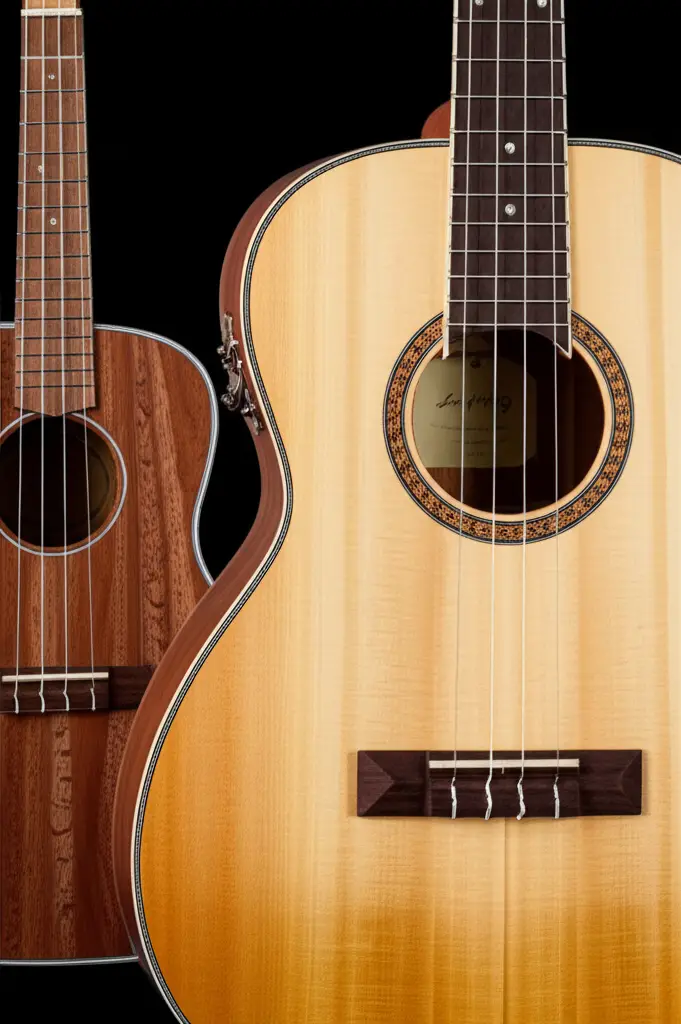
4. Baritone Tuning (D-G-B-E): The Guitar Connection
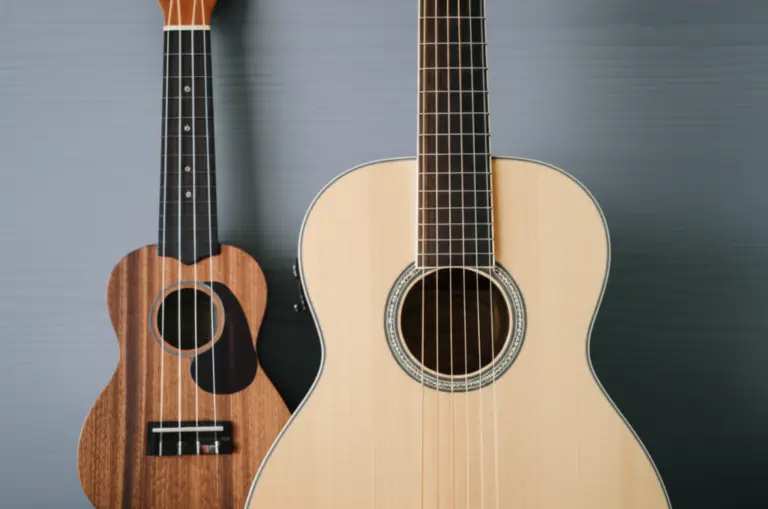
The Baritone Ukule is the odd one out. It is tuned D3-G3-B3-E4, which matches the top four strings of a standard guitar.
- Why it matters: If you are a guitarist, you can play guitar chords on a baritone uke without learning new shapes.
- The Catch: It sounds deeper and less “ukule-like.” To get the standard GCEA sound on a baritone, you need special strings and a different tuning approach.
5. C6 Tuning: The Jazz and Blues Favorite
Wait, isn’t GCEA a C6? Yes! But in jazz circles, C6 often refers to a specific voicing or a variation where the G is low, emphasizing the C6 chord structure.
- Usage: Essential for jazz players who want to voice chords with a bass note.
- Sound: Sophisticated, smooth, and perfect for complex harmonies.
6. D6 Tuning: Bright and Bouncy Melodies
Similar to D-tuning but often used for specific melodic runs.
- Configuration: A4 – D5 – F#5 – B5 (Same as D-tuning, but the focus is on the D6 chord structure).
- Best For: Fast, bouncy melodies in the Key of D.
7. Open G Tuning: Struming in a New Light
- Configuration: G4 – D4 – G4 – B4 (or variations).
- The Vibe: This creates an open G major chord. It’s great for slide playing and folk styles.
- Why try it? It changes the way you think about chord shapes entirely.
🛠️ Essential Tools for Perfect Ukule Tuning
You can’t tune a uke with a wish and a prayer (though we’ve all tried). You need the right gear.
1. Clip-On Tuners
These are the gold standard for live performance and noisy environments. They sense vibration through the wood, not sound.
- Top Picks:
Snark SN5X: The industry workhorse. Durable, accurate, and affordable.
Korg TM-60: A metronome and tuner combo, great for practice.
D’Addario NS Micro: Tiny and unobtrusive.
👉 CHECK PRICE on:
- Snark SN5X: Amazon | Sweetwater | Guitar Center
- Korg TM-60: Amazon | Sweetwater | Korg Official
2. Smartphone Apps
If you don’t want to buy a clip-on, your phone is a powerful tool.
- Boss TU-3 Chromatic Tuner App: Free and highly accurate. It uses the microphone to detect pitch.
- GuitarTuna: User-friendly with a great interface for beginners.
Pro Tip from the “First Video”: As noted in the video summary, “It does tend to always best to come up to the note.” When using an app, play the string, listen, and adjust the peg until the needle centers. If you are sharp, loosen it below the note, then tighten up.
3. Tuning Forks
For the purists. A 40Hz tuning fork gives you an A note. You tune the A string first, then tune the others relative to it. It’s a great exercise for your ear, but not practical for quick tuning on stage.
👂 How to Tune by Ear: Developing Your Musical Instincts
Relying solely on a tuner is like using training wheels forever. Eventually, you need to ride without them. Here is how to tune by ear, a skill that will make you a better musician.
The Relative Tuning Method
- Start with the A String: Use a reference (a piano, a tuning fork, or an app) to get your A string (1st string) in tune.
- The 5th Fret Trick:
- Press the A string at the 5th fret. This should match the open E string (2nd string).
- Press the E string at the 4th fret. This should match the open C string (3rd string).
- Press the C string at the 5th fret. This should match the open G string (4th string).
- Listen for the “Beats”: When two notes are slightly out of tune, you hear a wavering “wah-wah-wah” sound. As you get closer to the correct pitch, the wavering slows down. When it stops, you are in tune.
Why learn this?
Because in a jam session, your tuner might die, or the background noise might be too loud. If you can tune by ear, you are unstoppable. Plus, it helps you understand the intervals between strings.
🤔 Common Tuning Mistakes and How to Avoid Them
Even the pros make mistakes. Here are the most common pitfalls we see at Guitar Brands™.
1. Tuning Down to the Note
❌ The Mistake: You are sharp, so you just loosen the peg until it hits the note.
✅ The Fix: Losen it past the note, then tighten it back up. This removes slack from the winding and ensures stability.
2. Ignoring the “High G”
❌ The Mistake: Trying to tune a standard G string down to Low G.
✅ The Fix: Buy a dedicated Low G string. A standard string will sound floppy and intonation will be off.
3. Over-tightening
❌ The Mistake: Cranking the pegs too hard, thinking “more tension = better sound.”
✅ The Fix: If a string is too tight, it will snap. If it’s too loose, it will buzz. Trust your tuner.
4. Not Stretching New Strings
❌ The Mistake: Putting on new strings, tuning them once, and playing.
✅ The Fix: Stretch the strings gently by pulling them away from the fretboard, retune, and repeat until they hold their pitch.
🌡️ Why Your Ukule Goes Out of Tune (And How to Fix It)
Is your ukule a runaway train? Here’s why it happens.
- New Strings: As mentioned, they stretch. Give it 24-48 hours of playing and frequent tuning.
- Humidity and Temperature: Wood expands and contracts. If you live in a dry climate, your strings might go flat. If it’s humid, they might go sharp.
Solution: Use a humidifier for your case in dry months. - Poor Quality Tuning Pegs: Cheap friction pegs slip easily.
Solution: Upgrade to geared tuners (like those from Gotoh or Grover). They hold tension much better. - Slipping at the Bridge: If the knot at the bridge isn’t tight, the string will slip.
Solution: Learn the proper tie-block knot technique.
🎵 Changing Strings: A Step-by-Step Guide for Beginners
Changing strings can be scary, but it’s easy once you know the steps.
- Losen the Strings: Turn the pegs until the strings are loose.
- Remove the Old Strings: Unwind them from the pegs and untie the bridge.
- Clean the Fretboard: Use a soft cloth to wipe away grime.
- Insert the New Strings:
Bridge: Tie the string securely around the bridge block. Leave a little slack.
Peg: Insert the string into the peg hole. - Tune Up: Bring the string up to pitch slowly.
- Stretch and Retune: Pull the string gently, retune, and repeat until stable.
Recommended String Sets:
- Aquila Super Nylgut: The classic choice. Bright and loud.
- Martin M60: Warm and mellow.
- Worth Clear: Balanced and durable.
👉 Shop
- Aquila Strings: Amazon | Sweetwater | Aquila Official
- Martin Strings: Amazon | Guitar Center | Martin Official
📊 Comparison of Popular Ukule Tunings and Their Best Uses
Let’s break it down visually. Which tuning is right for your style?
| Tuning Name | Notes (4th to 1st) | Type | Best For | Sound Character |
|---|---|---|---|---|
| Standard (GCEA) | G4-C4-E4-A4 | Re-entrant | Beginners, Struming, Pop | Bright, Jangly, Classic |
| Low-G (Linear) | G3-C4-E4-A4 | Linear | Fingerstyle, Jazz, Solo | Warm, Full, Guitar-like |
| D-Tuning | A4-D5-F#5-B5 | Re-entrant | Vintage Hawaiian, Key of A | Piercing, Bright, Vintage |
| Slack-Key | G4-C4-E4-G4 | Re-entrant | Traditional Hawaiian, Open Chords | Drone-heavy, Melodic |
| Baritone (DGBE) | D3-G3-B3-E4 | Linear | Guitarists, Folk, Blues | Deep, Mellow, Guitar-like |
| Slide (C7) | G4-C4-E4-Bb4 | Re-entrant | Blues, Slide Guitar | Ethereal, Bluesy |
🏆 Expert Recommendations: Choosing the Right Tuning for Your Style
So, where do we stand? We’ve covered the history, the tools, the methods, and the alternatives. But which one should you pick?
If you are just starting out, stick to Standard GCEA. It’s the language of the ukule. 90% of the songs you’ll find online are written for this tuning. Don’t overcomplicate it.
Once you feel comfortable, try Low-G. It opens up a whole new world of fingerpicking. If you have a Baritone, embrace the DGBE tuning—it’s a guitar in disguise!
And remember, the “best” tuning is the one that makes you want to play. As the experts at Learn Play Uke say, “Honestly, C6 is a hallmark of the uke,” but experimenting is what makes music fun.
Final Thought:
Did you ever wonder why the ukule sounds so happy? It’s that re-entrant G string! It skips over the bass notes, creating a perpetual sense of lift. If you switch to Low-G, you lose that skip, but you gain depth. It’s a trade-off, not a right or wrong answer.
Now, go grab your tuner, tune up, and let’s make some noise! 🎶