Support our educational content for free when you purchase through links on our site. Learn more
🎸 8 Best Ukules for Beginners: Find Your Perfect Fit

For most adults, the best ukulele for beginners is a concert-size model: it offers more fret room than a soprano while staying compact, affordable, and easy to carry. Our all-around pick is the Kala KA-C, but players with smaller hands may prefer a soprano, while larger hands and fingerpickers may feel right at home on a tenor.
One of our musicians learned this the practical way: a soprano was delightful in a backpack, but cramped fingers turned a simple chord into an accidental string-muting contest. A quick try on a concert ukulele made the difference. The right size should make playing feel inviting, not like a tiny-hand gymnastics routine.
This guide compares beginner-friendly ukules from Kala, Cordoba, Fender, Donner, and Enya, then explains what to look for in size, tuning, construction, setup, and accessories. We’ll also help you avoid the common trap of buying a bundle full of extras while overlooking whether the instrument itself feels good to play.
Key Takeaways
- Choose for comfort first: Concert is a great starting point for many adults; soprano suits players who prioritize portability, and tenor offers more room and a fuller sound.
- Check the setup: Smooth tuning pegs, comfortable string height, clean notes, and no sharp fret ends matter more than flashy extras.
- Start with standard G–C–E–A tuning on soprano, concert, or tenor. Baritone ukulele commonly uses D–G–B–E.
- Our top all-around pick is the Kala KA-C Concert; consider the Kala KA-15S for a compact soprano, Cordoba 15CM for concert comfort, or Kala KA-T for tenor space.
- A tuner and protective case are useful essentials. You can leave most other accessories for later.
👉 Shop beginner-friendly ukules:
- Kala KA-C Concert: Amazon | Guitar Center | Kala Official
- Kala KA-15S Soprano: Amazon | Guitar Center | Kala Official
- Cordoba 15CM Concert: Amazon | Guitar Center | Cordoba Official
- Kala KA-T Tenor: Amazon | Guitar Center | Kala Official
Table of Contents
- ⚡️ Quick Tips and Facts: Choosing Your First Ukulele
- 🎸 Beginner Ukulele Background: A Little History and the Four Sizes
- Soprano, Concert, Tenor, and Baritone: What’s the Difference?
- 🏆 Best Ukules for Beginners: Our Top Picks
- 1. Best Overall Beginner Ukulele
- 2. Best Budget Ukulele for Beginners
- 3. Best Concert Ukulele for Comfortable Fretting
- 4. Best Soprano Ukulele for Classic Sound
- 5. Best Tenor Ukulele for Bigger Hands and Richer Tone
- 6. Best Beginner Ukulele Starter Kit
- 7. Best Left-Handed Ukulele for Beginners
- 8. Best Electric-Acoustic Ukulele for Practice and Performance
- 🎯 How to Choose a Beginner Ukulele
- Choosing the Right Ukulele Size for Your Hands
- Solid Wood, Laminated Wood, and Plastic Ukulele Bodies
- Nylon, Fluorocarbon, and Other Ukulele Strings
- Tuning Pegs, Frets, Intonation, and Build Quality
- Acoustic or Electric-Acoustic: Which Is Better for Beginners?
- Left-Handed Ukulele Setup: What to Know Before Buying
- 🎒 What Comes in a Ukulele Starter Kit?
- Essential Ukulele Accessories: Tuner, Case, Strap, and Picks
- Accessories You Can Skip at First
- 💰 How Much Should a Beginner Spend on a Ukulele?
- 🛒 Where to Buy a Beginner Ukulele
- Buying Online vs. Shopping at a Local Music Store
- How to Check a Ukulele Before You Buy
- 🎼 Beginner Ukulele Setup and Tuning
- Standard G-C-E-A Tuning and High-G vs. Low-G
- Why a New Ukulele Keeps Going Out of Tune
- How to Tune a Ukulele with an App or Clip-On Tuner
- 🎶 Your First Ukulele Chords and Strumming Patterns
- Easy Ukulele Chords for Beginners
- Simple Strumming Patterns to Get You Playing
- Common Beginner Mistakes and How to Fix Them
- 🧽 Ukulele Care, Storage, and String Changes
- ✅ Final Checklist: Is This the Right Ukulele for You?
- Conclusion
- Recommended Links
- FAQ
- What is the best ukulele for beginners?
- Should a beginner start with a soprano or concert ukulele?
- Is a concert ukulele easier to play than a soprano?
- Are cheap ukules good for beginners?
- How much should I spend on my first ukulele?
- Do I need a tuner to learn ukulele?
- How often should I tune a new ukulele?
- Can adults learn on a soprano ukulele?
- Is ukulele easier to learn than guitar?
- Can left-handed beginners play a standard ukulele?
- Reference Links
⚡️ Quick Tips and Facts: Choosing Your First Ukulele
Our ukulele buying guide starts with one friendly truth: the best ukulele for beginners is the one that feels comfortable, stays in tune, and makes you want to pick it up again tomorrow. You don’t need a fancy instrument to learn your first chords. You do need one that isn’t fighting back.
| Quick question | Our short answer |
|---|---|
| Best size for most adult beginners? | Concert is a comfortable starting point, with more fret space than a soprano. |
| Best size for small hands or children? | Soprano is compact and lightweight; try it in person if possible. |
| Best for larger hands or fingerpicking? | Tenor offers more room and a fuller sound. |
| What tuning should I expect? | Soprano, concert, and tenor commonly use G–C–E–A; baritone commonly uses D–G–B–E. |
| Do I need a starter bundle? | Not necessarily. A dependable tuner and protective case are more useful than a pile of accessories you may never touch. |
| What should I avoid? | Instruments with sharp fret ends, a visibly warped neck, or strings that are painfully high above the fretboard. |
Two-minute buying advice: hold the instrument, try a C chord, and listen for buzzing. If a beginner’s C chord sounds like a tiny swarm of bees, the setup may need attention—not more finger strength. The Kala Learn to Play ukulele guide is a useful companion for getting started.
🎸 Beginner Ukulele Background: A Little History and the Four Sizes

The ukulele’s roots are in Hawaii, where it developed in the late 19th century, influenced by small Portuguese instruments brought to the islands. The Smithsonian’s National Museum of American History documents the instrument’s Hawaiian history and cultural significance. Its portable size and approachable string tension helped it travel from local music into living rooms, classrooms, and stages around the world.
Today, choosing a ukulele means choosing more than a body size: the size affects fret spacing, sound, tuning, and how comfortable the instrument feels in your hands. If you’re already browsing our guitar buying guides, think of ukulele sizes as different neck-and-body combinations—not strict skill levels.
Soprano, Concert, Tenor, and Baritone: What’s the Difference?
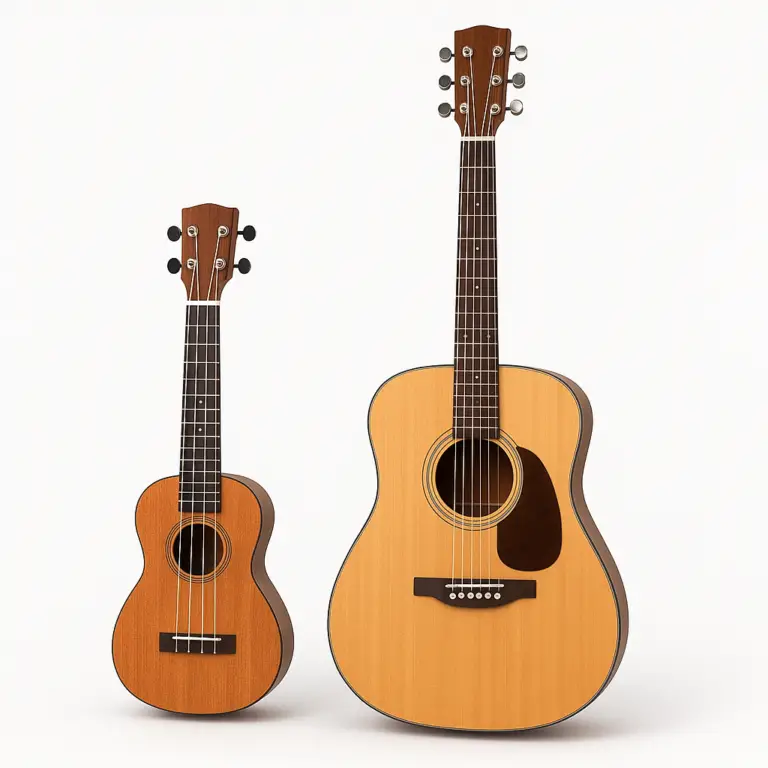
Exact dimensions vary by maker, but these are useful ballpark measurements. Scale length means the vibrating string length from nut to bridge; total instrument length includes the body and headstock.
| Size | Approx. total length | Typical scale length | Common tuning | Typical character | Often suits |
|---|---|---|---|---|---|
| Soprano | 21 in. | 13 in. | G–C–E–A | Bright, compact, classic | Children, travel, small hands |
| Concert | 23 in. | 15 in. | G–C–E–A | Warm, balanced, a little roomier | Many first-time adult players |
| Tenor | 26 in. | 17 in. | G–C–E–A | Fuller, more sustain and fret space | Larger hands, fingerstyle, performing |
| Baritone | 30 in. | 19 in. | D–G–B–E | Deep, mellow, guitar-like | Guitarists and players wanting lower notes |
The three smaller sizes generally share standard G–C–E–A tuning, so chord shapes transfer across them. Baritone is the exception: its D–G–B–E tuning corresponds to the highest four strings of a guitar, but familiar guitar chord shapes won’t necessarily produce the same chord names as on a standard-tuned ukulele. For a clear size overview, compare the advice from Terry Carter Music Store with the dimensions listed by individual manufacturers.
🏆 Best Ukules for Beginners: Our Top Picks
We’ve chosen instruments from established makers that offer sensible beginner features and are widely available. This is a category guide, not a claim that every instrument in every production run is identical: setup, string choice, and individual instrument quality still matter. Our ratings are practical comparison scores, not laboratory measurements.
| Pick | Design | Playability | Sound | Beginner value | Best for |
|---|---|---|---|---|---|
| Kala KA-C Concert | 8 | 9 | 8 | 9 | Most beginners who want a little extra fret room |
| Kala KA-15S Soprano | 8 | 8 | 8 | 9 | Portable, traditional soprano feel |
| Cordoba 15CM Concert | 8 | 9 | 8 | 8 | Comfortable concert-size starter |
| Fender Venice Soprano | 8 | 8 | 8 | 8 | Compact instrument with familiar brand support |
| Kala KA-T Tenor | 8 | 9 | 9 | 8 | Larger hands and a fuller sound |
| Donner DUC-1 Concert bundle | 7 | 7 | 7 | 8 | Buyers who want common starter accessories in one box |
| Kala KA-B Baritone | 8 | 8 | 9 | 8 | Guitarists curious about baritone tuning |
| Enya Nova U Concert | 8 | 8 | 7 | 8 | Players seeking a weather-resistant composite option |
1. Best Overall Beginner Ukulele
Kala KA-C Concert
The Kala KA-C is our strongest all-around starting point for most adult beginners: concert size gives you more room between frets than soprano, without making the instrument feel unwieldy. It uses familiar G–C–E–A tuning and has the classic, bright ukulele voice most new players expect.
Why we like it
- A practical size for learning open chords and basic strumming.
- Simple, traditional design with a broad ecosystem of lessons and accessories.
- More space for fretting fingers than many soprano models.
Trade-offs
- The extra size is less pocketable than a soprano.
- A lower-cost instrument can still benefit from a professional setup if the action feels high.
A musician on our team once chose a soprano for a weekend trip because it fit in a small backpack, then spent the first evening accidentally muting neighboring strings with adult-sized fingertips. The concert became the “practice at home” instrument. Comfort beats romantic notions of tiny-is-always-easier.
- 👉 CHECK PRICE on: Amazon | Guitar Center | Kala Official Website
2. Best Budget Ukulele for Beginners
Kala KA-15S Soprano
The Kala KA-15S is a straightforward soprano option for players who want a compact instrument from a recognizable ukulele maker. Its small footprint and standard tuning make it suitable for casual strumming, travel, and younger players.
Why it works
- Portable and easy to store.
- Familiar G–C–E–A tuning.
- A simple way to see whether ukulele playing sticks before investing in a more elaborate instrument.
What to keep in mind
-
Close fret spacing can feel cramped for larger hands.
-
Soprano bodies generally have less low-end resonance than tenor or baritone instruments.
-
👉 CHECK PRICE on: Amazon | Guitar Center | Kala Official Website
3. Best Concert Ukulele for Comfortable Fretting
Cordoba 15CM Concert
The Cordoba 15CM is a well-established concert-size model with a warm, approachable sound. Its larger fretboard can make initial chord practice less fiddly for many adults, while the instrument remains compact enough to take along.
Why it stands out
- Concert scale provides useful finger room.
- A classic acoustic format keeps the learning setup simple.
- Cordoba’s wider instrument lineup makes it easy to compare ukules with the company’s nylon-string guitars.
Possible drawback: Hand comfort is personal. A concert neck that feels roomy to one player may still feel narrow to someone with broad fingers; test a tenor before deciding.
- 👉 CHECK PRICE on: Amazon | Guitar Center | Cordoba Official Website
4. Best Soprano Ukulele for Classic Sound
Fender Venice Soprano
The Fender Venice brings the familiar compact soprano format to a household guitar name. It’s a sensible pick for players drawn to a traditional, bright ukulele sound and an instrument small enough to carry easily.
Good fit for
- Younger players and people with smaller hands.
- Travel and casual sing-alongs.
- Beginners who want soprano size but prefer a mainstream guitar-brand product.
Trade-off: Its tight fret spacing may make chord changes harder for larger fingers. A larger instrument is not “cheating”; it’s choosing a tool that fits.
- 👉 CHECK PRICE on: Amazon | Guitar Center | Fender Official Website
5. Best Tenor Ukulele for Bigger Hands and Richer Tone
Kala KA-T Tenor
The Kala KA-T offers a longer scale and more room for the fretting hand, alongside the fuller voice many players associate with tenor ukules. It remains in G–C–E–A tuning, so the standard chord shapes in most beginner lessons still apply.
Why choose tenor
- More space between frets can help with finger placement.
- A fuller sound may suit fingerpicking and singing.
- A comfortable step for guitarists who find soprano and concert necks cramped.
Trade-off: It’s larger to carry, and a richer tone won’t automatically make chords cleaner. That still comes from relaxed, accurate fretting.
- 👉 CHECK PRICE on: Amazon | Guitar Center | Kala Official Website
6. Best Beginner Ukulele Starter Kit
Donner DUC-1 Concert Bundle
A Doner DUC-1 concert ukulele bundle can be convenient if it includes a gig bag, tuner, and spare strings. Bundles vary, so check the exact contents rather than assuming every listing includes the same accessories.
Bundle benefits
- One purchase may cover several practical needs.
- A clip-on tuner is useful for regular tuning.
- A gig bag helps protect the instrument from scratches and dust.
Bundle cautions
- The included tuner or bag may be basic.
- “More accessories” doesn’t mean “better ukulele.”
- Inspect the instrument’s setup and return policy before buying.
For our general advice on choosing instruments and accessories, see the Guitar Buying Guide.
- 👉 CHECK PRICE on: Amazon | Doner Official Website
7. Best Left-Handed Ukulele for Beginners
Kala and other standard models: ask about setup before ordering
Dedicated left-handed ukules are less common than standard right-handed models, and many players learn comfortably on a standard instrument. You can play right-handed, restring for left-handed playing, or buy a model specifically configured for left-handed use. Don’t simply flip a standard ukulele over and assume the strings will work in reverse: nut slots, saddle compensation, and string order can affect intonation and playability.
Ask a music shop whether it can set up a chosen instrument for left-handed playing. The Kala brand site and local retailers can help confirm current model availability.
- 👉 Shop left-handed options on: Amazon | Guitar Center | Kala Ukulele Collection
8. Best Electric-Acoustic Ukulele for Practice and Performance
Kala KA-TE and other pickup-equipped models
A pickup-equipped ukulele can connect to an amplifier or PA for rehearsals and performances. The Kala KA-TE is one example of a tenor-style electric-acoustic option, but verify the exact pickup and onboard controls for the model year and listing.
Benefits
- Easier to amplify in a band or on stage.
- Useful for recording a direct signal.
- Lets you explore effects, though a clean amp is plenty for a first performance.
Drawbacks
- You’ll need amplification and cables to use the electronics.
- The pickup does not necessarily improve unpluged sound.
- More features mean more controls to learn and more parts to maintain.
The featured video makes a fair point: acoustic instruments suit home playing and small gatherings, while electric-acoustic models broaden your amplified options. Our guitar brand guides cover the same practical distinction across guitars.
- 👉 CHECK PRICE on: Amazon | Guitar Center | Kala Official Website
🎯 How to Choose a Beginner Ukulele
The strongest advice from teachers and retailers is consistent: start with comfort, size, and sound preference, not a brand’s fanciest wood description. Terry Carter Music Store calls concert size “the perfect balance between comfort and sound projection,” and generally recommends it for beginners, particularly adults. That’s useful guidance, but not a universal law: small-handed players may prefer soprano, while some adults find tenor more comfortable.
Choosing the Right Ukulele Size for Your Hands
Try this simple fit test before choosing:
- Hold the neck naturally without squeezing.
- Place your index finger near the first fret and fret a note.
- Form a C chord, then a G or G7 chord.
- Check whether your fingers can press cleanly without forcing your wrist into an uncomfortable bend.
- Strum all four strings and listen for muted or buzzing notes.
| If you notice… | Consider… | Why |
|---|---|---|
| Fingers collide on chord shapes | Concert or tenor | More fret spacing may help |
| The instrument feels heavy or awkward | Soprano | Smaller body and shorter reach |
| You want more low-end resonance | Tenor or baritone | Larger body and scale often produce a fuller voice |
| You already play guitar | Tenor or baritone | Tenor keeps G–C–E–A; baritone uses guitar-like D–G–B–E |
Do not choose by age alone. A child with larger hands may prefer a concert; an adult who loves portability may happily play soprano. Our acoustic guitar guides use the same principle: fit beats a one-size-fits-all rule.
Solid Wood, Laminated Wood, and Plastic Ukulele Bodies
| Construction | Benefits | Trade-offs | A sensible fit |
|---|---|---|---|
| Laminated wood | Often sturdy and consistent; practical for everyday use | Usually less responsive than comparable solid-wood tops | Many first-time buyers |
| Solid-wood top | Can offer a more responsive, nuanced sound | More sensitive to changes in humidity and care | Players who value tone and will maintain the instrument |
| Composite or plastic | Often resistant to moisture and temperature swings | Tone and feel differ from traditional wood | Travel, outdoor use, or humid environments |
A wooden body can resonate beautifully, but material alone does not determine sound. Construction, strings, bracing, setup, and the player’s touch all contribute. The first video’s material comparison makes a useful broad distinction—wood tends to offer more traditional resonance, while composite construction can be more weather-tolerant—but the best choice depends on where you’ll play and how you’ll care for it. For brand-by-brand comparisons, explore our Guitar Brands Showcase.
Nylon, Fluorocarbon, and Other Ukulele Strings
Most beginner ukules arrive with synthetic strings, commonly nylon or fluorocarbon. They feel gentler than steel guitar strings, but they still need correct tuning and a little time to settle.
- Nylon: Often has a soft feel and warm sound; properties vary by string set.
- Fluorocarbon: Often feels thinner and can sound clear and bright.
- Wound strings: Used on some lower strings, especially in alternate or baritone setups.
For a first instrument, keep the factory strings unless one is damaged or you have a specific reason to change them. String makers such as Aquila publish product information by instrument size and tuning. Never force a string to a pitch it is not designed for; check that the set matches your ukulele’s size and tuning.
Tuning Pegs, Frets, Intonation, and Build Quality
Before buying, inspect these details:
- Tuning machines: Turn smoothly and hold tension without obvious slipping.
- Frets: Feel along the neck edges for sharp ends; look for visibly uneven frets.
- Action: This is string height above the frets. Extremely high action makes chords harder; extremely low action can cause buzzing.
- Intonation: Compare an open string with its note at the 12th fret. A large mismatch may indicate a setup or instrument issue.
- Bridge and nut: Look for cracks, lifting, rough edges, or loose parts.
- Sound: Strum every string and check for dead notes, rattles, and inconsistent volume.
A beginner should not need to fight high action to earn musical merit badges. If the ukulele feels hard to fret, ask a qualified technician whether a setup can help. This is a good time to visit a local shop or browse our guitar brand guides for brand and construction context.
Acoustic or Electric-Acoustic: Which Is Better for Beginners?
| Type | Best for | What to consider |
|---|---|---|
| Acoustic | Home practice, lessons, casual playing | Simple setup; no amp needed |
| Electric-acoustic | Open mics, stage use, amplified recording | Requires a cable and amplifier or PA when plugged in |
| Solid-body electric ukulele | Effects and amplified sounds | Not the simplest choice if your main goal is unpluged practice |
For most beginners, an ordinary acoustic ukulele is enough. Choose electric-acoustic if you already know you’ll plug in. The featured video describes the extra tonal possibilities of amplified playing; just remember that effects are seasoning, not the meal. Our bass guitar category shows how pickup systems serve a different role on lower-register instruments.
Left-Handed Ukulele Setup: What to Know Before Buying
Left-handed beginners have three practical choices:
- Learn right-handed: The fretting hand does much of the chord work, some left-handed players adapt easily.
- Buy a left-handed instrument: Best if the standard orientation feels unnatural and a suitable model is available.
- Have a standard instrument professionally restrung and set up: Confirm the nut and saddle are appropriate for the new string order.
Try before committing when possible. A left-handed player is not required to play right-handed, and a right-handed instrument should not be reversed without considering setup.
🎒 What Comes in a Ukulele Starter Kit?
Starter kits can be convenient, but compare the instrument itself before getting dazzled by the accessory confetti. A good kit should include items you’ll actually use, not a dozen low-quality extras.
Essential Ukulele Accessories: Tuner, Case, Strap, and Picks
| Accessory | Essential? | What to look for |
|---|---|---|
| Clip-on tuner | Strongly recommended | Clear display and reliable pitch detection |
| Gig bag | Recommended | Padding and a secure closure |
| Spare strings | Useful | Correct size and tuning |
| Strap | Optional | Strap buttons or a suitable soundhole/neck attachment |
| Picks | Optional | Many players strum with a finger; try both |
| Humidity control | Depends on climate and instrument | More relevant to solid-wood instruments and dry rooms |
A chromatic clip-on tuner is an easy choice for beginners; Snark tuners are widely used for acoustic instruments. The Kala learning resources can help you get your first chords under your fingers.
Accessories You Can Skip at First
You can hold off on:
- An effects pedalboard.
- A premium pickup system if you only play at home.
- Multiple string sets before you know your preferred feel.
- Elaborate strap hardware if you are comfortable sitting and playing.
A basic instrument, tuner, and case will get you much farther than an accessory bundle that resembles a tiny music-store yard sale.
💰 How Much Should a Beginner Spend on a Ukulele?
We won’t pretend there’s one correct budget. A very low-cost instrument can be fine for a child’s first experiment, while a better-built ukulele may make daily practice more enjoyable. Your goal is reliable tuning, comfortable action, and sound you like, not the most expensive wood in the shop.
| Your situation | Put your attention on |
|---|---|
| Trying ukulele for the first time | Basic playability and a return policy |
| Buying for a child | Durable construction, manageable size, and a protective bag |
| Planning regular lessons | Comfortable fit, accurate fretting, and dependable tuning |
| Already playing guitar | Neck spacing, tuning choice, and sound rather than bundle size |
| Preparing to perform | Pickup quality, instrument setup, and stage-ready accessories |
A store setup may be worth prioritizing over decorative features. If you’re comparing options, use the Guitar Buying Guide as a checklist and ask the seller how returns and adjustments work.
🛒 Where to Buy a Beginner Ukulele
You can buy from an online retailer, a local music shop, or a maker’s official site. The best option depends on whether you value hands-on testing, selection, or convenience.
Buying Online vs. Shopping at a Local Music Store
| Option | Advantages | Watch-outs |
|---|---|---|
| Local music store | Try different sizes; ask about setup; support from staff | Selection may be limited |
| Online retailer | Broad selection and easy model comparison | You can’t feel the neck before delivery |
| Brand website | Official model details and support information | May not offer the same local setup service |
When buying online, confirm the exact size, tuning, included accessories, seller reputation, and return window. If the product page says “starter bundle,” inspect the contents carefully; bundles vary by retailer and listing.
How to Check a Ukulele Before You Buy
Use this checklist in-store, or adapt it when the instrument arrives:
- Inspect the body, bridge, neck, and tuning machines.
- Tune all strings with a reliable tuner.
- Play every open string, listening for rattles or muted notes.
- Try C, F, G, and G7 chords.
- Check for sharp fret ends or discomfort along the neck.
- Play notes up the neck and listen for dead spots or severe tuning problems.
- Ask whether the seller can adjust action or correct minor setup issues.
If the instrument fails basic checks, a beginner is not obliged to “grow into” a bad setup. Return or exchange it according to the seller’s policy.
🎼 Beginner Ukulele Setup and Tuning
Good setup starts with the right strings, comfortable action, and accurate tuning. The Kala beginner resources and Ukulele Magazine’s beginner technique guide offer useful next steps once you have an instrument in hand.
Standard G-C-E-A Tuning and High-G vs. Low-G
For soprano, concert, and tenor ukules, standard tuning from the fourth string to the first is G–C–E–A. Many beginner instruments use high-G re-entrant tuning, where the G string is higher in pitch than the C string. A low-G setup uses a lower G string for a wider range and a smoother bass line.
| Setup | Sound and feel | Best suited to |
|---|---|---|
| High-G | Classic, bright ukulele character | Chord strumming and standard beginner lessons |
| Low-G | More bass notes and extended range | Fingerstyle, melodic arrangements, and players who prefer a more linear scale |
Start with the tuning your lessons use. Switching later is possible, but you’ll need a string set intended for your instrument and setup.
Why a New Ukulele Keeps Going Out of Tune
New synthetic strings often stretch and settle, so a new ukulele may need frequent retuning at first. Temperature, humidity, a loose tuner, or a poor setup can also affect stability.
Try this routine:
- Tune each string accurately.
- Play for a few minutes, then tune again.
- Stretch strings gently only if appropriate for the string type; never yank them.
- Repeat for the first several practice sessions.
- If one string repeatedly slips or the instrument will not hold pitch, inspect the tuning machine and ask a repair technician.
The Fender instrument care guidance covers general acoustic-instrument care principles that also apply to ukules. Handle small instruments gently; “compact” is not code for “indestructible.”
How to Tune a Ukulele with an App or Clip-On Tuner
Step-by-step tuning
- Set the tuner to chromatic mode or ukulele mode.
- Pluck one string at a time, close to the soundhole.
- Read the displayed note and adjust the matching tuning peg slowly.
- Tune from the fourth string to the first: G, C, E, A for standard tuning.
- Pluck each string again to check that it remains in tune.
- Recheck the first string after tuning the fourth; string tension can shift slightly as you adjust the others.
Turn the peg a little at a time. If the tuner shows the wrong note, don’t keep tightening blindly—check the string name and tuning direction.
🎶 Your First Ukulele Chords and Strumming Patterns
The good news? You can make recognizable music with only a few chords. Ukulele Magazine notes that beginners can get started with “two or three chords,” while emphasizing relaxed technique over force. That’s more useful than trying to play at full speed on day one.
Easy Ukulele Chords for Beginners
| Chord | Beginner fingering idea |
|---|---|
| C | Ring finger on the third fret of the A string |
| Am | Middle finger on the second fret of the G string |
| F | Index finger on the first fret of the E string; middle on the second fret of the G string |
| G7 | Index on the first fret of the E string; middle on the second fret of the C string |
| G | A three-finger shape; take it slowly and check each string |
Fingering charts can vary by teaching method, so follow one consistent lesson source when learning a song. Keep your fingertips close behind the fret and press only hard enough to produce a clean note. If a chord buzzes, check placement and thumb position before adding pressure.
Simple Strumming Patterns to Get You Playing
Start with a steady down-strum on open strings:
- Count “1, 2, 3, 4.”
- Strum down once on each beat.
- Keep your wrist loose and your arm relaxed.
- Add an up-strum between beats when the down-strums feel steady.
- Change chords slowly without stopping the rhythm.
The Ukulele Magazine technique lesson recommends a relaxed down-up motion and practicing on open strings before adding chords. It also offers the rhythmic phrase “Pass me the Saltines, why don’t you…” as a way to feel a pattern. Yes, snacks have rhythm. Ukulele practice is a forgiving art.
Common Beginner Mistakes and How to Fix Them
| Common snag | Try this |
|---|---|
| Buzzing notes | Move your fingertip closer to the fret and check that another finger isn’t touching the string |
| Hand fatigue | Relax your grip between chord changes and reduce unnecessary pressure |
| Uneven strumming | Practice slowly with a metronome or steady count |
| Chords sound muted | Pick each string separately to find the muted note |
| Instrument keeps going out of tune | Retune often while new strings settle; inspect the pegs if the issue continues |
| Rushing between chords | Practice the transition alone, then add strumming |
The magazine’s “caterpillar” exercise places the fingers on frets one through four, one at a time, across the strings. Practice slowly for a few minutes, keeping the thumb behind the neck and using the fingertips. For chord changes, release excess tension, move the hand calmly, and press only when the next shape is ready.
🧽 Ukulele Care, Storage, and String Changes
A little care keeps a beginner instrument pleasant to play:
- Wipe the strings and body with a soft, clean cloth after playing.
- Store the instrument in a case when you’re not using it.
- Avoid leaving it in a hot car, direct sunlight, or damp space.
- Keep solid-wood instruments away from extreme humidity swings.
- Check tuning pegs, strings, and bridge occasionally for movement or damage.
- Replace strings when they become rough, damaged, or difficult to keep in tune.
For string changes, use a set made for your ukulele size and tuning. If you’re unsure how the strings attach at the bridge, ask a teacher or repair technician to demonstrate once. You’ll save yourself the classic beginner moment of staring at a loose string and wondering if it has always had that many knots.