Support our educational content for free when you purchase through links on our site. Learn more
Is the Ukulele Actually Hawaiian? 🌺


Yes—with a fascinating footnote. The ukulele’s closest ancestors came from Madeira, Portugal, but the instrument took shape in Hawaiʻi, where local makers and musicians made it their own and gave it a lasting cultural home.
The story begins in 1879, when Portuguese immigrants arrived in Honolulu aboard the Ravenscrag, bringing small string instruments and musical traditions with them. Hawaian craftspeople adapted those instruments, and soon the ukulele was more than a traveling guest: it had found its voice in Hawaiʻi.
So is the ukulele actually Hawaiian? Its ancestry is Portuguese; its development and cultural identity are deeply Hawaiian. Here’s how both parts of that story fit together.
Key Takeaways
- The ukulele’s closest known ancestors came from Madeira, Portugal, including the small four-string machete.
- The ukulele developed into its recognizable form in Hawaiʻi, shaped by local musicians, makers, and musical traditions.
- Koa wood is strongly associated with Hawaiian ukules, but koa alone doesn’t determine where an instrument was made or how good it sounds.
- “Jumping flea” is a popular explanation for the word ukulele, though the name’s origin is debated.
- The clearest answer is both-and: Portuguese roots, Hawaiian development and identity, worldwide popularity.
Table of Contents
- ⚡️ Quick Tips and Facts
- 🌺 The Ukulele’s Origins: Portuguese Roots and Hawaiian Identity
- The machete, cavaquinho, and other Portuguese ancestors
- How Madeira immigrants brought small guitars to Hawaiʻi
- 🎸 How the Ukulele Became Hawaiian
- The role of King Kalākaua and the Hawaiian royal court
- Hawaian musicians, makers, and musical traditions
- 🔎 What Does “Ukulele” Mean? The Name’s Origins and Debate
- 🌍 Is the Ukulele Actually Hawaiian? A Clear, Nuanced Answer
- 🪕 Ukulele Types, Tuning, Materials, and Sound
- Soprano, concert, tenor, and baritone sizes
- Traditional Hawaiian koa and other tonewoods
- Standard ukulele tuning and how it differs from guitar
- 🎶 Hawaiian Music and the Ukulele’s Cultural Significance
- The ukulele in hula, mele, and local music
- Cultural respect: avoiding the “just a novelty” stereotype
- ✨ From Hawaiʻi to the World: The Ukulele’s Global Journey
- Mainland U.S. popularity and the Panama-Pacific Exposition
- Modern ukulele artists and styles
- 🧭 How to Choose a Ukulele with Hawaiian Roots in Mind
- What to look for in a Hawaiian-made ukulele
- Responsible koa sourcing and ethical buying
- 💡 Common Myths About the Hawaiian Ukulele
- ✅ Conclusion
- 🔗 Recommended Links
- ❓ FAQ
- Was the ukulele invented in Hawaiʻi?
- Did the Portuguese invent the ukulele?
- Is ukulele a Hawaiian word?
- Do you need a Hawaiian-made ukulele to play Hawaiian music?
- What makes a ukulele sound Hawaiian?
- 📚 Reference Links
⚡️ Quick Tips and Facts
Short answer: The ukulele’s immediate ancestors came from Madeira, Portugal, but the instrument was developed, named, and adopted as a cultural symbol in Hawaiʻi. So “Portuguese in origin” and “Hawaian in identity” are both true.
The question gets more interesting once we separate where an instrument’s ancestors came from from where its recognizable form and musical identity took shape. If you’re also wondering what the word ukulele means, see our guide to ukulele meaning.
| Fact | What the evidence suggests |
|---|---|
| Instrument family | The ukulele developed from small Portuguese string instruments, especially Madeira’s machete (also called braguinha). |
| Arrival in Hawaiʻi | Portuguese Madeiran immigrants arrived in 1879 aboard the Ravenscrag, bringing music and instrument-making knowledge with them. |
| Hawaian development | Hawaiian musicians and makers adapted the instrument, helped establish its local sound and design, and made it part of Hawaiian musical life. |
| Koa connection | Hawaiian koa became a signature material for many traditional ukules. |
| Royal patronage | King David Kalākaua supported Hawaiian arts and music, helping the ukulele gain visibility. |
| Origin of the name | The name’s precise origin is debated; popular explanations include “jumping flea,” but that translation is not settled fact. |
A caution from our instrument bench: “Hawaian ukulele” can mean several different things—an instrument made in Hawaiʻi, one built with Hawaiian koa, or simply a ukulele used in Hawaiian music. Those descriptions overlap, but they are not interchangeable.
🌺 The Ukulele’s Origins: Portuguese Roots and Hawaiian Identity
The ukulele’s story begins not with a single inventor but with migration, musical exchange, and adaptation. The most commonly cited ancestors are instruments from Madeira, a Portuguese island in the Atlantic. The Hawaiʻi Music Hall of Fame and ukulele historians trace the instrument’s early development through the Portuguese community that settled in Hawaiʻi in the late 19th century.
The machete, cavaquinho, and other Portuguese ancestors
Madeira’s small, plucked machete—also known as the braguinha—is widely regarded as the ukulele’s closest ancestor. It was compact, four-stringed, and suited to lively strumming. Related Portuguese instruments, including the cavaquinho and the five-string rajão, are also part of the wider family tree.
The relationship is not simply “the machete was renamed.” Early Hawaiian ukules appear to have combined features and musical ideas from more than one instrument. Ukulele Magazine describes the first ukules as “hybrid instruments”: the machete contributed to their small size and shape, while the rajão may have influenced the familiar G–C–E–A tuning. The machete itself commonly used a different tuning, such as D–G–B–D. See Ukulele Magazine’s history of the instrument for a detailed account.
| Instrument | Connection to the ukulele | Useful distinction |
|---|---|---|
| Machete / braguinha | Often identified as the closest ancestor | A small Madeiran instrument with four strings |
| Rajão | Possible influence on tuning and string arrangement | A five-string Portuguese instrument |
| Cavaquinho | Part of the broader Portuguese small-guitar tradition | Related family member, not simply another name for the ukulele |
Why the distinction matters: cultural origins are rarely a tidy family tree. The ukulele’s design emerged through people carrying musical traditions across oceans and then making something new in a different place.
How Madeira immigrants brought small guitars to Hawaiʻi
In 1879, Portuguese immigrants from Madeira arrived in Honolulu aboard the Ravenscrag. One often-repeated story centers on João Fernandes, who played a small instrument after arriving. Accounts say his quick fingers caught the attention of onlookers; a contemporary description compared the newcomers’ instruments to “a kind of cross between a guitar and a banjo.” That comparison tells us how unfamiliar the sound and shape could seem to people encountering it for the first time.
Among the immigrants were skilled woodworkers Manuel Nunes, Augusto Dias, and José do Espírito Santo, who later became associated with instrument-making in Honolulu. Who built the first instrument specifically called a ukulele is not known with certainty. Nunes claimed to have invented it in promotional material, but historians do not have conclusive proof that one person alone deserves the credit.
The first video linked above offers another useful perspective: it describes the three makers as cabinetmakers from Funchal who adapted the Madeiran machete after arriving in Hawaiʻi. It also emphasizes that they began using local koa as imported materials were costly. You can revisit that account through the featured video.
A useful distinction: João Fernandes’s celebrated performance is part of the instrument’s arrival story; it does not establish that he invented the ukulele. The makers’ exact roles and the instrument’s gradual evolution are separate questions.
🎸 How the Ukulele Became Hawaiian
An instrument can travel; a cultural identity grows through what people do with it. In Hawaiʻi, the ukulele was reshaped by local makers, musicians, materials, and audiences. As Timbers Kauaʻi’s history explains, Portuguese origins and a distinctly Hawaiian cultural home can both be part of the same story.
The role of King Kalākaua and the Hawaiian royal court
King David Kalākaua, known for his support of Hawaiian arts, helped bring music and performance into royal settings. The ukulele became associated with the court and with gatherings where Hawaiian music was celebrated. Queen Emma and the future queen, Liliʻuokalani, are also connected to the instrument’s early Hawaiian history.
Royal patronage helped make the ukulele visible and respected, but it did not create Hawaiian music on its own. Hawaian cultural practice, community performance, and the work of musicians were essential too. The instrument’s story is richer when we credit both the royal court and the broader musical community.
Hawaian musicians, makers, and musical traditions
Hawaian makers gave the ukulele a local material identity, particularly through the use of koa, a tree native to Hawaiʻi. The result was not merely a Portuguese-style instrument made on another island: it was a local instrument shaped by available woods, Hawaiian craftsmanship, and the musical tastes of its players.
Some accounts describe early Hawaiian ukules as notably light, thin-bodied, and loud for their size. Those qualities made sense for a small instrument intended to be heard in a room or gathering. Over time, local makers and players helped turn the ukulele into a familiar voice within Hawaiian music.
Our workshop takeaway: a tradition can be genuinely Hawaiian without having been invented from scratch in Hawaiʻi. The ukulele’s transformation is a clear example of cultural adoption that involved real local creativity—not just a change of address.
🔎 What Does “Ukulele” Mean? The Name’s Origins and Debate
The popular translation is “jumping flea,” often explained as a comparison between a player’s quick-moving fingers and a flea hopping over the strings. It’s memorable, it’s vivid, and it makes a good story. But the exact origin of ukulele remains uncertain.
Some historical discussions point out that the word has older Hawaiian-language associations, and the story of its meaning is not as simple as a definitive dictionary translation. Ukulele Magazine notes that ukulele appeared in an 1865 dictionary in a different sense, adding another layer to the debate. For more on the competing explanations, see our article on the meaning and origin of “ukulele” and the Hawaian-language resources at ʻŌiwi TV.
| Popular explanation | Why people repeat it | What to keep in mind |
|---|---|---|
| “Jumping flea” | It vividly describes nimble fingers moving across the strings | Widely circulated, but not a settled explanation |
| A reference to a player’s movement | Connects the name to energetic performance | Often repeated as interpretation rather than proven etymology |
| Older Hawaiian word usage | Historical dictionaries record earlier meanings | The word’s history is more complicated than one translation |
Best answer: “Jumping flea” is the best-known explanation, but it should be presented as a popular interpretation—not an unquestionable fact.
🌍 Is the Ukulele Actually Hawaiian? A Clear, Nuanced Answer
Yes, the ukulele is Hawaiian in cultural identity and musical history; no, its closest known ancestors were not invented in Hawaiʻi. That’s the most accurate answer without forcing the story into a yes-or-no box.
Here’s why apparently conflicting articles can both sound convincing:
- They may be answering different questions. “Where did the instrument’s ancestors originate?” points to Madeira. “Where did the ukulele become a distinct instrument and cultural symbol?” points to Hawaiʻi.
- “Invented” is difficult to pin to one person. The instrument developed through adaptation, and evidence does not establish a single confirmed inventor.
- Different sources emphasize different parts of the story. A maker’s history may focus on Hawaiian craftsmanship and koa, while a musical-history article may focus on Portuguese instruments and migration.
A concise way to put it: Portuguese ancestry, Hawaiian development and identity, global popularity. That formulation respects the evidence and avoids treating culture as a simple birthplace label.
A note on cultural context
Hawaiʻi’s history in the 19th century included profound political upheaval. The featured video describes the ukulele as part of a period of political turmoil and refers to the protest song “Kaulana Nā Pua.” That context matters: Hawaiian music has expressed joy, remembrance, identity, and political feeling. The ukulele should not be reduced to a cheerful tourist souvenir.
🪕 Ukulele Types, Tuning, Materials, and Sound
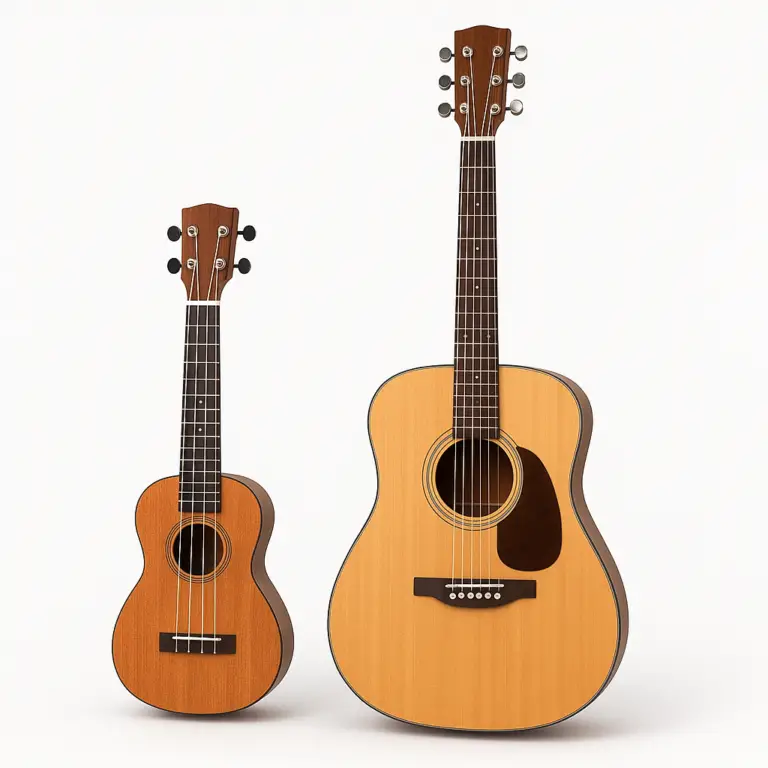
A ukulele is a small, fretted, plucked string instrument, but its sound depends on more than body size. Scale length, strings, construction, wood, tuning, and the player’s touch all matter. If you’re comparing it with other string instruments, our acoustic guitar guide covers related construction and tonewood basics.
Soprano, concert, tenor, and baritone sizes
These are the most familiar ukulele sizes. Measurements vary by maker, so treat the table as a guide rather than a hard rule.
| Size | Typical character | Common use | Potential drawback |
|---|---|---|---|
| Soprano | Bright, compact, classic ukulele sound | Travel, traditional strumming, smaller hands | Tight fret spacing may feel cramped |
| Concert | A little more body and finger room | General-purpose playing | Slightly less compact than soprano |
| Tenor | Fuller sound, longer scale, more room | Fingerstyle, lead playing, larger hands | May feel less like the traditional small soprano |
| Baritone | Deper, guitar-like sound | Players wanting lower register or familiar chord shapes | Usually uses different tuning from standard ukulele tuning |
A traditional soprano may look like the obvious choice for Hawaiian music, but there is no size requirement for playing Hawaiian repertoire. Choose the instrument that fits your hands, musical goals, and preferred sound.
Traditional Hawaiian koa and other tonewoods
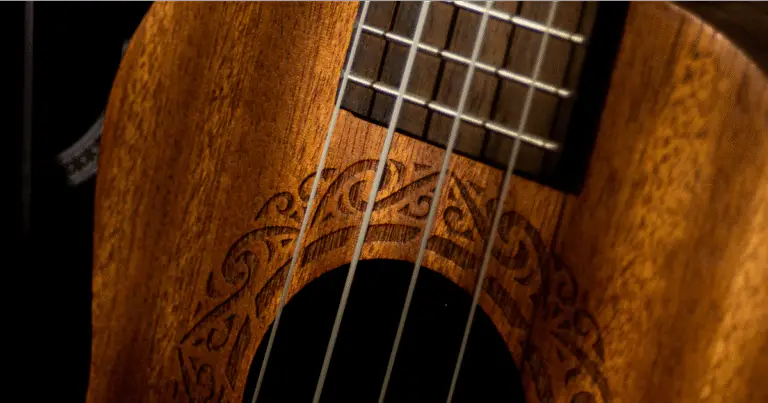
Koa is a native Hawaiian hardwood strongly associated with Hawaiian ukules. It can produce a clear, lively tone and often has distinctive grain. Koa’s history and local importance make it meaningful beyond its acoustic properties.
Other common materials include mahogany, spruce, cedar, laminate, and alternative hardwoods. Each can work well; a solid-koa instrument is not automatically better for every player. Construction quality, setup, and how the instrument feels in your hands matter more than a label alone.
| Material | Common appeal | Practical consideration |
|---|---|---|
| Koa | Strong Hawaiian association; distinctive appearance and bright, clear sound | Ask about sourcing and construction; solid koa requires responsible stewardship |
| Mahogany | Warm, balanced sound; widely used | Tone varies by build and model |
| Spruce or cedar tops | Can offer strong projection and detail | Less visually associated with traditional all-koa Hawaiian models |
| Laminate | Stable and often durable | Usually less responsive than a well-made solid-wood instrument, though quality varies |
For background on koa as a Hawaiian tree, consult the University of Hawaiʻi’s botany resources.
Standard ukulele tuning and how it differs from guitar
Most soprano, concert, and tenor ukules use G–C–E–A tuning, often with a high G string. This is called re-entrant tuning because the strings do not rise in pitch in a simple low-to-high sequence. Low-G setups are also common and give the instrument a wider lower register.
Baritone ukules are commonly tuned D–G–B–E, like the four highest-pitched strings of a guitar. That makes the chord shapes familiar to many guitar players, but the instrument sounds lower than a standard-tuned soprano or concert ukulele.
| Instrument/setup | Common tuning | What a guitarist should know |
|---|---|---|
| Soprano, concert, tenor | G–C–E–A | Chord shapes differ from guitar |
| Low-G ukulele | G–C–E–A, with a low G | Adds lower range without changing the other strings |
| Baritone ukulele | D–G–B–E | Shares the guitar’s top-four-string tuning |
🎶 Hawaiian Music and the Ukulele’s Cultural Significance
The ukulele is associated with Hawaiian music around the world, but Hawaian music is far broader than the ukulele. It includes vocal traditions, hula, slack-key guitar, steel guitar, and many other instruments and forms. The Smithsonian Center for Folklife and Cultural Heritage offers useful context for understanding music as a living cultural practice.
The ukulele in hula, mele, and local music
The ukulele became part of a broader musical world in Hawaiʻi, accompanying songs and performances and adapting to changing styles. It can support singing, rhythmic strumming, melody, and ensemble playing. In modern settings, Hawaiian musicians use it alongside guitars, bass, percussion, and other instruments.
The instrument’s cultural meaning is not frozen in the 19th century. Players continue to reinterpret it—sometimes in traditional repertoire, sometimes in contemporary arrangements, and sometimes far outside Hawaiian styles.
Cultural respect: avoiding the “just a novelty” stereotype
The ukulele’s cheerful popular image can be fun, but it can also flatten its history. A respectful approach means recognizing that:
- The instrument has Portuguese roots and a Hawaiian cultural home.
- Hawaiian makers and musicians shaped its identity.
- Hawaiian music includes serious, joyful, political, devotional, and everyday expression.
- Buying a koa ukulele or visiting Hawaiʻi does not make someone an expert on Hawaiian culture.
A small instrument can carry a large history. Treating it as more than a novelty is a good first chord.
✨ From Hawaiʻi to the World: The Ukulele’s Global Journey
The ukulele spread beyond Hawaiʻi as Hawaiian music reached wider audiences. It became particularly visible in mainland America in the early 20th century, then traveled through recordings, performance, popular culture, and later waves of beginner-friendly instruments.
Mainland U.S. popularity and the Panama-Pacific Exposition
Hawaian music and dance attracted mainland audiences during the early 190s. The Panama-Pacific International Exposition in San Francisco in 1915 helped bring Hawaiian performers and culture to an enormous public gathering. From there, the ukulele appeared in popular entertainment, recordings, and home music-making.
The instrument’s global rise did not erase its Hawaiian identity; it made the history more important to explain. A musician playing a ukulele in London, Tokyo, or New York is participating in a global instrument culture whose story passes through Hawaiʻi.
Modern ukulele artists and styles
Today, players use the ukulele in Hawaiian, folk, pop, jazz, rock, and fingerstyle music. Artists such as Israel Kamakawiwoʻole helped bring the instrument and Hawaiian repertoire to international listeners, while performers such as Jake Shimabukuro have shown how much technical range a ukulele can offer.
If you’re used to guitars, the ukulele’s small size can be misleading. It can play melody, harmony, rhythmic accompaniment, and technically demanding solo arrangements. Our guitar brand guides and guitar buying guide can help if you’re also comparing it with guitar-family instruments.
🧭 How to Choose a Ukulele with Hawaiian Roots in Mind
A Hawaiian-made instrument can be a meaningful purchase, but geography alone doesn’t guarantee the right fit. Play several instruments if possible. Compare comfort, setup, tone, craftsmanship, and the maker’s story.
What to look for in a Hawaiian-made ukulele
Hawaian brands often discussed by players include Kamaka, KoAloha, and Kanileʻa. Other makers and small workshops also contribute to Hawaiʻi’s instrument-making community. Visit each maker’s official site for current models and company information:
When comparing instruments, check:
- Comfort: Can you reach the chords without strain? Does the neck profile suit your hand?
- Setup: Are the strings comfortable to press? Do notes ring cleanly along the fretboard?
- Sound: Listen for even volume across strings and frets—not only an impressive open-chord strum.
- Build: Look for tidy fretwork, secure tuners, clean joints, and a stable bridge.
- Materials and provenance: Ask what woods were used and where they came from.
- Purpose: A travel ukulele, a fingerstyle instrument, and a collectible koa model may call for different priorities.
A discussion on Ukulele Underground about what to buy when visiting Hawaiʻi offers a helpful player perspective: try instruments instead of buying a brand name on reputation alone. Forum experiences are individual opinions, not lab tests, but that advice is sound.
Responsible koa sourcing and ethical buying
Koa is a native Hawaiian tree and a treasured material. Its significance makes responsible sourcing especially important. Ask the retailer or maker:
- Is the instrument made with solid koa, koa veneer, or another material?
- Can the maker explain where the wood came from?
- Is the instrument made in Hawaiʻi, or is it a Hawaiian brand made elsewhere?
- Does the maker provide information about sustainability and wood sourcing?
“Hawaian koa” describes a material, not necessarily the instrument’s place of manufacture. Likewise, a ukulele made in Hawaiʻi may use a variety of woods. Clear answers are better than a vague island-themed label.
A simple in-store comparison routine
- Tune each instrument before comparing; an out-of-tune ukulele can make a good one sound disappointing.
- Play the same chord progression on each instrument.
- Check every fret by playing notes up the neck and listening for buzzes or dead spots.
- Try both strumming and fingerpicking to hear how the instrument responds.
- Take a short break, then play again. Your first favorite may be loud; your lasting favorite is often the one that feels right.
The forum thread’s travel advice also has practical value: call shops ahead about hours, appointments, tours, and whether a particular instrument is actually at that location. A dream ukulele may be in the workshop, not the storefront.
💡 Common Myths About the Hawaiian Ukulele
| Myth | What’s more accurate |
|---|---|
| “The ukulele was invented in Hawaiʻi.” | Its closest known ancestors came from Madeira, while the recognizable instrument developed in Hawaiʻi. |
| “The ukulele is Portuguese, so it isn’t Hawaiian.” | Portuguese ancestry and Hawaiian cultural identity can both be true. |
| “Ukulele definitely means ‘jumping flea.’” | That is the best-known explanation, but the name’s origin is debated. |
| “Only koa ukules are genuinely Hawaiian.” | Koa is strongly associated with Hawaiian instruments, but wood alone does not determine cultural identity or quality. |
| “A Hawaiian ukulele must be a soprano.” | Players use soprano, concert, tenor, and baritone instruments in many musical settings. |
| “The ukulele is just a beginner instrument.” | It is accessible to beginners and capable of advanced solo and ensemble playing. |
The history is not a tug-of-war between Portugal and Hawaiʻi. It is a story of musical inheritance and local reinvention—and that’s exactly why the ukulele belongs in both conversations.