Support our educational content for free when you purchase through links on our site. Learn more
Can Beginners Learn Ukulele Before Guitar? 🎶

Yes, beginners can learn ukulele before guitar, and many find it an excellent first step. The smaller instrument, four strings, gentler fretting, and quick access to simple songs can make those first practice sessions feel surprisingly rewarding.
But here is the catch: ukulele is not a mandatory waiting room for guitar. If your musical dream is electric guitar, blues bends, acoustic fingerstyle, or thunderous low-end chords, starting directly with guitar may keep your motivation stronger.
We have seen players pick up a concert ukulele, learn three chords, and accompany a song within their first week. Later, when they moved to guitar, their rhythm and chord-transition skills transferred nicely, even though the wider neck, steel strings, bass strings, and different tuning demanded fresh practice.
The key question is not simply, “Which instrument is easier?” It is which instrument will you actually play tomorrow—and again next week?
Key Takeaways
- Yes, beginners can learn ukulele before guitar. It is often comfortable, portable, and encouraging for first-time players.
- Ukulele builds transferable skills, including rhythm, strumming, chord changes, ear training, and musical confidence.
- Ukulele does not teach every guitar skill. Guitar-specific techniques such as steel-string fretting, bass-note control, barre chords, picking, and bending still require dedicated practice.
- Start with guitar instead if guitar is your clear musical goal, especially for rock, blues, classical, country, jazz, or electric guitar.
- Concert and tenor ukules often provide more comfortable fretboard space than very small soprano models.
- Keep tunings and chord charts separate: standard ukulele is commonly tuned G-C-E-A, while guitar is commonly tuned E-A-D-G-B-E.
- The best first instrument is the one you will practice consistently. A played ukulele beats an abandoned guitar every time.
Table of Contents
- ⚡️ Quick Tips and Facts: Can Beginners Learn Ukulele Before Guitar?
- 🎯 The Short Answer: Is Ukulele a Good First Instrument?
- 📚 Ukulele and Guitar Origins: How These Instruments Developed
- 🎸 Ukulele vs. Guitar: Key Differences for New Players
- Size, Weight, and Fretboard Comfort
- Tuning, Strings, and Chord Shapes
- Sound, Volume, and Musical Range
- Learning Curve and Playing Technique
- ✅ 11 Reasons Beginners May Prefer Learning Ukulele First
- 1. Ukulele Chords Are Easier to Form
- 2. Nylon Strings Are Gentler on Fingertips
- 3. Smaller Frets Can Build Early Confidence
- 4. Simple Songs Become Playable Quickly
- 5. Ukulele Encourages Consistent Practice
- 6. It Is Portable for Home, Travel, and School
- 7. Basic Strumming Patterns Feel More Manageable
- 8. Ukulele Supports Singing and Group Playing
- 9. It Teaches Rhythm, Chords, and Musical Timing
- 10. Affordable Beginner Ukules Are Widely Available
- 11. Early Success Makes Guitar Practice Less Intimidating
- ⚠️ 7 Reasons Ukulele May Not Be the Best First Instrument
- 1. Guitar Chord Shapes Do Not Transfer Directly
- 2. Rentrant Tuning Can Take Adjustment
- 3. Guitar Requires Different Finger Strength
- 4. Some Players May Outgrow the Smaller Range
- 5. Guitar May Better Match Your Musical Goals
- 6. Transitioning Instruments Still Requires Practice
- 7. Ukulele Technique Can Create a Few Habits to Unlearn
- 🧠 What Ukulele Skills Transfer to Guitar?
- Rhythm, Strumming, and Picking Accuracy
- Chord Changes and Fretting-Hand Coordination
- Reading Chord Charts and Tablature
- Ear Training, Singing, and Musical Confidence
- 🔄 What Does Not Transfer Directly From Ukulele to Guitar?
- 🎼 How Ukulele Tuning Relates to Guitar Tuning
- Standard G-C-E-A Ukulele Tuning Explained
- Rentrant and Low-G Ukulele Tuning
- Why Guitarists Recognize Some Ukulele Chords
- 🪕 Choosing the Right Beginner Ukulele
- Soprano, Concert, Tenor, or Baritone Ukulele?
- Wood, Laminate, and Plastic Ukulele Bodies
- Essential Features: Tuning Stability, Action, and Intonation
- Should You Buy a Ukulele Starter Bundle?
- Recommended Beginner Ukulele Brands
- 🎸 When Should You Start Learning Guitar After Ukulele?
- Signs You Are Ready for the Guitar
- How Long Should You Learn Ukulele First?
- Moving From Ukulele Chords to Guitar Chords
- Preparing Your Fingers for Steel Strings
- 🗓️ A Beginner Practice Plan for Ukulele Before Guitar
- Week 1: Holding, Tuning, and Basic Chords
- Week 2: Chord Changes and Steady Strumming
- Week 3: Songs, Rhythm Variations, and Singing
- Week 4: Fingerpicking and Guitar Preparation
- 🎵 Best Beginner Ukulele Songs That Build Guitar Skills
- Easy Two-Chord Ukulele Songs
- Easy Three- and Four-Chord Ukulele Songs
- Songs for Strumming, Fingerpicking, and Singing
- 🚫 Common Beginner Mistakes on Ukulele
- Ignoring Tuning and Setup
- Squezing the Neck Too Hard
- Practicing Too Fast
- Using Only Downstrokes
- Avoiding Music Theory Completely
- 💡 How to Practice Ukulele Effectively
- How Much Should a Beginner Practice Each Day?
- A Balanced Practice Routine
- Using a Metronome, Tuner, and Recording App
- Online Lessons, Apps, Books, and In-Person Teachers
- 👨 👩 👧 Is Ukulele Better for Children Than Guitar?
- Age, Hand Size, and Attention Span
- Ukulele Safety, Comfort, and Motivation
- When a Child Should Begin Guitar Instead
- 🎶 Is Ukulele Easier for Adults and Older Beginners?
- 🎤 Ukulele for Singing, Songwriting, and Performing
- 🌴 Join the Ukulele Learning Community
- Ukulele Clubs, Workshops, and Group Lessons
- Online Communities and Beginner-Friendly Resources
- How Playing With Others Accelerates Progress
- 🔍 Ukulele Before Guitar: Which Learner Benefits Most?
- Choose Ukulele First If You Want Fast, Casual Progress
- Choose Guitar First If You Have Specific Guitar Goals
- Learn Both Instruments Together
- 💰 Ukulele and Guitar Learning Costs to Consider
- Instrument, Accessories, and Maintenance
- Lessons, Courses, and Practice Materials
- Avoiding False Economies When Buying Your First Instrument
- 🩹 Hand Comfort, Finger Pain, and Injury Prevention
- ❓ Can Learning Ukulele Make You a Better Guitarist?
- 🏆 Final Verdict: Should Beginners Learn Ukulele Before Guitar?
- Conclusion
- Recommended Links
- FAQ
- Is ukulele easier to learn than guitar?
- Can I switch from ukulele to guitar easily?
- How long should I play ukulele before learning guitar?
- Will ukulele teach me guitar chords?
- Is ukulele good for children and older adults?
- Should I buy a ukulele or guitar as my first instrument?
- Reference Links
Quick Tips and Facts: Can Beginners Learn Ukulele Before Guitar? 🎶
Yes, beginners can absolutely learn ukulele before guitar. It is not a required “training level,” though. The better question is: which instrument will make you practice consistently?
Our musicians at Guitar Brands™ have watched players make excellent progress on a ukulele, then move to guitar with stronger rhythm, better chord coordination, and less fear of the fretboard. We have also seen the opposite: someone buys a ukulele as a supposed shortcut, but their heart is set on guitar, so the little instrument gathers dust beside the coffee machine.
If you are comparing instruments in detail, our ukulele guide is a useful companion to this article.
Quick decision table
| Your main goal | Best starting point | Why |
|---|---|---|
| Play songs quickly and sing along | Ukulele | Fewer strings, softer strings, compact chord shapes |
| Eventually play guitar-specific music | Guitar | Direct practice on the instrument you want |
| Manage small hands or fingertip sensitivity | Ukulele or nylon-string guitar | Lower physical barrier |
| Learn fingerstyle, bass lines, rock, blues, or jazz guitar | Guitar | Wider range and guitar-specific technique |
| Practice while traveling | Ukulele | Lightweight and portable |
| Join casual group jams | Ukulele | Easy to carry and socially approachable |
| Learn both instruments | Start with one, then add the other | Prevents tuning and chord-name confusion |
Fast facts
- A standard ukulele has four strings and is commonly tuned G-C-E-A.
- A standard guitar has six strings and is commonly tuned E-A-D-G-B-E.
- Ukules typically use nylon or fluorocarbon strings; steel-string guitars use steel strings.
- Ukulele chord shapes may resemble guitar shapes, but the chord names can differ because the instruments are tuned differently.
- Ukulele can develop rhythm, strumming, chord transitions, musical timing, and confidence.
- It does not automatically teach guitar-specific skills, such as managing two bass strings, using a pick, bending steel strings, or forming guitar barre chords.
- A playable instrument matters more than the number of strings. A badly set-up ukulele is not “easy”; it is a tiny wooden interrogation device.
- Short, regular practice usually beats occasional marathon sessions. The National Association for Music Education discusses the broader cognitive and social benefits associated with music learning.
Our practical recommendation
Choose ukulele first if:
- You want a gentle, portable first instrument.
- You mainly want to strum and sing.
- You have smaller hands or fingertip sensitivity.
- You need a low-friction way to build a daily practice habit.
- You are genuinely excited by ukulele music.
Choose guitar first if:
- Guitar is the instrument you actually dream about playing.
- You want electric guitar, blues, rock, country, jazz, or guitar-specific fingerstyle.
- You want to learn guitar techniques without translating from another tuning.
- You already have access to a comfortable, well-set-up guitar.
The winner is the instrument you will pick up tomorrow. But there is a tuning wrinkle lurking ahead, and it explains why ukulele skills transfer well without transferring perfectly.
The Short Answer: Is Ukulele a Good First Instrument? 🎯
For many beginners, yes. Ukulele offers a compact fretboard, four strings, relatively gentle fretting, and a cheerful sound that makes early songs feel attainable. Those advantages can help you establish the most valuable beginner skill of all: showing up repeatedly.
However, “easier” needs a little unpacking. The Ukulele Tricks comparison guide correctly emphasizes that four strings do not magically remove the need for coordination. You still need to:
- Hold the instrument securely.
- Press notes cleanly.
- Change chords smoothly.
- Strum in time.
- Listen critically.
- Practice when nobody is applauding.
A ukulele may reduce the physical and psychological barrier, but it does not eliminate musicianship.
Where ukulele helps most
Early chord playing
Common beginner chords such as C, Am, F, and G can be physically approachable on ukulele. Many songs use only two, three, or four chords, allowing a new player to focus on rhythm rather than wrestling with a crowded fretboard.
Finger comfort
Nylon or fluorocarbon strings generally feel gentler than steel guitar strings. You may still develop tender fingertips, but the first week is often less dramatic. If discomfort persists, stop and inspect your technique rather than treating pain like a musical badge of honor.
Portability
A ukulele can sit beside your desk, sofa, or travel bag. That convenience matters because instruments that are visible and accessible tend to receive more playing time.
Social motivation
Ukulele groups are common in community centers, schools, libraries, and music clubs. Playing with others can make timing, chord changes, and song structure feel more meaningful than isolated drills.
Where ukulele does not replace guitar
Ukulele is not a miniature six-string guitar. It does not directly train:
- Guitar’s two lowest strings.
- Guitar scale length and fret spacing.
- Steel-string pressure and bending.
- Guitar pick technique.
- Guitar-specific bass-note control.
- Full guitar chord voicings.
- Electric-guitar muting, amplification, and effects.
That distinction matters. The forum contributors at Ukulele Underground broadly agree that dexterity, rhythm, chord formation, and general coordination transfer, while tuning and instrument-specific technique require deliberate study.
The most honest answer
Ukulele is a good first instrument when it matches your goals. It is a less ideal first instrument when you secretly want to play guitar and are using ukulele only because somebody told you that you must “graduate” to guitar later.
You do not graduate from ukulele. You either continue with it, add guitar, or move on because your musical interests changed. All three are valid.
Ukulele and Guitar Origins: How These Instruments Developed 📚
Understanding the instruments’ backgrounds helps explain their modern differences.
Guitar’s broader stringed-instrument family
The modern guitar developed through a long history of plucked string instruments in Europe and the Mediterranean. The Metropolitan Museum of Art describes the guitar’s development from earlier instruments, including the vihuela and related lute-family designs.
Modern guitars commonly have:
- Six strings.
- A larger body.
- A longer scale length.
- Wider harmonic and melodic range.
- Steel or nylon strings, depending on the design.
The guitar became central to classical, folk, blues, country, rock, pop, jazz, flamenco, and countless regional styles.
Ukulele’s Portuguese roots and Hawaiian identity
The ukulele emerged in Hawaii in the late nineteenth century, influenced by Portuguese instruments brought by immigrants. The Smithsonian’s National Museum of American History documents the ukulele’s place in American cultural history, while the Hawaii State Archives provides historical resources on Hawaii’s musical heritage.
The ukulele’s identity is not simply “small guitar.” Its tuning, construction, repertoire, rhythmic role, and cultural history are distinct.
Why the history matters for learners
The instruments developed for different musical roles:
| Characteristic | Ukulele | Guitar |
|---|---|---|
| Cultural association | Strong Hawaiian and Pacific identity | Broad global traditions |
| Typical role | Rhythm, accompaniment, melody, ensemble playing | Rhythm, bass accompaniment, melody, solo, harmony |
| Common beginner expectation | Quick chord-based songs | Broad stylistic versatility |
| Physical design | Compact body and shorter scale | Larger body and longer scale |
| Musical personality | Bright, buoyant, percussive | Broad, deep, powerful, or highly adaptable |
The history also helps answer a common misconception: ukulele is not merely a simplified guitar. It is its own instrument, with its own techniques and artistic possibilities.
Ukulele vs. Guitar: Key Differences for New Players 🎸
The following comparison combines practical playing experience with the specifications commonly used by manufacturers and educators. For guitar-related buying advice, see our Guitar Buying Guide.
| Feature | Ukulele | Guitar |
|---|---|---|
| Standard string count | 4 | 6 |
| Common tuning | G-C-E-A | E-A-D-G-B-E |
| Typical string material | Nylon or fluorocarbon | Steel or nylon |
| Typical scale length | Roughly 13–17 inches, depending on size | Roughly 24–26.5 inches for many full-size models |
| Common body lengths | Soprano, concert, tenor, baritone formats | Classical, dreadnought, concert, parlor, jumbo, electric formats |
| Typical range | Smaller | Larger |
| Bass response | Limited on standard ukulele | Stronger and deeper |
| Portability | Excellent | Moderate |
| Beginner chord barrier | Often lower | Often higher |
| Guitar-specific technique | Limited | Full access |
Specifications vary by model, so always check the manufacturer’s information. For example, Kala, Fender, Taylor, and Yamaha publish model-specific measurements.
Size, Weight, and Fretboard Comfort
Ukulele scale and hand reach
Ukules come in several common sizes:
| Ukulele size | Approximate scale | Typical feel |
|---|---|---|
| Soprano | 13–14 inches | Compact, traditional, close fret spacing |
| Concert | 14–15 inches | Slightly more room and body volume |
| Tenor | 16–17 inches | More fretboard space and fuller tone |
| Baritone | About 19 inches | Larger, guitar-like feel and D-G-B-E tuning |
A concert or tenor ukulele often provides a useful compromise: still portable, but less cramped than a soprano.
Guitar scale and reach
A full-size acoustic guitar may feel physically demanding because:
- The neck is longer.
- Frets are more widely spaced.
- The body can be bulky.
- Steel strings require more pressure.
- Chords may involve six-string control.
A short-scale guitar can reduce reach. The Taylor GS Mini and Baby Taylor are examples of compact acoustic designs, while Yamaha offers several beginner-friendly body sizes.
Our fit test
Sit with the instrument for five minutes. Ask:
- Can your fretting wrist remain fairly relaxed?
- Can your thumb sit behind the neck without squeezing?
- Can your strumming arm move freely?
- Can you see your fretting hand without hunching?
- Does the instrument remain stable without constant wrestling?
If the answer is no, change the instrument size or setup before blaming your hands.
Tuning, Strings, and Chord Shapes
Standard ukulele tuning: G-C-E-A
Most standard ukules use G-C-E-A tuning, often with a high-G fourth string. This is called rentrant tuning because the G string may be higher in pitch than the neighboring C string.
A low-G setup replaces the high G with a lower G, creating a more linear pitch arrangement. Low G can be useful for:
- Fingerstyle.
- Melodic playing.
- Fuller descending bass movement.
- Players transitioning toward guitar-like note organization.
Standard guitar tuning: E-A-D-G-B-E
Guitar tuning runs from low to high:
E-A-D-G-B-E
The interval between most adjacent strings is a perfect fourth, except between G and B, which is a major third. That exception influences chord shapes, scales, and movable patterns.
Why the same shape can have different names
Suppose you place a familiar three-finger shape on a ukulele and guitar. The fingers may look similar, but the strings are tuned differently. The resulting pitches change, so the chord name changes too.
This is the tuning trap:
✅ Transferable: finger independence, rhythm, visual pattern awareness
❌ Not automatically transferable: chord names and exact pitch content
Use separate chord charts. Label them clearly:
- “Standard ukulele: G-C-E-A”
- “Guitar: E-A-D-G-B-E”
- “Baritone ukulele: D-G-B-E”
Do not rely on memory when switching instruments. Memory is wonderfully confident and frequently wrong.
Sound, Volume, and Musical Range
Ukulele sound
Ukulele tone is commonly:
- Bright.
- Shorter in sustain.
- Percussive.
- Midrange-focused.
- Easy to blend in a group.
A tenor ukulele may offer more warmth and projection than a soprano. A low-G ukulele can sound less “sparkly” and more linear.
Guitar sound
Guitar offers:
- Greater bass extension.
- More harmonic complexity.
- Longer sustain.
- Wider dynamic range.
- More options for alternating bass, melodies, and chord voicings.
Steel-string guitars can be loud acoustically, while nylon-string guitars provide a softer, rounded attack. Electric guitars add amplification, effects, sustain, and techniques that have no direct ukulele equivalent.
Learning Curve and Playing Technique
Ukulele often feels easier during the first few sessions because the beginner can play recognizable chord progressions with less physical strain. Guitar may feel harder initially, but guitar practice is more direct if guitar is your destination.
| Learning task | Ukulele | Guitar |
|---|---|---|
| Basic open chords | Often approachable | More physically demanding |
| Chord changes | Requires coordination | Requires coordination plus wider reach |
| Barre chords | Possible, but smaller shapes | Significant strength and accuracy challenge |
| Strumming | Simple to begin | Simple to begin, broader string control |
| Fingerpicking | Accessible | More notes and bass independence |
| Pick technique | Optional in many styles | Common in many styles |
| Bass-note control | Limited | Central to many styles |
| Full-range solo playing | More limited | Extensive possibilities |
The Berklee College of Music has published educational material emphasizing the relationship between practice, musical expression, and skill development. The instrument changes the details, but consistent musical practice remains the engine.
11 Reasons Beginners May Prefer Learning Ukulele First ✅
1. Ukulele Chords Are Easier to Form
Many common ukulele chord shapes require fewer fingers and less reach. That can let you experience a complete musical loop quickly:
- Tune the instrument.
- Learn two chords.
- Practice a steady downstroke.
- Change chords every four beats.
- Play along with a song.
That first loop is disproportionately valuable. It turns “I am learning an instrument” into “I can accompany a song.”
Do not confuse easier chord formation with effortless playing. Your chord still needs clean notes and accurate timing.
2. Nylon Strings Are Gentler on Fingertips
Steel strings can make the first days of guitar uncomfortable, especially if you press too hard. Ukulele strings are usually friendlier, although fingertip tenderness remains normal.
✅ Mild tenderness after practice can be normal.
❌ Sharp pain, numbness, tingling, or wrist pain is a reason to stop and reassess.
A lighter touch also teaches a useful habit for guitar: press only as hard as necessary.
3. Smaller Frets Can Build Early Confidence
Shorter scale length means less left-hand travel. This can help:
- Children.
- Adults with smaller hands.
- Players with limited mobility.
- Anyone intimidated by a large guitar neck.
However, very close fret spacing may bother players with larger fingers. In that case, try a tenor ukulele rather than deciding the entire instrument family is cramped.
4. Simple Songs Become Playable Quickly
A beginner can often build a useful song repertoire around chord families such as:
- C-F-G.
- G-C-D.
- Am-F-C-G.
- C-Am-F-G.
The precise shapes and names depend on the instrument. The musical concept remains: learn chord relationships, not isolated finger gymnastics.
Try this sequence:
- Two minutes: change between C and F.
- Two minutes: add G.
- Two minutes: strum four steady beats per chord.
- Two minutes: play with a metronome.
- Two minutes: play without stopping, even after mistakes.
This is the sort of practice that produces a playable musician rather than a collector of chord diagrams.
5. Ukulele Encourages Consistent Practice
A small instrument is easier to keep nearby. That sounds trivial until you compare:
- Ukulele within arm’s reach.
- Guitar in a case behind a chair.
- Guitar pulled out only after a twelve-step furniture rearrangement.
Convenience lowers the activation energy of practice. The National Endowment for the Arts provides research resources on arts participation and engagement; the practical lesson is simple: access and enjoyment help sustain participation.
6. It Is Portable for Home, Travel, and School
A ukulele can travel to:
- Campfires.
- Classrooms.
- Family gatherings.
- Rehearsals.
- Vacations.
- Office breaks.
Choose a protective case and keep the instrument away from extreme heat and humidity. A tiny instrument can still suffer very real structural damage.
7. Basic Strumming Patterns Feel More Manageable
With four strings, beginners can focus on:
- Downstrokes.
- Upstrokes.
- Muted strums.
- Accents.
- Syncopation.
- Dynamics.
On guitar, beginners must often think about whether a strum should include all six strings, avoid the low E, or target a bass note. Ukulele reduces that initial string-selection workload.
8. Ukulele Supports Singing and Group Playing
Ukulele is particularly effective for accompaniment. Once you can maintain a steady pulse, singing becomes a musical exercise rather than a separate activity.
Start with:
- One downstroke per beat.
- Four beats per chord.
- A clear vocal melody.
- Slow tempo.
- No stopping when a chord change goes wrong.
Singers often find ukulele approachable because it provides harmonic support without overwhelming the voice.
9. It Teaches Rhythm, Chords, and Musical Timing
These skills transfer strongly to guitar:
- Keeping a steady tempo.
- Counting measures.
- Hearing chord changes.
- Anticipating transitions.
- Coordinating both hands.
- Recovering after a mistake.
A guitarist with weak rhythm is still a beginner, regardless of how many chords they know. Ukulele can expose and improve timing in a friendly way.
10. Affordable Beginner Ukules Are Widely Available
Ukulele offers a broad range of beginner instruments from brands such as:
Avoid choosing solely by appearance. A beautiful instrument with poor tuning stability will sabotage motivation faster than an ugly one with reliable intonation.
11. Early Success Makes Guitar Practice Less Intimidating
Once you have learned to:
- Tune.
- Read a chord chart.
- Change chords.
- Count rhythm.
- Play through mistakes.
…the guitar feels less mysterious. You still need to develop guitar-specific strength and technique, but the entire concept of accompanying music is no longer new.
This is why several contributors in the Ukulele Underground discussion described prior ukulele experience as solving part of the hardest early learning work.
7 Reasons Ukulele May Not Be the Best First Instrument ⚠️
1. Guitar Chord Shapes Do Not Transfer Directly
The biggest source of confusion is assuming:
“This shape is called C on ukulele, so it must be C on guitar.”
No. The tuning determines the pitches.
Keep separate notebooks or digital folders for each instrument. Write the tuning at the top of every chord page.
2. Rentrant Tuning Can Take Adjustment
High-G ukulele tuning gives the instrument its familiar bounce, but it can challenge players who expect strings to rise steadily in pitch.
Low-G tuning may help with:
- Scales.
- Melodies.
- Fingerstyle.
- Guitar-oriented note mapping.
It can also change the instrument’s sound and require a suitable string setup. Follow the manufacturer’s recommendations or ask a qualified technician.
3. Guitar Requires Different Finger Strength
Ukulele builds some fretting coordination, but guitar adds:
- Wider stretches.
- Higher string tension.
- More demanding barre chords.
- Bass-string control.
- Pick resistance.
- String bending.
Treat guitar as a new physical discipline, not simply a larger ukulele.
4. Some Players May Outgrow the Smaller Range
If you want:
- Walking bass lines.
- Low alternate tunings.
- Full fingerstyle arrangements.
- Extended chord voicings.
- Guitar solos.
- Heavy rock rhythm.
…the guitar provides a more suitable platform.
That does not make ukulele inferior. It makes the instruments different tools.
5. Guitar May Better Match Your Musical Goals
If you constantly imagine yourself playing a steel-string acoustic, electric guitar, or classical guitar, begin there if you can access a comfortable model.
Motivation is not a soft factor. It directly influences practice frequency, persistence, and willingness to troubleshoot.
6. Transitioning Instruments Still Requires Practice
Ukulele experience can accelerate your first guitar lessons, but it will not eliminate:
- Finger soreness.
- Tuning practice.
- Guitar chord changes.
- Bass-string muting.
- Guitar setup issues.
- Pick coordination.
Expect a temporary reset. You are not failing; you are adding a new instrument.
7. Ukulele Technique Can Create a Few Habits to Unlearn
Potential habits include:
- Strumming every string without considering bass notes.
- Using ukulele chord names on guitar.
- Ignoring pick technique.
- Squezing a guitar neck too tightly.
- Expecting ukulele-sized fret spacing.
- Relying on rentrant tuning patterns.
The solution is not avoiding ukulele. The solution is labeling your technique clearly and practicing each instrument on its own terms.
What Ukulele Skills Transfer to Guitar? 🧠
The transfer is strongest in musicianship, not in exact finger placement.
Rhythm, Strumming, and Picking Accuracy
Ukulele can build rhythmic control through:
- Continuous down-up motion.
- Accent placement.
- Syncopated patterns.
- Muted percussive strokes.
- Metronome practice.
- Dynamic contrast.
When you move to guitar, the arm motion remains useful. The target strings and amount of force change.
Chord Changes and Fretting-Hand Coordination
Ukulele helps develop:
- Finger independence.
- Anticipating the next chord.
- Moving multiple fingers together.
- Minimizing unnecessary motion.
- Releasing pressure during transitions.
Try a “one-minute change” drill:
- Choose two chords.
- Set a timer for 60 seconds.
- Change back and forth slowly.
- Count only clean changes.
- Repeat without squeezing harder.
The goal is not frantic speed. It is economical movement.
Reading Chord Charts and Tablature
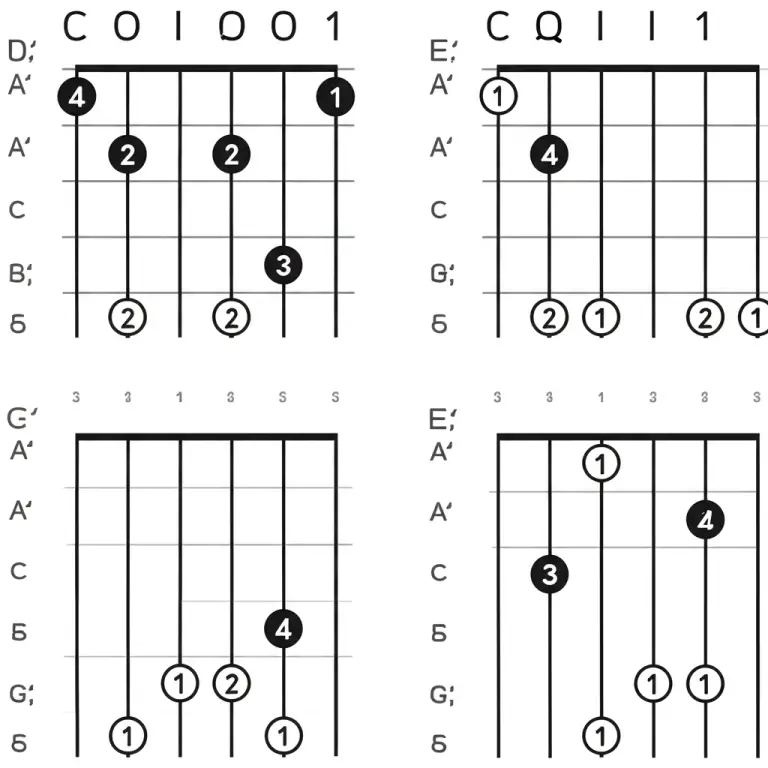
Chord diagrams teach a transferable visual language:
- Vertical lines represent strings.
- Horizontal lines represent frets.
- Dots show finger positions.
- “O” usually indicates an open string.
- “X” usually indicates a muted or unused string.
The diagram orientation and tuning still matter. Confirm the instrument before playing.
Ear Training, Singing, and Musical Confidence
Ukulele can help you hear:
- Major versus minor mood.
- Chord changes.
- Melodic direction.
- Repeated song structures.
- Timing against a beat.
These are fundamental musical skills. A guitarist who listens well progresses faster than one who merely memorizes shapes.
What Does Not Transfer Directly From Ukulele to Guitar? 🔄
| Skill or feature | Transfers directly? | Explanation |
|---|---|---|
| Keeping time | ✅ Strongly | Pulse and counting are instrument-independent |
| Basic strumming motion | ✅ Partly | The motion transfers; string targeting changes |
| Chord-chart reading | ✅ Yes | Shapes and tunings must be labeled correctly |
| Exact chord names | ❌ No | Different tunings create different pitches |
| Finger independence | ✅ Strongly | Coordination carries over |
| Guitar barre chords | ❌ Not fully | Guitar needs greater reach and pressure |
| Guitar bass strings | ❌ No | Ukulele has no equivalent low E and A |
| Pick technique | ⚠️ Partly | Basic control transfers, but guitar demands differ |
| Guitar bending | ❌ No | Steel strings and longer scale require new technique |
| Fretboard note mapping | ⚠️ Partly | Concepts transfer, locations do not match exactly |
| Singing while accompanying | ✅ Strongly | Coordination and song form carry over |
The tuning rule that prevents confusion
Before practicing, say aloud:
- “This is standard ukulele, G-C-E-A.”
- “This is guitar, E-A-D-G-B-E.”
- “This is baritone ukulele, D-G-B-E.”
It feels silly for approximately ten seconds. It saves you from ten weeks of chord-name confusion.
How Ukulele Tuning Relates to Guitar Tuning 🎼
Standard G-C-E-A Ukulele Tuning Explained
Standard ukulele tuning is commonly written:
g-C-E-A
The lowercase “g” often signals a high-G rentrant string. That high fourth string contributes to the instrument’s distinctive sound.
Chord shapes are compact because:
- The strings are tuned within a relatively narrow register.
- The instrument has only four strings.
- Many common chord voicings omit bass notes found on guitar.
Rentrant and Low-G Ukulele Tuning
| Setup | Fourth string | Advantages | Considerations |
|---|---|---|---|
| High G | Higher G | Classic ukulele bounce and compact sound | Less linear for scales |
| Low G | Lower G | Fuller range and melodic flexibility | Different feel and string setup |
If your long-term goal is guitar fingerstyle, low G may make melodic work feel more intuitive. If your goal is traditional strumming, high G remains a natural choice.
Why Guitarists Recognize Some Ukulele Chords
Baritone ukulele tuning is D-G-B-E, matching the highest four strings of guitar. This makes some chord relationships more familiar to guitarists.
The Ukulele Underground discussion includes players who found baritone ukulele especially guitar-adjacent, while also warning that switching between baritone and standard tuning can create confusion.
Do not map tunings mentally in real time while trying to perform. Learn the instrument you are holding, then switch deliberately.
Choosing the Right Beginner Ukulele 🪕 ⭐
Soprano, Concert, Tenor, or Baritone Ukulele?
| Size | Best for | Strengths | Drawbacks |
|---|---|---|---|
| Soprano | Traditional sound, children, portability | Compact and lively | Tight fret spacing, smaller body |
| Concert | General beginners | More room than soprano, still portable | Slightly less compact |
| Tenor | Adults, larger hands, fingerstyle | Wider feel and fuller tone | Larger and often less “toy-like” |
| Baritone | Guitarists and guitar-bound learners | D-G-B-E tuning, guitar-like layout | Chord charts and repertoire differ |
Our default recommendation for many adults is a concert or tenor ukulele, not because soprano is poor, but because a little extra room can improve comfort.
Wood, Laminate, and Plastic Ukulele Bodies
Solid wood
✅ Potentialy richer acoustic resonance.
❌ More sensitive to humidity and temperature.
Laminate wood
✅ Durable, stable, and often practical for beginners.
❌ May offer less complex resonance than a strong solid-wood design.
Composite or plastic
✅ Resistant to climate changes and travel abuse.
✅ Easy to maintain.
❌ Tone varies widely by model and may not satisfy players seeking traditional warmth.
Brands such as Kala, Flight, and Enya offer different construction approaches. Listen before buying if possible.
Essential Features: Tuning Stability, Action, and Intonation
Tuning stability
The instrument should remain reasonably close to pitch after normal playing. Constant retuning can result from:
- New strings stretching.
- Weak tuners.
- Poor string installation.
- Temperature changes.
- Neck or bridge problems.
Action
Action is the distance between the strings and fretboard. Too high, and fretting becomes difficult. Too low, and buzzing may occur.
Intonation
A simple check:
- Tune the open string.
- Play the note at the twelfth fret.
- Compare the octave.
- If it is noticeably sharp or flat, the instrument may have intonation issues.
No beginner should have to fight the instrument to produce an in-tune chord.
Should You Buy a Ukulele Starter Bundle?
A bundle can be convenient if it includes:
- A reliable tuner.
- A padded case.
- Spare strings.
- A strap or strap button solution.
- Basic learning material.
Be cautious about bundles built around accessories rather than the instrument itself. A pile of mediocre extras does not compensate for poor fretwork.
Recommended Beginner Ukulele Brands
- Kala: broad beginner-to-professional range.
- Lanikai: many accessible acoustic models.
- Flight: travel-friendly and visually distinctive designs.
- Fender: familiar guitar-brand styling and accessible ukulele options.
- Cordoba: strong reputation across nylon-string instruments.
- Enya: composite and modern beginner-focused designs.
- Kamor: often offers beginner packages, but inspect model-specific reviews carefully.
- Doner: budget-oriented options; quality can vary by model.
Read reviews for recurring comments about:
- Tuning stability.
- Fret sharpness.
- String height.
- Intonation.
- Packaging damage.
- Customer support.
Product snapshot ratings
These are category-level ratings for beginner suitability, not laboratory scores.
| Product family | Design | Comfort | Tuning stability | Guitar transfer | Beginner value |
|---|---|---|---|---|---|
| Kala concert ukulele | 9/10 | 9/10 | 8/10 | 7/10 | 9/10 |
| Lanikai concert ukulele | 8/10 | 8/10 | 8/10 | 7/10 | 8/10 |
| Flight travel ukulele | 8/10 | 8/10 | 8/10 | 7/10 | 8/10 |
| Cordoba tenor ukulele | 9/10 | 9/10 | 8/10 | 8/10 | 8/10 |
| Enya Nova U | 8/10 | 8/10 | 8/10 | 7/10 | 8/10 |
| Donner beginner ukulele | 7/10 | 7/10 | 6/10 | 7/10 | 7/10 |
| Yamaha nylon-string guitar | 8/10 | 8/10 | 8/10 | 9/10 | 9/10 |
| Taylor Baby Taylor | 9/10 | 9/10 | 9/10 | 9/10 | 8/10 |
| Yamaha FS-series acoustic guitar | 8/10 | 8/10 | 8/10 | 9/10 | 9/10 |
👉 CHECK PRICE on:
- Kala Concert Ukulele: Amazon | [Guitar Center](https://www.guitarcenter.com/ search?Ntt=Kala+concert+ukulele) | Kala Official
- Lanikai Ukulele: Amazon | Lanikai Official
- Flight Ukulele: Amazon | Flight Official
- Cordoba Ukulele: Amazon | Sweetwater | Cordoba Official
- Enya Ukulele: Amazon | Enya Official
When Should You Start Learning Guitar After Ukulele? 🎸
You do not need to reach an advanced ukulele level first. A beginner can add guitar after learning the basic mechanics of musical accompaniment.
Signs You Are Ready for the Guitar
You are probably ready when you can:
- Tune the ukulele independently.
- Hold a steady strumming pulse.
- Change between three or four chords.
- Play through a simple song without stopping.
- Read basic chord diagrams.
- Identify when you are out of time.
- Practice without needing constant novelty.
You are also ready if you simply want guitar badly enough. Motivation can arrive before technical readiness; that is perfectly normal.
How Long Should You Learn Ukulele First?
There is no mandatory timeline. Reasonable options include:
| Practice situation | Sensible approach |
|---|---|
| You have 10 minutes daily | Focus one instrument for several weeks |
| You have 30 minutes daily | Add guitar after basic ukulele coordination develops |
| You have lessons weekly | Tell the teacher you want a two-instrument plan |
| Guitar is your clear goal | Start guitar immediately or within a short trial |
| You are uncertain | Try both for one or two lessons |
The contributors quoted in Ukulele Underground repeatedly returned to the same practical idea: it is not a race. The best sequence is the one that preserves motivation and fits available practice time.
Moving From Ukulele Chords to Guitar Chords
Use a three-stage transition:
Stage 1: Separate the vocabulary
Write down:
- Ukulele tuning.
- Guitar tuning.
- Ukulele chord names.
- Guitar chord names.
- Any shared shapes that produce different chords.
Stage 2: Transfer the musical function
If you know a I-IV-V progression in one key on ukulele, learn the same musical function on guitar rather than trying to copy every finger position.
Stage 3: Add guitar-specific mechanics
Practice:
- Bass-string awareness.
- Pick control.
- Guitar open chords.
- Muting.
- Barre-chord preparation.
- Alternating bass patterns.
Preparing Your Fingers for Steel Strings
When starting guitar:
- Use a well-set-up instrument.
- Begin with short sessions.
- Press just behind each fret.
- Avoid squeezing the neck.
- Stop before pain becomes significant.
- Rest between sessions.
- Consider lighter strings after consulting a technician.
A nylon-string guitar can provide a gentler transition. Yamaha’s classical guitar range offers examples, while a compact steel-string such as the Taylor Baby Taylor provides a smaller acoustic platform.
A Beginner Practice Plan for Ukulele Before Guitar 🗓️
Week 1: Holding, Tuning, and Basic Chords
Goal: Build comfort and produce clean individual notes.
Daily 10–15-minute routine:
- Tune each string.
- Practice holding the instrument without squeezing.
- Play each open string.
- Learn C, Am, F, and G.
- Check every note in each chord.
- Strum four slow downstrokes per chord.
- End with one minute of relaxed playing.
Do not chase speed. A clean slow chord is more useful than a fast blur of buzzing strings.
Week 2: Chord Changes and Steady Strumming
Goal: Change chords without breaking the pulse.
Practice:
- C to Am.
- Am to F.
- F to G.
- G to C.
- Four beats per chord.
- Then two beats per chord.
- Finally, a simple down-up pattern.
Use a metronome. Soundbrener and Pro Metronome are examples of metronome resources, while many tuners also include rhythm tools.
Week 3: Songs, Rhythm Variations, and Singing
Goal: Make the instrument musical rather than merely accurate.
Choose one song with a manageable progression. Practice:
- Chords alone.
- Rhythm alone on muted strings.
- Chords and rhythm together.
- Singing or humming.
- Playing through mistakes.
- Recording one take.
Your recording will reveal timing issues that your enthusiastic brain politely ignored.
Week 4: Fingerpicking and Guitar Preparation
Goal: Expand coordination and begin thinking about transfer.
Try:
- Thumb on the lowest practical string.
- Index, middle, and ring fingers on higher strings.
- Simple alternating patterns.
- Slow melody fragments.
- Chord changes without looking constantly.
Then spend five minutes looking at a guitar chord chart, not to master it, but to learn the visual difference in string count and bass-note management.
Best Beginner Ukulele Songs That Build Guitar Skills 🎵
Easy Two-Chord Ukulele Songs
Look for songs built from:
- C and G7.
- C and F.
- Am and F.
- G and C.
Two-chord songs teach:
- Timing.
- Anticipation.
- Repetition.
- Recovery.
- Singing over accompaniment.
Use legally licensed chord resources where possible. Musicnotes and Hal Leonard are reputable sources for authorized arrangements.
Easy Three- and Four-Chord Ukulele Songs
Progressions such as C-F-G, G-C-D, and Am-F-C-G appear across popular music. Learn the progression by ear and by function:
- Which chord feels like “home”?
- Which chord creates tension?
- Where does the chorus return?
- Does the progression repeat?
This musical awareness transfers better than memorizing a song as a sequence of disconnected diagrams.
Songs for Strumming, Fingerpicking, and Singing
Build a balanced repertoire:
| Song type | Primary skill |
|---|---|
| Slow ballad | Chord clarity and vocal timing |
| Upbeat pop song | Continuous strumming |
| Folk song | Chord-family awareness |
| Simple fingerstyle piece | Right-hand independence |
| Group singalong | Tempo and recovery |
| Instrumental melody | Ear training and fretboard orientation |
The first video’s instructors make a similar distinction: the ukulele can feel approachable and relaxed, while guitar offers more strings and a different sound palette. Their Domestika courses emphasize beginner instruction on both instruments; you can explore the featured material at #featured-video.
Common Beginner Mistakes on Ukulele 🚫
Ignoring Tuning and Setup
A poorly tuned ukulele makes every chord sound wrong. Tune before each session, especially during the first weeks when strings stretch.
If notes are in tune open but badly out of tune higher up the neck, investigate intonation. Do not simply practice harder against a mechanical problem.
Squezing the Neck Too Hard
Use the minimum pressure needed for a clean note. A relaxed thumb and wrist improve:
- Endurance.
- Speed.
- Tone.
- Chord transitions.
- Injury prevention.
Practicing Too Fast
Speed hides errors. Slow practice exposes them safely.
Use this progression:
- Play once slowly.
- Identify the difficult transition.
- Isolate it.
- Repeat five clean times.
- Increase tempo slightly.
- Reinsert it into the song.
Using Only Downstrokes
Downstrokes are useful, but relying on them can create stiff rhythm. Add gentle upstrokes once your pulse is stable.
Think of the strumming hand as a pendulum. It should continue moving even when a particular stroke does not contact the strings.
Avoiding Music Theory Completely
You do not need a conservatory degree to understand:
- Beat.
- Measure.
- Key.
- Major and minor.
- Chord families.
- Roman numerals.
- Transposition.
A little theory reduces memorization. It tells you why certain chords sound as if they belong together.
How to Practice Ukulele Effectively 💡
How Much Should a Beginner Practice Each Day?
A useful starting range is:
- 10 minutes: enough to maintain contact.
- 15–20 minutes: meaningful daily progress.
- 30 minutes: strong beginner development.
- 45–60 minutes: useful when divided into focused blocks.
Consistency matters more than heroic weekend sessions. If you have only 30 minutes weekly, the Ukulele Underground contributors’ suggestion of six five-minute blocks can work:
- Five minutes tuning and warm-up.
- Five minutes chord changes.
- Five minutes strumming.
- Five minutes song practice.
- Five minutes fingerpicking.
- Five minutes free playing.
A Balanced Practice Routine
| Practice block | Time | Focus |
|---|---|---|
| Tune and warm up | 2–5 minutes | Instrument readiness |
| Technique | 5 minutes | Chord changes or picking |
| Rhythm | 5 minutes | Metronome and strumming |
| Repertoire | 10 minutes | Songs |
| Ear training | 5 minutes | Find melodies or chord changes |
| Free play | 5 minutes | Enjoyment and exploration |
Using a Metronome, Tuner, and Recording App
Three tools give useful feedback:
- Tuner: pitch accuracy.
- Metronome: tempo accuracy.
- Recording app: real-world consistency.
Record once per week. Compare:
- Chord clarity.
- Tempo.
- Noise.
- Strumming tension.
- Confidence.
- Ability to continue after mistakes.
Online Lessons, Apps, Books, and In-Person Teachers
Online lessons
Good for flexibility and repetition. Look for instructors who explain:
- Posture.
- Tuning.
- Chord mechanics.
- Rhythm.
- Practice strategy.
Apps
Useful for reminders, tuners, chord libraries, and interactive exercises. They are less useful when they replace listening and musical judgment.
Books
Method books can provide structure. Search for established publishers such as Hal Leonard and Alfred Music.
Teachers
A teacher can identify:
- Excess tension.
- Poor instrument position.
- Inefficient finger movement.
- Misunderstood rhythm.
- Setup problems.
Tell the teacher your actual practice time. A plan built for an imaginary two-hour schedule will fail before the second week.
Is Ukulele Better for Children Than Guitar? 👨 👩 👧
Age, Hand Size, and Attention Span
Ukulele may suit younger learners because:
- It is lighter.
- Its neck is shorter.
- It is easier to hold.
- The strings are gentler.
- Simple songs can arrive sooner.
A properly sized guitar can also work. The National Association for Music Education emphasizes the educational value of active music participation, but the instrument should fit the child physically and emotionally.
Ukulele Safety, Comfort, and Motivation
Check:
- No sharp fret ends.
- Comfortable neck shape.
- Stable tuning.
- Case or safe storage.
- Manageable instrument weight.
- Child-chosen repertoire.
Let the learner play songs they recognize. “Here is a song you love” beats “Here is an exercise selected by a committee” almost every time.
When a Child Should Begin Guitar Instead
Start guitar first when:
- The child strongly prefers guitar.
- The guitar size fits comfortably.
- The child is motivated by guitar music.
- A teacher can provide an appropriate setup.
- The child is ready for a slightly steper physical start.
Do not force ukulele as a prerequisite. Motivation is especially fragile in young learners.
Is Ukulele Easier for Adults and Older Beginners? 🎶
Often, yes physically and logistically, but adult learners bring different strengths:
- Better ability to understand patterns.
- More patience with structured practice.
- Clearer musical preferences.
- More responsibility for scheduling practice.
Adults may also have:
- Arthritis.
- Reduced finger flexibility.
- Shoulder or neck discomfort.
- Less recovery time after overuse.
Choose a comfortable body size, use a strap if needed, and keep sessions short enough to finish feeling successful.
A tenor ukulele, nylon-string guitar, or short-scale guitar may offer a better physical fit than a standard soprano or full-size dreadnought.
Ukulele for Singing, Songwriting, and Performing 🎤
Ukulele is a strong songwriting tool because it makes harmonic experimentation easy to carry around.
Try this songwriting exercise:
- Choose three chords.
- Play them in two different orders.
- Hum a melody over each order.
- Record the strongest phrase.
- Change the rhythm.
- Write one lyric line that matches the emotional color.
The instrument’s limited range can be creatively useful. Constraints encourage decisions.
For performance, consider:
- Pickup or microphone options.
- Reliable tuning.
- A strap.
- A clear vocal range.
- A practiced intro and ending.
- A plan for missed chords.
Join the Ukulele Learning Community 🌴
Ukulele Clubs, Workshops, and Group Lessons
Group playing teaches:
- Listening across multiple parts.
- Staying in time.
- Recovering after mistakes.
- Following a leader.
- Adjusting volume.
Search local music schools, libraries, community centers, and ukulele clubs. Many groups welcome beginners, but check whether they provide chord sheets and beginner sessions.
Online Communities and Beginner-Friendly Resources
Useful communities include:
- Ukulele Underground.
- Ukulele Tricks.
- Kala’s learning resources.
- Fender Play for guitar and related instruction.
Treat forum advice as experience rather than universal law. One player’s perfect instrument may feel uncomfortable to another.
How Playing With Others Accelerates Progress
Playing with others makes rhythm functional. You cannot pause the group every time a chord change feels awkward, so you learn to simplify, listen, and recover.
That is not cheating. It is ensemble musicianship.
Ukulele Before Guitar: Which Learner Benefits Most? 🔍
Choose Ukulele First If You Want Fast, Casual Progress
Ukulele is a strong choice if you want:
- A portable companion.
- Chord-based singing.
- Gentle entry-level fretting.
- Low setup complexity.
- Group participation.
- A bright, distinctive sound.
Choose Guitar First If You Have Specific Guitar Goals
Start guitar if you want:
- Electric guitar.
- Blues bends.
- Rock riffs.
- Classical repertoire.
- Country flatpicking.
- Guitar fingerstyle.
- Full-range solo arrangements.
- Bass-heavy accompaniment.
Explore our Acoustic Guitars category and Guitar Brand Guides for guitar-specific comparisons.
Learn Both Instruments Together
This can work if you:
- Have sufficient practice time.
- Keep chord charts separate.
- Label tunings.
- Use a clear weekly schedule.
- Accept slower progress on each instrument.
- Work with a teacher who understands both.
A practical alternating plan:
| Day | Main instrument | Secondary task |
|---|---|---|
| Monday | Ukulele | 5 minutes guitar theory |
| Tuesday | Guitar | 5 minutes ukulele rhythm |
| Wednesday | Ukulele | Song practice |
| Thursday | Guitar | Chord changes |
| Friday | Ukulele | Free play |
| Saturday | Guitar | Repertoire |
| Sunday | Both | Review and record |
A perspective from experienced players
The Ukulele Underground discussion includes the blunt encouragement, “You will be fine. Just do it.” That advice is useful, but only when paired with realistic practice planning.
The forum also includes the more nuanced view that “what you learn well one will translate to the other,” while warning about tuning and chord-name differences. Both perspectives can be true:
- Musicianship transfers.
- Fingerings and instrument mechanics require adjustment.
Ukulele and Guitar Learning Costs to Consider 💰
Instrument, Accessories, and Maintenance
Budget for more than the instrument:
- Tuner.
- Case.
- Spare strings.
- Strap or strap solution.
- Music stand.
- Cleaning cloth.
- Setup or adjustment.
- Learning materials.
The cheapest instrument is not always the least expensive choice if poor tuning causes you to quit.
Lessons, Courses, and Practice Materials
Compare:
- One-to-one lessons.
- Group classes.
- Subscription platforms.
- One-time courses.
- Books.
- Community workshops.
- Free educational videos.
Paid instruction can be worthwhile when it solves a specific problem, such as posture, rhythm, or chord transitions. Free material can work well when you already know how to organize practice.
Avoiding False Economies When Buying Your First Instrument
A reliable beginner instrument should:
- Tune accurately.
- Have comfortable action.
- Avoid sharp fret ends.
- Produce clear notes.
- Stay structurally stable.
- Feel inviting.
For guitars, our Guitar Brands Showcase can help you compare established manufacturers. For ukulele, prioritize playability over decorative extras.
Hand Comfort, Finger Pain, and Injury Prevention 🩹
Normal adjustment versus warning signs
| Sensation | Likely interpretation | Response |
|---|---|---|
| Mild fingertip tenderness | Normal adaptation | Shorten practice and rest |
| Temporary hand fatigue | Technique or duration issue | Relax and take breaks |
| Sharp finger pain | Warning sign | Stop and inspect technique |
| Wrist pain | Position or tension issue | Stop and seek qualified advice |
| Numbness or tingling | Potential nerve irritation | Stop and seek medical guidance |
| Shoulder or neck pain | Instrument position issue | Adjust strap, posture, or size |
Never force through persistent pain. The NHS guidance on repetitive strain injury provides general information about symptoms and prevention, though it is not a substitute for professional medical advice.
A relaxed setup checklist
- Sit or stand with a neutral spine.
- Keep the instrument close to your body.
- Avoid bending the wrist sharply.
- Keep shoulders low.
- Let the thumb rest rather than clamp.
- Take a short break every 10–15 minutes.
- Stretch gently; never force a joint.
Can Learning Ukulele Make You a Better Guitarist? 🏆
Yes, if you use it to build musicianship rather than avoid guitar forever.
Ukulele can make you a better guitarist by improving:
- Rhythmic consistency.
- Chord awareness.
- Musical confidence.
- Singing coordination.
- Ear training.
- Practice discipline.
- Fretboard familiarity.
- Ability to play through mistakes.
It may not improve guitar-specific skills unless you deliberately add guitar practice. Ukulele will not teach you to manage a low E string by osmosis. It will, however, help you arrive at the guitar with a stronger musical foundation.
Final Verdict: Should Beginners Learn Ukulele Before Guitar? 🏆
Our recommendation
Beginners can learn ukulele before guitar, and many should. Ukulele is especially well suited to learners who want a compact, comfortable, song-friendly first instrument.
But do not choose it as a mandatory waiting room for guitar. If guitar is your clear musical goal, start guitar with an appropriately sized, well-set-up instrument. A Yamaha nylon-string guitar, Yamaha FS-series acoustic, Taylor Baby Taylor, or similar comfortable model may serve you better than delaying the instrument you truly want.
Decision matrix
| If this describes you | Our recommendation |
|---|---|
| You want to strum and sing quickly | Ukulele first |
| You have small hands or fingertip sensitivity | Concert/tenor ukulele or nylon guitar |
| You want rock, blues, or electric guitar | Guitar first |
| You are unsure what you want | Try both |
| You have limited practice time | Choose one instrument initially |
| You want a portable group instrument | Ukulele |
| You want broad harmonic and bass range | Guitar |
| You want both | Learn one foundation, then add the other |
The answer to the question we left hanging
At the beginning, we asked which instrument you would actually pick up tomorrow. That is the deciding test.
- If it is the ukulele, start there without apology.
- If it is the guitar, do not force yourself through a ukulele detour.
- If it is both, separate the tunings, protect your practice time, and accept that progress may take longer.
Ukulele is an excellent first instrument, but it is not a compulsory stepping stone. Your motivation, instrument fit, practice routine, and musical goals matter more than the order.