Support our educational content for free when you purchase through links on our site. Learn more
25 Ukulele Songs for Beginners: Start Strumming 🎶

The best ukulele songs for beginners use a few familiar chords, a steady rhythm, and a melody you already love. Start with tunes built around C, F, G, and Am, such as “You Are My Sunshine,” “Three Little Birds,” or “I’m Yours,” and you’ll be making music before fancy strumming gets a say.
We’ve seen new players get stuck trying to match a recording note for note. A better first win? Strum one downstroke per beat, change chords slowly, and keep the song moving—even if your F chord needs a little extra rehearsal.
Below, we’ve gathered 25 popular beginner picks, explained what makes each one approachable, and shared practical tips for tuning, chord changes, and singing along. One small surprise: the song that sounds easiest on paper isn’t always the easiest to play—rhythm can be sneakier than chords. 🪕
Key Takeaways
- Start with songs you already know and arrangements with two to four repeating chords.
- Learn C, Am, F, and G first; they unlock many common beginner song versions.
- Tune to G–C–E–A before practising, and check each chord for clear, ringing notes.
- Keep strumming simple at first: steady downstrokes build timing before you add upstrokes or rhythmic accents.
- Song charts vary. Check the key, tuning, and arrangement against a reliable lesson or recording.
- Practise in short, focused sessions. A few clean chord changes are better than rushing through a whole song.
Table of Contents
- ⚡ Quick Tips and Facts
- 🌺 Ukulele Songs for Beginners: A Quick Introduction
- 🎼 Why the Ukulele Is Great for Learning Songs
- 🪕 Get Ready to Play: Tuning, Chords, and Strumming
- Standard Ukulele Tuning: G–C–E–A
- Essential Beginner Ukulele Chords
- Easy Strumming Patterns and Rhythm Tips
- How to Read Chord Charts and Tabs
- 🎸 25 Easy Ukulele Songs for Beginners
- 1. “I’m Yours” — Jason Mraz
- 2. “Riptide” — Vance Joy
- 3. “Three Little Birds” — Bob Marley & The Wailers
- 4. “Stand by Me” — Ben E. King
- 5. “You Are My Sunshine” — Traditional
- 6. “Jambalaya (On the Bayou)” — Hank Williams
- 7. “Leaving on a Jet Plane” — John Denver
- 8. “Can’t Help Falling in Love” — Elvis Presley
- 9. “I’m a Believer” — The Monkes
- 10. “Lava” — Kuana Torres Kahele, Napua Greig, and James Ford Murphy
- 11. “Count on Me” — Bruno Mars
- 12. “Hey, Soul Sister” — Train
- 13. “Brown Eyed Girl” — Van Morrison
- 14. “The Lion Sleeps Tonight” — The Tokens
- 15. “Take Me Home, Country Roads” — John Denver
- 16. “Sweet Home Alabama” — Lynyrd Skynyrd
- 17. “What a Wonderful World” — Louis Armstrong
- 18. “Hallelujah” — Leonard Cohen
- 19. “La Bamba” — Ritchie Valens
- 20. “One Love” — Bob Marley & The Wailers
- 21. “Perfect” — Ed Sheran
- 22. “Let It Be” — The Beatles
- 23. “House of the Rising Sun” — Traditional
- 24. “Somewhere Over the Rainbow” — Israel Kamakawiwoʻole
- 25. “Happy Birthday to You” — Traditional
- 🎶 Beginner Ukulele Songs by Difficulty and Chord Count
- Easiest Songs with Two Chords
- Popular Songs with Three or Four Chords
- Easy Songs for Fingerpicking
- 🔄 How to Change Ukulele Chords Smoothly
- ⏱️ How to Practice Ukulele Songs as a Beginner
- A Simple 15-Minute Practice Routine
- Common Beginner Mistakes and How to Fix Them
- 🎤 Singing While Playing the Ukulele
- 🎹 Transposing Songs and Using a Capo
- 📚 Where to Find Ukulele Chords, Tabs, and Tutorials
- 🪵 Choosing a Ukulele for Learning Songs
- ✅ Conclusion
- 🔗 Recommended Links
- ❓ FAQ
- 📖 Reference Links
⚡️ Quick Tips and Facts
If you’re looking for approachable songs, our ukulele guide is a useful companion to this song-focused roundup. We’ve found that the fastest route to a satisfying first jam is simple: pick a song you already know, learn its chord loop, and make the rhythm steady before making it fancy. 🎶
| Quick fact | What it means for you |
|---|---|
| Standard soprano, concert, and tenor tuning is usually G–C–E–A | Tune before you practice; a slightly sour uke can make correct chords sound wrong. (Fender’s tuning guide) |
| Four beginner-friendly chords—C, G, Am, and F—appear in many popular song arrangements | Learn them first, then check each song’s key and arrangement; chord versions can differ. |
| The ukulele has four strings, commonly made of nylon or similar materials | They’re generally gentler on fingertips than steel guitar strings, though new players still need time to build comfort. |
| A short, regular practice session beats a long, occasional one | Start with 10–15 focused minutes, especially while chord changes are still new. |
| Song sheets are arrangements, not universal rules | Verify the chords and strumming pattern against a reliable lesson or recording. |
Our first-song rule: if you can hum it, you can work toward strumming it. Choose a familiar tune with two to four repeating chords, slow it down, and let the groove arrive before speed does.
🌺 Ukulele Songs for Beginners: A Quick Introduction

The ukulele is a friendly little accomplice: portable, bright-sounding, and capable of making a simple chord progression feel like a whole afternoon at the beach. But the best beginner song isn’t automatically the one with the fewest chords. It’s the one you enjoy enough to play again tomorrow.
A useful guide from Angeles Academy of Music recommends starting with familiar songs and a small set of foundational chords. That’s sound advice, with one caveat: song arrangements vary. A simplified version of “Riptide” may use a different chord set or strumming feel from a transcription that follows the original recording more closely.
How to choose your first song
Look for these beginner-friendly features:
- Two to four recurring chords, ideally with manageable finger shapes.
- A steady, predictable beat.
- A melody or lyric you already know.
- A version that can be played slowly without losing its shape.
- A song you genuinely like. Motivation is a practice tool, not a luxury.
The lists below include popular choices, traditional songs, and a few tunes that ask for a little more coordination. Treat them as a learning menu, not a promise that every published chord chart will match every recording.
🎼 Why the Ukulele Is Great for Learning Songs
A ukulele can make the first steps into strummed accompaniment feel less intimidating than they might on a steel-string guitar. Its four strings simplify many chord shapes, and common ukulele strings are typically softer under the fingertips. That doesn’t make every chord effortless—F and G can still challenge new hands—but it does give beginners a compact instrument and a manageable starting point.
The benefits for new players
- Compact and portable: A soprano or concert uke is easy to carry to lessons, a park, or the sofa.
- Fast route to accompaniment: A handful of chords can support a surprising number of songs.
- Accessible for group playing: Familiar tunes are easy to sing and strum with friends or family.
- A useful musical foundation: Chord changes, steady time, dynamics, and listening skills all transfer to other instruments.
Ukulele and guitar are related but not interchangeable. A standard guitar has six strings and a different tuning layout, so a ukulele chord shape does not automatically become the same guitar chord. Still, skills like keeping time, changing chords cleanly, and listening for song structure carry across. If you’re comparing instruments, browse our guides to acoustic guitars and the broader guitar buying guide.
The honest drawbacks
- Small scale, small spacing: Players with larger hands may prefer a concert or tenor model over a soprano.
- New strings can drift in pitch: Nylon strings often settle with use, so tune regularly.
- Chord charts can disagree: Different keys, capo positions, and simplified arrangements produce different chord lists.
- Strumming can sound thin without control: A steady, relaxed hand matters more than vigorous downstrokes.
🪕 Get Ready to Play: Tuning, Chords, and Strumming
Standard Ukulele Tuning: G–C–E–A
Most beginner song resources assume standard re-entrant tuning, written from the string nearest your chin to the floor as G–C–E–A. The G string is often a high G, which gives the instrument its familiar bright, “jumping” sound. Some players use low-G tuning, especially on tenor ukules, so check which tuning a lesson expects. (Fender’s ukulele tuning guide)
Tune before each practice session:
- Hold the ukulele in playing position.
- Use a clip-on tuner or a reliable tuning app.
- Pluck one string at a time, letting the note ring.
- Turn the matching tuning peg slowly until the display centers on the note.
- Play a chord and check again if the strings have just been adjusted.
New strings may need frequent retuning at first. That’s normal—not a sign that your instrument has developed a personal grudge.
Essential Beginner Ukulele Chords
Start with C, Am, F, and G. They’re useful in many beginner song arrangements, but chord shapes are only half the job: press close to the fret, use your fingertips, and check that every string rings clearly.
| Chord | Beginner shape, standard G–C–E–A tuning | Common sticking point |
|---|---|---|
| C | 0003 | Reaching the A string comfortably |
| Am | 200 | Avoiding accidental contact with open strings |
| F | 2010 | Keeping the first finger from muting nearby strings |
| G | 0232 | Coordinating three fingers without squeezing |
Numbers show the fret for each string in G–C–E–A order; 0 means an open string. Chord diagrams and fingering conventions can vary, so compare with a trusted chart such as Fender Play’s ukulele chord guide.
A clean-chord check: play each string individually. If one buzzes or goes silent, move your fingertip closer to the fret wire and arch your finger slightly. Use only enough pressure to make the note ring.
Easy Strumming Patterns and Rhythm Tips
Begin with a relaxed downstroke on each beat. Once that feels steady, try a pattern such as down, down, down-up. Keep your strumming hand moving at an even pace, even when it doesn’t strike the strings on every motion.
- Count aloud: 1, 2, 3, 4.
- Strum down on each count.
- Repeat until the chord changes stop interrupting the beat.
- Add an upstroke between counts only when the downstrokes feel comfortable.
- Keep your wrist loose; avoid strumming from a stiff elbow.
For another beginner-friendly demonstration, the featured video teaches “You Are My Sunshine” with C, F, and G, showing both simple four-downstroke strumming and a down-down-up pattern. The instructor’s reminder—“Grab your uke and make sure it’s in tune.”—is practical advice worth borrowing.
How to Read Chord Charts and Tabs
A chord chart is a snapshot of the ukulele’s fretboard:
- Vertical lines represent strings.
- Horizontal lines represent frets.
- Dots show where fingers go.
- Numbers may identify which fingers to use.
- X usually means don’t play that string; O means play it open.
Tabs, or tablature, use four horizontal lines for the four strings. Numbers tell you which fret to play. Tabs are useful for single-note melodies and riffs, while chord charts are usually quicker for strummed songs.
Online arrangements can be user-submitted. Ukulele Tabs’ beginner song section encourages players to rate, comment, and share contributions. That community approach can be useful for discovering songs, but check a tab against a recording or lesson before assuming every chord or rhythm is authoritative.
🎸 25 Easy Ukulele Songs for Beginners
These are familiar songs that often appear in beginner lessons and songbooks. The chord sets below are common simplified starting points, not guaranteed transcriptions of the original recordings. Chord progressions, keys, and strumming patterns differ between arrangements, so use a song sheet that suits your voice and skill level.
| Song | Common beginner chord set | Why try it |
|---|---|---|
| “I’m Yours” | C, G, Am, F | A familiar four-chord loop |
| “Riptide” | Am, G, C, F | Repetition makes it easy to map the form |
| “Three Little Birds” | C, F, G | Simple harmony and an easy groove |
| “Stand by Me” | C, Am, F, G | A useful chord-change workout |
| “You Are My Sunshine” | C, F, G | Familiar melody and accessible strumming |
| “Jambalaya (On the Bayou)” | C, F, G7 | A chance to work on a lively pulse |
| “Leaving on a Jet Plane” | C, F, G | Slow tempo leaves room for chord changes |
| “Can’t Help Falling in Love” | C, Em, Am, F, G | A gentle next step with an Em shape |
| “I’m a Believer” | C, F, G | Bright, upbeat strumming |
| “Lava” | C, F, G7 | Gentle melody; good for a relaxed tempo |
| “Count on Me” | C, G, Am, F | A popular song for practicing transitions |
| “Hey, Soul Sister” | C, G, Am, F | A recognizable progression with rhythmic variation |
| “Brown Eyed Girl” | G, C, D, Em | Introduces chords beyond the first four |
| “The Lion Sleeps Tonight” | C, F, G | Repeated harmony helps build confidence |
| “Take Me Home, Country Roads” | G, D, Em, C | Useful once D and Em feel comfortable |
| “Sweet Home Alabama” | D, C, G | A familiar three-chord cycle |
| “What a Wonderful World” | C, Em, F, G | Combines open chords with a slower feel |
| “Hallelujah” | C, Am, F, G | Slow phrasing makes changes easier to hear |
| “La Bamba” | C, F, G | A clear repeating progression |
| “One Love” | C, F, G | An inviting song for steady strumming |
| “Perfect” | G, Em, C, D | A step up in chord changes and phrasing |
| “Let It Be” | C, G, Am, F | A familiar progression in many simplified charts |
| “House of the Rising Sun” | Am, C, D, F, E | Better for a later beginner; includes more demanding changes |
| “Somewhere Over the Rainbow” | C, Em, Am, F, G | Works as strumming or a simple picked melody |
| “Happy Birthday to You” | C, F, G7 | A practical tune to have ready |
1. “I’m Yours” — Jason Mraz
A common beginner arrangement uses C, G, Am, and F, but the original recording’s feel depends on a relaxed, syncopated groove. Start with one downstroke per beat; add the characteristic bounce only after the chord changes are reliable. (Jason Mraz’s official site)
2. “Riptide” — Vance Joy
“Riptide” is popular partly because simplified versions repeat a compact progression. Many charts use Am, G, C, and F, though versions differ. Start slowly and keep the strum hand moving through the chord changes; the right-hand rhythm is often trickier than the left-hand shapes. (Vance Joy’s official site)
3. “Three Little Birds” — Bob Marley & The Wailers
A simplified chart may use C, F, and G. The key lesson is to leave space: a relaxed, even strum suits the song better than rushing to fill every beat. (Bob Marley’s official site)
4. “Stand by Me” — Ben E. King
The familiar C–Am–F–G loop gives beginners a chance to make several chord changes without a complicated form. Strum one beat per chord at first, then use a gentle four-beat pattern. (Rock & Roll Hall of Fame: Ben E. King)
5. “You Are My Sunshine” — Traditional
This is a strong first-song choice because the melody is familiar and a simple version can use C, F, and G. The featured lesson video demonstrates the song with these three chords and two approachable strumming patterns. Try four steady downstrokes first; add the down-down-up pattern after your changes are clean.
6. “Jambalaya (On the Bayou)” — Hank Williams
A simple arrangement can be built around C, F, and G7. Its upbeat character encourages a lively strum, but beginners should keep the tempo comfortable before trying to match a recording. (Country Music Hall of Fame: Hank Williams)
7. “Leaving on a Jet Plane” — John Denver
A simplified version commonly uses C, F, and G, making the slower pace helpful for practicing changes. Focus on clean chord ringing and lyric phrasing rather than adding a complicated strum. (John Denver’s official site)
8. “Can’t Help Falling in Love” — Elvis Presley
This ballad is best approached slowly. Beginner charts commonly introduce Em alongside familiar chords such as C, Am, F, and G. If Em slows you down, practise the shape separately before putting it into the song. (Graceland: Elvis Presley)
9. “I’m a Believer” — The Monkes
A simplified chord version often centers on C, F, and G. Keep your strumming even and let the upbeat energy come from the song, not from racing your hand. (The Monkes’ official site)
10. “Lava” — Kuana Torres Kahele, Napua Greig, and James Ford Murphy
The gentle “Lava” song from Pixar’s short film is often arranged with C, F, and G7. Its unhuried phrasing suits beginners who want to practise smooth changes without a fast strum. Confirm the key in the version you choose. (Pixar’s Lava page)
11. “Count on Me” — Bruno Mars
A popular simplified arrangement uses C, G, Am, and F, a useful loop for working on transitions. Change chords in time even if one shape is not perfect yet; then slow down and fix any muted strings. (Bruno Mars’ official site)
12. “Hey, Soul Sister” — Train
Many beginner charts simplify the song into a repeating chord set, often including C, G, Am, and F. Focus on the rhythmic feel and don’t assume one strumming pattern fits every arrangement. (Train’s official site)
13. “Brown Eyed Girl” — Van Morrison
This is a good next-step song because common arrangements may include G, C, D, and Em. If D or Em is new, practise the change by itself before adding the lyrics. (Van Morrison’s official site)
14. “The Lion Sleeps Tonight” — The Tokens
A beginner version can use a small set of major chords, often C, F, and G. Repeating sections make it easier to focus on steady timing and singing without changing the chord sequence every few seconds.
15. “Take Me Home, Country Roads” — John Denver
A common simplified version uses G, D, Em, and C. It’s a satisfying choice once you’re comfortable with more than the basic C–F–G group. (John Denver’s official site)
16. “Sweet Home Alabama” — Lynyrd Skynyrd
The recognizable chord cycle is often simplified to D, C, and G. The changes are manageable, but matching the recording’s groove takes listening. Start with a plain strum, then add rhythmic accents. (Lynyrd Skynyrd’s official site)
17. “What a Wonderful World” — Louis Armstrong
Slow phrasing gives you room to listen closely and let chords ring. Beginner arrangements often introduce Em among more familiar shapes. Treat it as a gentle coordination exercise, not a race to keep up with the vocal.
18. “Hallelujah” — Leonard Cohen
Many simplified charts use familiar chords such as C, Am, F, and G, though arrangements vary. Its slow pace makes it useful for practising chord changes and dynamics; softer strumming can be just as musical as a full-volume pattern. (Leonard Cohen’s official site)
19. “La Bamba” — Ritchie Valens
The repeating C–F–G progression makes this a useful rhythm workout. Begin at a moderate pace, switch chords without stopping, and increase the tempo only when the pattern stays even. (Rock & Roll Hall of Fame: Ritchie Valens)
20. “One Love” — Bob Marley & The Wailers
A simplified version can use C, F, and G. Its laid-back feel is a good reminder that a strum can be simple and still sound musical. Listen to the recording for accents, but keep your first arrangement comfortable. (Bob Marley’s official site)
21. “Perfect” — Ed Sheran
A beginner arrangement may use G, Em, C, and D. The progression is accessible once those shapes are familiar, while the song’s phrasing offers a chance to practise gentle dynamics. (Ed Sheran’s official site)
22. “Let It Be” — The Beatles
Simplified versions often draw on C, G, Am, and F. Start with a steady downstroke on each beat, then listen for where the chords change in the verse and chorus. (The Beatles’ official site)
23. “House of the Rising Sun” — Traditional
This is a more challenging pick than its familiar melody suggests. Common arrangements may include Am, C, D, F, and E, and the rolling arpeggio is more demanding than basic strumming. Save it for when several chord shapes feel comfortable.
24. “Somewhere Over the Rainbow” — Israel Kamakawiwoʻole
A simplified arrangement often uses C, Em, Am, F, and G. Start with strummed chords, then try picking out a simple melody one note at a time. Israel Kamakawiwoʻole’s performance is famously associated with the ukulele, but matching its style takes time, touch, and careful listening. (Hawaiʻi Music Hall of Fame)
25. “Happy Birthday to You” — Traditional
A simple arrangement may use C, F, and G7. The melody is familiar, making it a practical tune for practising chord changes and singing while playing. Try it slowly once before the celebration—birthday candles are not known for waiting patiently.
🎶 Beginner Ukulele Songs by Difficulty and Chord Count
The easiest song is usually the one that fits your current chord vocabulary. Use this quick guide to choose a useful next step:
| Learning stage | Try | Main focus |
|---|---|---|
| First chord | “Old MacDonald Had a Farm” or a one-chord song | Steady pulse and relaxed strumming |
| Two chords | “Row, Row, Row Your Boat” or a simplified “Baby Shark” | Changing chords without losing the beat |
| Three chords | “You Are My Sunshine,” “Three Little Birds,” “Lava” | Clean C, F, and G/G7 changes |
| Four-chord loop | “I’m Yours,” “Count on Me,” “Let It Be” | Smooth transitions and consistent rhythm |
| Next-step shapes | “Brown Eyed Girl,” “Country Roads” | Adding D and Em |
| Melody picking | “Twinkle, Twinkle, Little Star” or “Happy Birthday” | Single-note control |
Easiest Songs with Two Chords
Songs with two repeated chords let you concentrate on the right hand. “Row, Row, Row Your Boat” and simplified children’s songs are often adapted to use C and G or another pair, but check the arrangement: keys and versions differ.
Try this practice sequence:
- Strum the first chord four times.
- Change to the second chord and strum four times.
- Repeat without singing.
- Add the melody once the changes feel predictable.
Popular Songs with Three or Four Chords
The familiar C–F–G group is a practical foundation. Add Am and you can try many simplified versions of pop songs. The Angeles Academy guide also highlights these foundational chords and recommends beginning with songs that have a small, repeating chord set.
A useful caution: the same song may be published in several keys. If a chart’s chords are unfamiliar, look for a transposed version or use a capo only if the lesson explains how it affects the arrangement.
Easy Songs for Fingerpicking
Fingerpicking is not mandatory for a beginner, but it’s a nice change of pace. Try a melody you already know, such as “Twinkle, Twinkle, Little Star,” or pick individual notes from the opening of a familiar song.
- Use your thumb for a lower string and index finger for a higher one.
- Pluck slowly and let each note ring.
- Practise a four-note pattern before combining it with chord changes.
- Keep your picking hand relaxed; tension makes accurate plucking harder.
🔄 How to Change Ukulele Chords Smoothly
If your song falls apart every time you change chords, the fix is usually not “strum harder.” It’s prepare the change, reduce the tempo, and repeat the movement accurately.
- Pick two chords, such as C and F.
- Form the first chord and check each string.
- Lift your fingers only as far as needed; don’t fling them away from the fretboard.
- Move to the second chord slowly.
- Repeat the change 10 times without strumming.
- Add one slow downstroke per chord.
- Increase the pace only when the sound stays clean.
The “anchor finger” trick
Some chord changes allow a finger to stay in place or move only slightly. Look for that shared finger in your chord diagrams and use it as a reference point. Not every change has one, but when it does, it can make your hand feel less like it’s performing a small juggling act.
When a chord buzzes or goes quiet
- Press closer to the fret wire, not directly on top of it.
- Use the fingertip rather than flattening the finger.
- Check that an adjacent finger isn’t touching another string.
- Relax your grip and press only as hard as needed.
- If several chords buzz, check your tuning and consider asking a teacher or repair technician to inspect the setup.
⏱️ How to Practice Ukulele Songs as a Beginner
Consistent, focused practice makes songs feel familiar. A practical routine might take 15 minutes:
| Minutes | Practice task |
|---|---|
| 2 | Tune and check posture |
| 3 | Review chord shapes one at a time |
| 4 | Practise two difficult chord changes slowly |
| 4 | Strum one section of your song with a metronome or steady count |
| 2 | Play the section for fun, even if it isn’t perfect |
You can make a shorter session work, too. The point is to finish with one thing improved: a cleaner F chord, a steadier strum, or a transition that no longer causes a full musical traffic jam.
A Simple 15-Minute Practice Routine
Step 1: Tune. Use a clip-on tuner or app and check all four strings.
Step 2: Warm up with chord checks. Play C, Am, F, and G once each. Make sure every note rings.
Step 3: Isolate the sticky change. If F to G is the trouble spot, practise only that change for two or three minutes.
Step 4: Use a slow pulse. A metronome gives you an honest beat; a gentle foot tap works if you can keep it steady.
Step 5: Play a short section. Work on a verse or chorus instead of forcing yourself through the entire song.
Step 6: End with a song you enjoy. Play at a comfortable tempo and notice what improved.
Common Beginner Mistakes and How to Fix Them
| Common issue | Why it happens | Try this |
|---|---|---|
| Strumming faster than you can change chords | Excitement outruns coordination | Slow the beat and keep your hand moving |
| Buzzing notes | Finger placement, pressure, or muted strings | Check each string separately |
| Sore fingertips | New pressure on unfamiliar skin | Practise briefly and take breaks |
| Holding the uke too tightly | Trying to control the instrument with grip | Support it comfortably and relax your shoulders |
| Memorizing a chart without hearing the song | Chords alone don’t show the full rhythm | Listen to a recording and count the changes |
| Expecting one chart to be definitive | Different keys and adaptations exist | Compare the arrangement with a trusted lesson |
🎤 Singing While Playing the Ukulele
Singing and strumming at once asks your hands and voice to manage different rhythms. Make the job easier by learning each part separately:
- Strum the chord progression without singing.
- Speak the lyrics in time with the strum.
- Hum the melody while playing a simple downstroke pattern.
- Add a more complex rhythm only when the vocal feels settled.
If you lose the beat, simplify the strum rather than abandoning the song. One downstroke per beat is a perfectly musical arrangement.
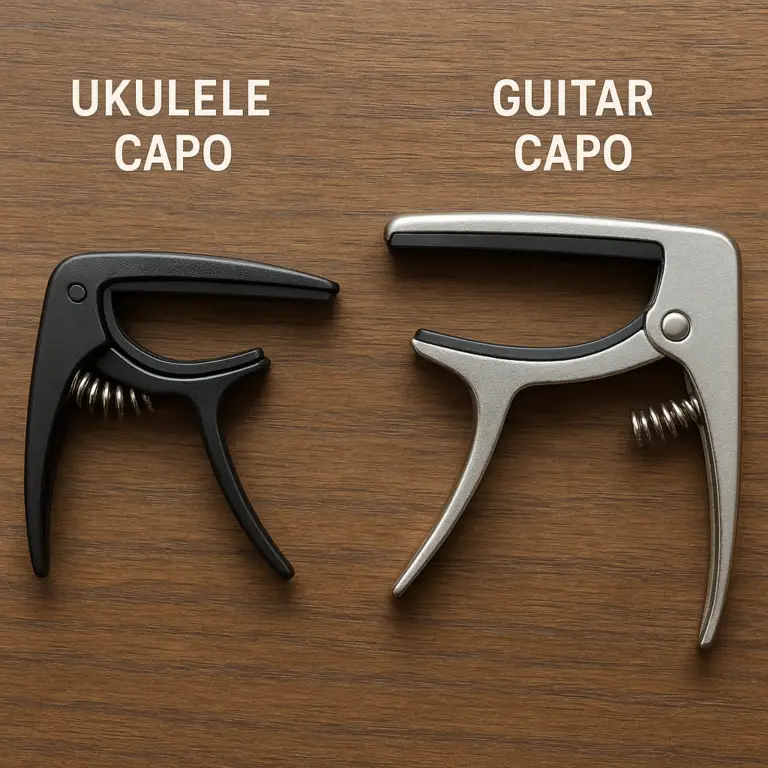
🎹 Transposing Songs and Using a Capo
A song may sit too high or low for your voice, or a chart may contain chord shapes you don’t know yet. Transposing moves the song to another key while preserving the relationships between its chords. A capo raises the pitch of the strings, allowing familiar chord shapes to sound in a higher key.
- Try a different key or a transposed chord chart if the melody doesn’t suit your voice.
- Use a capo only when the arrangement specifies where it belongs.
- Remember that a capo changes pitch; it does not change the chord shapes you physically play.
- If a chart and recording seem to disagree, check the key and capo position before assuming either is wrong.
📚 Where to Find Ukulele Chords, Tabs, and Tutorials
A mix of resources can help you learn: a chord chart for finger placement, a video for rhythm, and a recording for musical context.
- Fender Play’s ukulele lessons provide structured instruction and song-based lessons.
- Ukulele Tabs offers a community catalog of user-contributed songs and tabs. Treat community arrangements as starting points and verify them by listening.
- The Angeles Academy of Music beginner song guide recommends familiar songs, manageable chord counts, and steady practice.
- For an instructional demonstration of “You Are My Sunshine,” visit the featured video, which covers C, F, G, and two strumming patterns.
The supplied summary of Gear4music’s beginner ukulele songs page indicates that the page displayed a security-verification screen rather than accessible article content. Because its song recommendations and wording could not be verified, we haven’t attributed a quote or specific advice to it. When sources conflict, use the actual chord chart, lesson, and recording you can inspect—not a title or search snippet.
🪵 Choosing a Ukulele for Learning Songs
You don’t need an expensive instrument to begin, but you do need one that stays in tune and feels comfortable. The right size depends on your hands, playing position, and sound preference.
| Size | Typical feel | Consider it if… |
|---|---|---|
| Soprano | Small, bright, compact | Portability is the priority |
| Concert | A little more room on the fretboard | You want a comfortable all-purpose size |
| Tenor | Larger body and more fretboard space | You prefer fuller projection or have larger hands |
| Baritone | Larger scale, commonly tuned D–G–B–E | You want a guitar-like tuning layout; check song resources carefully |
What to check before buying
- Tuning stability: New strings may stretch, but the instrument should settle into tune.
- Comfort: Hold it in playing position and see whether your fretting hand reaches the chords easily.
- Intonation: Notes should sound reasonably in tune up the neck.
- Setup: High action can make fretting uncomfortable; ask a music shop to assess it.
- Tuning and size: Confirm the instrument’s tuning before using standard G–C–E–A charts.
Brands such as Kala, Fender, and Lanikai offer ukules in different sizes and styles. The instructor in the featured video plays a Kala ukulele, but the teaching point applies to any well-set-up instrument: tune first, then listen carefully to each chord.
For more instrument advice, explore our Guitar Brand Guides and Guitar Brands Showcase. Ukulele players who later add guitar can also browse our guitar buying guide, acoustic guitar resources, and bass guitar guides.