Support our educational content for free when you purchase through links on our site. Learn more
🎸 What Is the Best Ukulele Size to Learn On?

For many adult beginners, a concert ukulele is the best size to learn on: it keeps standard ukulele tuning while giving your fingers more room than a soprano. But comfort, sound, and the kind of music you want to play matter more than any one-size-fits-all rule.
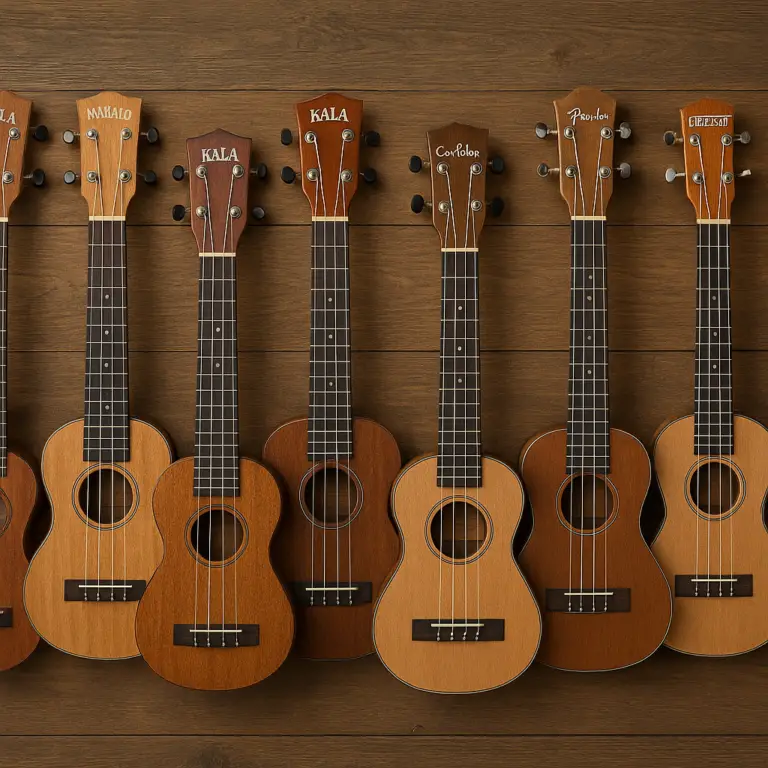
The first time we compared soprano, concert, and tenor ukules side by side, the size differences looked small. Then we tried a few chords: suddenly, fret spacing, body balance, and tone made each instrument feel like a different invitation to play.
If you’re asking, “What is the best size ukulele to learn on?”, start by comparing a concert with a soprano or tenor. We’ll show you how to choose based on your hands, preferred sound, playing style, and tuning—so you can pick the uke you’ll actually want to practice.
Key Takeaways
- Concert is a strong all-around starting choice for many adult beginners, offering standard G–C–E–A tuning and a little extra fretboard room.
- Soprano is compact, bright, and portable; tenor offers more space and a fuller sound; baritone has a lower, guitar-like tuning.
- Size alone doesn’t determine difficulty. Comfort, setup, posture, and tuning all affect how easy a ukulele feels to play.
- Try two sizes if you can. Form a few chords, strum, and choose the instrument that feels comfortable and sounds enjoyable.
Table of Contents
- ⚡️ Quick Tips and Facts
- 🎸 Ukulele Sizes at a Glance: Which One Should You Learn On?
- 🧭 How Ukulele Size Affects Learning, Comfort, and Sound
- 📏 The 5 Main Ukulele Sizes Compared
- 1. Sopranino Ukulele: The Tiny Travel Option
- 2. Soprano Ukulele: The Classic Beginner Size
- 3. Concert Ukulele: Extra Room for Comfortable Chords
- 4. Tenor Ukulele: A Roomier Fretboard and Fuller Sound
- 5. Baritone Ukulele: The Deep-Voiced, Guitar-Like Choice
- 🏆 So, What Is the Best Ukulele Size to Learn On?
- 🖐️ Choosing a Size for Your Hands, Fingers, and Playing Style
- 🎼 Ukulele Tuning by Size: GCEA vs. DGBE
- 🎶 How Ukulele Size Changes Chords, Strings, and Sound
- 🧒 Best Ukulele Size for Children by Age and Reach
- 🎤 Best Ukulele Size for Adults, Beginners, and Guitar Players
- 🪵 Wood, Build Quality, and Setup: What Matters Beyond Size
- 🛒 How to Choose and Buy Your First Ukulele
- 🧰 Beginner Ukulele Accessories Worth Considering
- ❌ Common Ukulele Size Mistakes to Avoid
- 🧪 How to Test a Ukulele for Comfort Before Buying
- 💡 Quick Tips for Learning Ukulele at Any Size
- 🔚 Conclusion
- 🔗 Recommended Links
- ❓ FAQ
- 📚 Reference Links
Quick Tips and Facts
- Best all-around starting point: A concert ukulele suits many adult beginners because it keeps standard ukulele tuning while giving your fretting hand a little more room than a soprano.
- Want the classic, compact ukulele sound? Try a soprano. Its small body is easy to carry, though its closer fret spacing may feel cramped for some hands.
- Want extra fretboard space or a fuller tone? Consider a tenor. It can be comfortable for fingerpicking and larger hands, but it’s bigger to hold.
- Already play guitar? A baritone may feel familiar: it’s commonly tuned D–G–B–E, like the four highest-pitched strings of a guitar. That tuning differs from standard soprano, concert, and tenor tuning.
- Size isn’t a skill level. Experienced musicians play sopranos, and beginners can learn on any size that feels comfortable.
- Try before you buy when possible. Hold the instrument in playing position and test a few chords. A ukulele that feels good is more likely to get played.
- For a wider look at choosing and shopping for a first instrument, see our ukulele buying guide and Guitar Buying Guide.
| Quick question | Useful starting answer |
|---|---|
| Best size for many adult beginners | Concert |
| Smallest common full-size option | Soprano |
| More room for fretting and picking | Tenor |
| Most guitar-like tuning and feel | Baritone |
| Most important deciding factor | Comfort in your hands |
Ukulele Sizes at a Glance: Which One Should You Learn On?
There isn’t one ukulele size that wins for every beginner. The right choice depends on how the instrument feels, which tuning you want, and the sound you enjoy. Many new players start with a soprano or concert; others find the wider fret spacing of a tenor more comfortable. Guitar players may gravitate toward baritone.
The Ukulele Magazine size guide describes the core trade-off well: each size changes more than the instrument’s physical dimensions. Scale length, fret spacing, body size, tuning, and tone all affect the experience.
| Size | Approx. overall length* | Typical tuning | Beginner-friendly for… | Main trade-off |
|---|---|---|---|---|
| Sopranino | Varies by maker | Often G–C–E–A | Travelers and players seeking a tiny instrument | Very compact fretboard |
| Soprano | About 20–21 in | G–C–E–A | Players after a classic, bright ukulele sound | Close fret spacing |
| Concert | About 23 in | G–C–E–A | Many first-time adult players | Less compact than soprano |
| Tenor | About 26 in | G–C–E–A | Fingerpickers and players wanting more room | Larger body; often benefits from a strap |
| Baritone | About 29 in | D–G–B–E | Guitar players and players wanting a lower register | Different tuning and chord shapes |
*Dimensions are typical, not universal. Manufacturers’ measurements and body shapes vary, so check the specific instrument’s specifications.
Our practical starting recommendation: If you can’t try several sizes in person, begin by comparing a concert and a tenor. A concert retains the familiar high-G ukulele sound with a roomier feel than a soprano. A tenor gives you still more space and a fuller voice. But if the bright, compact sound is exactly what you want, a soprano is not a “lesser” choice—it’s simply a different one.
How Ukulele Size Affects Learning, Comfort, and Sound
Ukulele size influences several things you notice immediately: how far your fingers stretch, how much room there is between frets, how the instrument sits against your body, and how bright or deep it sounds.
Scale length and fret spacing
Scale length is the vibrating length of a string, measured from the nut to the bridge. A longer scale generally means the frets are farther apart and the strings may feel different under your fingers. This can give larger hands more room, but it can also ask for a wider stretch.
A longer neck doesn’t automatically make an instrument easier. If a tenor feels bulky in your arms or difficult to position, its wider fret spacing won’t rescue the experience. Likewise, small hands don’t automatically require a soprano: relaxed technique and a comfortable neck profile matter too.
Body size, projection, and tone
A ukulele’s body helps shape its resonance and projection. As a general tendency, smaller instruments sound brighter and more compact; larger instruments often sound fuller and deeper. Strings, wood, body construction, setup, and playing technique also affect tone, so size alone can’t predict exactly how a particular ukulele will sound.
What actually makes learning easier?
For most beginners, these details matter more than a size label:
- Comfortable posture: Can you hold it without hunching or squeezing?
- Fret access: Can you reach the chords you’re learning without your fingers colliding?
- Good setup: Is the action—the string height above the fretboard—comfortable enough for clean notes?
- Stable tuning: Does the instrument stay reasonably in tune after the strings settle?
- Motivating sound: Do you like hearing it enough to practice?
When we test a beginner instrument, we play a few open chords, then try a simple melody above the first few frets. That quick check can tell you more than staring at a size chart. And it leads to a question we’ll return to: is extra fretboard room always worth having?
The 5 Main Ukulele Sizes Compared
Most beginner comparisons focus on four familiar sizes: soprano, concert, tenor, and baritone. A sopranino is even smaller and can be fun for travel, but it is less common as a first learning instrument. Here’s how the five options compare.
| Size | Typical scale length | Typical overall length | Common tuning | General character |
|---|---|---|---|---|
| Sopranino | Varies | Varies | Often G–C–E–A | Very compact and bright |
| Soprano | About 13.5 in | About 20–21 in | G–C–E–A | Traditional, lively, portable |
| Concert | About 15 in | About 23 in | G–C–E–A | Roomier, with a fuller sound |
| Tenor | About 17 in | About 26 in | G–C–E–A | More fingerboard space and projection |
| Baritone | About 19–21 in | About 29 in | D–G–B–E | Lower-register, guitar-like feel |
These are common reference measurements, not strict standards. For instance, the Ukulele Magazine guide lists approximate standard scale lengths of 13 9/16 inches for soprano, 15 inches for concert, and 17 inches for tenor. Individual manufacturers may differ.
1. Sopranino Ukulele: The Tiny Travel Option
A sopranino is the smallest option in this comparison. Its compact size makes it easy to pack, and its bright sound can be charming. But the trade-off is obvious when you try to fret it: very little room for your fingers.
Good fit if you:
- Want a very small instrument for travel or novelty playing.
- Already know ukulele or have a specific reason to choose a tiny body.
- Prefer portability over a roomy fretboard.
Think twice if you:
- Are buying your first instrument and want room to grow.
- Have larger fingers or find closely spaced frets uncomfortable.
- Expect it to sound or feel like a standard soprano.
For a first ukulele, we’d usually compare soprano, concert, and tenor before choosing a sopranino. Tiny is delightful; tiny can also turn a basic chord into a game of finger Tetris.
2. Soprano Ukulele: The Classic Beginner Size
The soprano is the traditional, compact ukulele many people picture first. It is light, portable, and naturally bright, with the familiar high-G, C, E, A tuning used by many ukulele players.
The small size is a benefit for carrying and holding, but the closer fret spacing can be challenging if you have larger fingers. That doesn’t rule it out. Experienced players choose sopranos too, and its compact feel may be exactly what you enjoy.
Best for: Players who want the classic ukulele sound, easy portability, or a small instrument that feels manageable.
Possible drawbacks: Less room between frets than on larger sizes; a smaller body may have less resonance and projection than a larger instrument.
3. Concert Ukulele: Extra Room for Comfortable Chords
The concert ukulele is a popular middle ground: larger than a soprano, smaller than a tenor, and commonly available in standard G–C–E–A tuning. It gives your fretting hand somewhat more room while retaining the familiar high-register ukulele character.
The Denver Folklore comparison calls concert a strong all-around option, highlighting its extra fretboard room and fuller mid-range compared with soprano. That’s a useful perspective, though comfort remains personal: one player’s “roomier” can be another player’s “slightly too big.”
Best for: Many adult beginners, players who find soprano frets cramped, and anyone wanting a compact instrument with a little more space.
Possible drawbacks: Not as small as a soprano, and not as spacious or resonant as many tenors.
4. Tenor Ukulele: A Roomier Fretboard and Fuller Sound
A tenor offers more scale length and fretboard space than a concert. Many players like it for fingerpicking, melodic playing, and a fuller, more projecting sound. Standard G–C–E–A tuning is common, though tenor players can also use low-G tuning to extend the lower range.
Tenor isn’t automatically the best beginner choice. Its body and neck may be more comfortable for some adults and less comfortable for others, especially if the player prefers a small, light instrument. A strap can help support it during longer sessions.
Best for: Players wanting more room for fretting or picking, adults who prefer a larger instrument, and players interested in a fuller sound.
Possible drawbacks: Larger body, less pocketable, and potentially a different balance in the arms than a concert.
5. Baritone Ukulele: The Deep-Voiced, Guitar-Like Choice
The baritone is the largest of the common ukulele sizes here, and its usual tuning—D–G–B–E—matches the four highest-pitched strings of a standard guitar. This gives it a lower, warmer voice and makes it feel familiar to many guitarists.
The key catch is tuning. Baritone chord shapes and note relationships differ from standard G–C–E–A ukulele tuning. You can absolutely learn on a baritone, but many beginner ukulele tutorials, chord charts, and song resources are written for G–C–E–A instruments. Check the tuning before you follow a lesson; otherwise, your perfectly good chord may sound like it has taken a wrong turn.
Best for: Guitar players, people who prefer a lower register, and learners happy to use baritone-specific learning material.
Possible drawbacks: Different tuning from the three smaller common sizes; less of the bright, traditional ukulele sound.
So, What Is the Best Ukulele Size to Learn On?
For many adult beginners, concert is the safest all-around recommendation: it remains compact, usually uses standard ukulele tuning, and offers more room than a soprano. But there’s no universal winner.
Choose a soprano if the classic sound and small size are your priorities. Choose a tenor if you want more room, play a lot of melodies, or prefer a fuller tone. Choose a baritone if you already play guitar or specifically want its lower sound and guitar-like tuning.
| If your priority is… | Start by trying… | Why |
|---|---|---|
| Classic ukulele sound and portability | Soprano | Compact body and bright character |
| A flexible first instrument for many adults | Concert | A useful balance of size and fretboard room |
| More space for fingerstyle and fretting | Tenor | Longer scale and roomier feel |
| Guitar-like tuning and lower tone | Baritone | D–G–B–E tuning and deeper voice |
| The smallest possible instrument | Sopranino | Very portable, but unusually compact |
This balances two common recommendations. The Denver Folklore article favors concert as a comfortable general-purpose starting point, while Ukulele Magazine emphasizes matching size to the player’s preferred sound and feel rather than declaring a universal winner. Both perspectives can be true: concert is a practical default for many people, but personal fit should decide.
Choosing a Size for Your Hands, Fingers, and Playing Style
Hand size can guide your shortlist, but it shouldn’t decide for you. Finger length, finger width, wrist comfort, playing posture, and the chords you want to play all matter.
If your hands are small
A soprano may feel easy to hold, while a concert can offer extra fret space without becoming too large. Small hands don’t necessarily need the smallest instrument: the best test is whether your fingers can form chords cleanly without tension.
If your hands or fingers are larger
Try concert and tenor sizes. The extra space may help your fingertips land without muting neighboring strings. Still, a good chord depends on finger angle and technique as well as fret spacing. A setup with comfortable action is also valuable.
If you fingerpick or play melodies
A tenor may give your picking hand and fretting hand more room, and its longer neck can offer more playing range. That said, players perform fingerstyle on smaller ukules too. You’re choosing a feel and sound, not getting permission to play a style.
If you mostly strum songs
Soprano and concert sizes are both sensible options. For strumming, many beginners prioritize a comfortable hold, a pleasing sound, and reliable tuning over maximum fretboard space.
Try this comfort check:
- Sit or stand as you expect to play.
- Support the instrument without clamping your shoulder or wrist.
- Form a basic C chord, then move to F and G.
- Check whether your fingertips can land cleanly without touching neighboring strings.
- Strum gently and see whether the instrument stays balanced.
- Repeat on a different size before deciding.
The first video’s comparison also recommends trying sizes in person and notes the broad pattern that smaller bodies tend to sound higher and less resonant, while larger instruments tend to sound deeper. Treat that as a useful general guide—not a promise that every tenor will sound better than every soprano.
Ukulele Tuning by Size: GCEA vs. DGBE
Tuning matters as much as size when you’re choosing a first ukulele. Soprano, concert, and tenor ukules are commonly tuned G–C–E–A. Baritone ukules are commonly tuned D–G–B–E.
| Ukulele size | Common tuning | What it means for learning |
|---|---|---|
| Soprano | G–C–E–A | Standard tuning for many beginner lessons and chord charts |
| Concert | G–C–E–A | Same standard tuning as soprano |
| Tenor | G–C–E–A or low-G variant | Standard chord charts generally apply; low-G adds lower notes |
| Baritone | D–G–B–E | Use baritone-specific chord charts and lessons |
What is re-entrant tuning?
Many standard ukules use re-entrant tuning: the G string is tuned higher than the C string rather than continuing downward in pitch. Low-G tuning replaces that high G with a lower G string, giving the instrument a broader lower range.
Neither setup is inherently superior. High-G preserves the familiar, bright ukulele texture. Low-G can suit melodic playing and players who want more bass notes, though it changes the instrument’s tonal balance.
Why does baritone tuning matter to beginners?
A baritone’s D–G–B–E tuning corresponds to a guitar’s four highest-pitched strings, which can feel intuitive if you already play guitar. But standard ukulele chord diagrams won’t automatically match baritone tuning. Before buying, make sure your preferred lessons and song resources support the instrument you choose.
How Ukulele Size Changes Chords, Strings, and Sound
A chord name stays the same across ukulele sizes, but the finger positions, tuning, and sound you produce depend on the instrument. On soprano, concert, and tenor in standard tuning, many familiar ukulele chord shapes are shared. Baritone is the major exception because its tuning differs.
Do bigger ukules have harder chords?
Not necessarily. A larger neck provides more room, which some players find helpful. But the increased stretch can challenge others. The feel also depends on string tension, nut width, neck shape, action, and the individual chord.
Can you use the same chord charts?
- Soprano, concert, and standard-tuned tenor: Usually yes, when all use G–C–E–A.
- Low-G tenor: Many chord shapes remain the same, but the lowest string changes register.
- Baritone: Use chord charts made for D–G–B–E tuning.
What changes in tone?
As a broad tendency, soprano sounds bright and compact, concert a little rounder, tenor fuller, and baritone lower. But tone also depends on the strings and the instrument’s construction. Two ukules of the same size can sound noticeably different, so don’t buy by size chart alone.
Best Ukulele Size for Children by Age and Reach
Children often find smaller ukules easier to hold, but age is only a rough guide. A child’s arm reach, hand span, posture, and attention span can matter more than the number on a birthday cake.
| Player | Sizes worth trying | What to check |
|---|---|---|
| Young child with a short reach | Soprano | Can they hold it securely and reach the first frets? |
| Older child or smaller teen | Soprano or concert | Are chords comfortable without straining? |
| Teen with larger hands | Concert or tenor | Does the body feel balanced? Is the fretboard roomy enough? |
A child-friendly fitting check
- Have the child sit comfortably and hold the ukulele in playing position.
- Check that they can reach the first few frets without twisting their wrist sharply.
- Ask them to form one or two simple chords.
- Make sure the body doesn’t feel awkwardly large or heavy.
- Let them strum and choose the sound they enjoy.
Avoid buying an instrument so small that the child immediately outgrows the fretboard, but don’t choose a size they cannot hold comfortably just to “grow into it.” A short, happy practice session beats a long struggle with an oversized instrument.
Best Ukulele Size for Adults, Beginners, and Guitar Players
Adult beginners
A concert is a practical place to start if you want a standard-tuned ukulele with a little extra room. Try soprano too if portability and the traditional bright sound matter more to you. If you have larger hands or want more space for fingerstyle, test a tenor.
Guitar players
A baritone can feel familiar because its tuning corresponds to the top four strings of a guitar. You may recognize chord shapes and note patterns, though ukulele and guitar chord charts aren’t interchangeable in every context. If you want to learn standard ukulele tuning instead, a concert or tenor is a straightforward option.
Players coming from other string instruments
If you already play guitar, bass, or another fretted instrument, you may adapt quickly to chord changes—but the smaller scale and tuning can still require adjustment. Our acoustic guitar guides and bass guitar resources cover related fretted-instrument topics; the same basic habits—relaxed hands, clean fretting, and good posture—help on ukulele too.
Wood, Build Quality, and Setup: What Matters Beyond Size
Two instruments with the same dimensions can feel and sound quite different. Before choosing based on size alone, look at playability, tuning stability, construction, and setup.
Setup and string height
String height above the frets affects how much effort it takes to press notes. A poorly set-up ukulele can make learning frustrating at any size. If chords feel unusually hard or notes buzz, ask a qualified music shop or repair technician to assess the setup rather than assuming you bought the wrong size.
Materials and construction
Solid wood, laminate, body shape, bracing, and string choice influence tone and durability. There is no single material that guarantees a better beginner experience. A well-made, properly set-up laminate ukulele can be a sensible first instrument; a more expensive instrument is not automatically more comfortable.
Tuning stability and strings
New strings often stretch as they settle, so a new ukulele may need frequent retuning at first. Check the instrument with a reliable tuner and give the strings time to stabilize. If tuning remains unstable, have the tuners, nut, bridge, and strings checked.
For brand research, browse our Guitar Brand Guides and Guitar Brands Showcase. When comparing a specific ukulele, focus on its scale length, tuning, construction, and return policy—not just the logo on the headstock.
How to Choose and Buy Your First Ukulele
Use this step-by-step process to make a confident choice rather than guessing from a product photo.
Step 1: Decide what sound and tuning you want
If you want the standard bright ukulele sound and the widest selection of beginner lessons, start with G–C–E–A tuning. Choose baritone if its lower register and guitar-like tuning appeal to you.
Step 2: Shortlist two sizes
- Start with soprano and concert if you value portability.
- Compare concert and tenor if you want more fretboard room.
- Consider baritone if you play guitar or want a lower tone.
Step 3: Check the specifications
Look for the instrument’s actual scale length, overall length, tuning, string type, fret count, and nut width where available. Product labels such as “concert” are useful, but specifications let you compare instruments more precisely.
Step 4: Test the feel
Hold each instrument in playing position, form a few chords, and try a short melody. Listen for buzzing, dead notes, or strings that feel uncomfortably high.
Step 5: Check the retailer’s policies
Review return terms, warranty coverage, included accessories, and whether a setup is available. A clear return policy is helpful because comfort is personal and difficult to judge from a screen.
Step 6: Make sure learning materials match
Confirm that the lessons or chord charts you plan to use match your tuning. A standard G–C–E–A lesson may not transfer directly to a D–G–B–E baritone.
For online shopping, compare full specifications and verified customer feedback rather than choosing by a single star rating. Reviews can reveal practical patterns—such as tuning issues or unexpected size—but individual experiences vary by setup, delivery, and playing expectations.
Beginner Ukulele Accessories Worth Considering
You don’t need a suitcase full of accessories to begin. A few useful basics can make practice easier.
- Clip-on tuner: Helps you check tuning quickly.
- Padded case: Protects the instrument during storage and travel.
- Spare strings: Useful if a string breaks or you want to experiment with a different set.
- Strap: Optional, but may help support a tenor or baritone while standing.
- Picks: Optional. Many players strum with their fingers, but felt picks are available if you prefer a pick.
- Music stand: Keeps chord sheets and lessons at a comfortable viewing height.
Check whether a beginner bundle includes accessories you’ll actually use. A bundle can be convenient, but a case and tuner are more valuable than a pile of extras that never leave the box.
Common Ukulele Size Mistakes to Avoid
❌ Assuming bigger always means easier. More fret space can help, but a larger body may feel awkward.
❌ Choosing only by hand size. Technique, neck shape, action, and posture matter too.
❌ Treating soprano as a children’s instrument. Players of all experience levels choose soprano for its sound and portability.
❌ Buying a baritone without checking the tuning. Its common D–G–B–E tuning differs from standard G–C–E–A.
❌ Ignoring setup and tuning. High string action or unsettled strings can make a good size feel difficult.
❌ Assuming a size label guarantees exact dimensions. Manufacturers vary; check the actual specifications.
❌ Picking a ukulele you don’t enjoy hearing. The instrument that inspires you to practice has a practical advantage over the one that looks perfect on paper.
How to Test a Ukulele for Comfort Before Buying
If you can visit a music store, test at least two sizes. Ask staff for help comparing models, especially if you’re new to fretted instruments.
- Sit naturally and hold the instrument without lifting your shoulder.
- Check reach by placing a finger near the first fret and forming simple chords.
- Listen for clean notes on each string, with no unexpected buzz or muted sound.
- Strum softly and firmly to see how the instrument responds.
- Try a short melody to assess finger spacing and access.
- Compare weight and balance between sizes.
- Ask about setup and returns before deciding.
If you’re buying online, check manufacturer specifications and use the retailer’s return policy to reduce the risk of a poor fit. You can also compare user reviews, but look for repeated, specific observations rather than treating every review as a universal verdict.
Quick Tips for Learning Ukulele at Any Size
- Tune before each practice session, especially while new strings are settling.
- Start slowly and aim for clean notes before speeding up chord changes.
- Use a light touch; squeezing the neck harder than necessary can tire your hand.
- Practice short, regular sessions rather than waiting for one marathon practice day.
- Check that tutorials match your tuning.
- If your wrist or shoulder hurts, stop and adjust your posture or instrument position.
- Record a short practice clip now and then; progress can be easier to hear than to feel.
- If you’re unsure between two sizes, choose the one that feels comfortable and makes you want to pick it up again.