Support our educational content for free when you purchase through links on our site. Learn more
🎶 Can Ukulele Play Any Song? Yes—With a Twist

Can ukulele play any song? It can play an arrangement of almost any song, though it may not reproduce every note, bass line, or electric-guitar sound exactly as recorded. The trick is to adapt the music to the ukulele’s four strings, tuning, and range.
We’ve found that songs often click once you decide what to keep: the melody, the chords, or the groove. A big rock riff may become a nimble melody line; a piano ballad can turn into gentle fingerpicking. Same song, different outfit—and sometimes it fits surprisingly well. 🎸
Key Takeaways
- Almost any song can be adapted for ukulele, even if it wasn’t written for the instrument.
- The original arrangement may need changes: transpose the song, simplify chords, move notes by an octave, or rework guitar and bass parts.
- Standard G–C–E–A tuning shapes the ukulele’s sound and range. Low-G tuning can add lower notes for some melodies and fingerstyle arrangements.
- The melody and rhythm are often more important than copying every note. A simple, well-timed arrangement can sound more convincing than crowded chord shapes.
- Play along with guitar, piano, bass, or mandolin by matching the key, chords, and timing.
Table of Contents
- ⚡️ Quick Tips and Facts
- 🎶 Can a Ukulele Play Any Song? The Short Answer
- 🕰️ A Brief History of the Ukulele and Its Musical Range
- 🎼 How Ukulele Tuning, Chords, and Melody Shape What You Can Play
- Standard G–C–E–A Tuning and High-G vs. Low-G
- Chords, Keys, and Transposing Songs for Ukulele
- Playing Melodies, Riffs, and Instrumental Parts
- ✅ Songs That Sound Great on Ukulele
- Pop, Rock, and Indie Songs
- Folk, Country, and Traditional Songs
- Jazz, Blues, and Classical Music
- Movie Themes, Game Music, and Instrumentals
- 🎸 Songs That Are Tricky to Play on Ukulele
- Low Notes and Bass-Heavy Parts
- Complex Chords, Fast Changes, and Wide Ranges
- Electric Guitar Riffs, Power Chords, and Alternate Tunings
- 🛠️ How to Adapt Any Song for Ukulele
- Find the Song’s Key, Chords, and Melody
- Choose an Easier Key or Use a Capo
- Simplify Chords and Create Ukulele-Friendly Voicings
- Rewrite Bass Lines and Guitar Parts
- Match the Original Feel with Strumming or Fingerpicking
- 🎤 Can You Sing Any Song While Playing Ukulele?
- 🎼 Can Ukulele Play Along with Guitar, Piano, or Other Instruments?
- 🪕 Does Ukulele Size or Type Affect Which Songs You Can Play?
- Soprano, Concert, Tenor, and Baritone Ukules
- Acoustic vs. Electric Ukules
- 📚 Beginner-Friendly Ways to Learn Songs on Ukulele
- 🔎 Finding Accurate Ukulele Chords, Tabs, and Sheet Music
- 🚫 Common Myths About Ukulele Song Choices
- 🧰 Troubleshooting: Why a Song Doesn’t Sound Right
- ✨ Quick Tips for Making Almost Any Song Work
- Conclusion
- Recommended Links
- FAQ
- Reference Links
⚡️ Quick Tips and Facts
Short answer: a ukulele can play music from almost any genre, but it cannot reproduce every song exactly as recorded without adaptation. Its four strings, tuning, range, and bright tone affect how you arrange a song—not whether you’re allowed to try it. If you’re weighing the instrument against guitar, start with our guide to ukulele vs. guitar.
| Quick fact | What it means when you play |
|---|---|
| Standard tuning is usually G–C–E–A | Many familiar chord shapes are compact, but guitar chord diagrams won’t automatically match. |
| A ukulele has four strings | You can play chords, melodies, riffs, and arrangements, but may need to redistribute parts written for six-string guitar or piano. |
| High-G tuning is re-entrant | The G string sits higher than the C string, giving the ukulele its characteristic bright, compact sound. |
| Low-G tuning extends the lower register | It can help with melody and fingerstyle arrangements, though it still doesn’t turn a ukulele into a bass. |
| Transposition changes the key, not the song’s identity | Moving a song to a ukulele-friendly key can make awkward chords easier to play. |
| The original arrangement may not fit; the song can still work | Simplify, transpose, pick out the melody, or create a new accompaniment. |
The practical rule
✅ Try nearly any song if you’re happy to arrange it for the instrument.
❌ Don’t expect every original note, bass line, or guitar effect to transfer unchanged.
The Ukulele Mate guide puts the idea simply: “you can take on almost any song, provided you are willing to adapt it.” We agree—with one useful refinement: a song’s parts may need changing, while its melody, harmony, rhythm, or overall feel can remain recognizable.
Our musicians’ tip: When a song feels impossible, don’t give up after the first chord chart. Ask which part you want to preserve: the vocals, the melody, the groove, or a memorable riff. That answer usually points to the right arrangement.
🎶 Can a Ukulele Play Any Song? The Short Answer
Yes, a ukulele can play an arrangement of almost any song. No, it may not reproduce every song exactly as performed on the original instruments. Those answers aren’t contradictory. They distinguish between playing a song and duplicating a recording.
A ukulele can accompany singing with chords, play a recognizable melody, outline a riff, or join an ensemble. It has limits in range, sustain, string count, volume, and tone, so parts written for electric guitar, piano, bass, or a full orchestra sometimes need rethinking.
| What you want to play | Can a ukulele do it? | Common adjustment |
|---|---|---|
| Chord accompaniment | ✅ | Use ukulele chord shapes; transpose if needed |
| Vocal melody | ✅ | Find the melody’s notes within the instrument’s range |
| A simple guitar riff | ✅ | Re-finger the riff as ukulele tab or a single-note line |
| A full guitar arrangement | Sometimes | Split the arrangement into melody, chords, and bass; simplify or omit parts |
| Deep bass notes | Limited | Revoice the line higher, use low-G tuning, or let a bassist handle it |
| Distorted, sustained electric-guitar tone | Not acoustically identical | Use an electric ukulele or effects, while accepting a different sound |
| Piano chords spanning a wide range | Not in the same voicing | Choose a compact voicing or play only the essential notes |
The distinction matters when you search for a song online. A chord chart may show a playable accompaniment, not a note-for-note version of the recording. That can be exactly what you need for singing around a campfire—and a disappointment if you expect a solo ukulele to recreate every layer of a studio track.
A useful way to define “play any song”
Think of a song as having several ingredients:
- Melody: the tune you can hum.
- Harmony: the chords supporting that tune.
- Rhythm: the pulse and groove.
- Bass: the low notes that anchor the harmony.
- Arrangement and tone: the specific instruments and sounds in a recording.
A ukulele player can often preserve the melody and harmony while changing the bass, rhythm, and arrangement. That’s not “cheating.” It’s arranging. 🎵
🕰️ A Brief History of the Ukulele and Its Musical Range

The ukulele is closely associated with Hawaiʻi, where it developed in the late 19th century after Portuguese immigrants brought small, guitar-like instruments to the islands. The Smithsonian’s National Museum of American History documents the instrument’s historical presence and cultural context. Its portability and distinctive sound helped it spread into popular music, home playing, and group accompaniment.
That history explains part of the ukulele’s reputation: many people first meet it through bright, strummed songs. But a familiar sound is not a musical boundary. Players use ukules for fingerstyle, jazz chords, classical arrangements, blues, pop covers, and original compositions. The instrument’s four strings invite different solutions from those used on guitar, but they don’t confine it to one genre.
A useful comparison: a painter can work on a smaller canvas. The space changes the technique; it doesn’t dictate the subject. The ukulele’s compact range and sound shape the arrangement, while the player decides what the music becomes.
🎼 How Ukulele Tuning, Chords, and Melody Shape What You Can Play
Standard G–C–E–A Tuning and High-G vs. Low-G
Most soprano, concert, and tenor ukules use G–C–E–A tuning. The G string is commonly tuned as a high G, above the C string in pitch. This is called re-entrant tuning: the strings don’t move from lowest to highest in the straightforward order many guitarists expect.
| Setup | What changes | Best suited to |
|---|---|---|
| High-G G–C–E–A | Bright, familiar ukulele sound; compact chord voicings | Strumming, group singing, traditional ukulele repertoire |
| Low-G G–C–E–A | G string is tuned an octave lower than high G | Fingerstyle, extended melody range, fuller lower notes |
| Baritone D–G–B–E | Lower, guitar-like tuning across four strings | Players seeking lower pitch and familiar guitar chord shapes |
A low-G string can give melodies and fingerstyle parts more room in the lower register. It won’t provide the lowest notes of a guitar or bass, and switching from high G may require a suitable string and setup. For more instrument comparisons and gear guidance, see our Guitar Buying Guide.
Chords, Keys, and Transposing Songs for Ukulele
A chord chart labeled “C, G, Am, F” names the chords, but the diagrams depend on the instrument. A guitar C chord shape is not the same fingering as a ukulele C chord shape, even when both produce the chord C.
If a song’s chords are awkward, you can transpose it: move every chord by the same number of semitones into a different key. A capo can also raise the pitch while retaining familiar shapes, though it doesn’t magically make every chord easy.
Try this:
- Find a reliable chord chart or identify the song’s key.
- Play through the progression slowly.
- Circle chords that are difficult or interrupt the rhythm.
- Use a transposition tool or chart to try a nearby key.
- Check that the new key suits your vocal range.
- Play along with the recording or a metronome to confirm the harmony sounds right.
The musictheory.net lessons offer clear explanations of notes, intervals, and scales if you want to understand why transposition works rather than merely move chord names around.
Playing Melodies, Riffs, and Instrumental Parts
You don’t need a chord chart to play a song. You can work out its melody by ear, read sheet music, or use ukulele tablature. A melody may fit comfortably one string or require movement across strings and frets; the best fingering is often the one that keeps the notes connected and the hand relaxed.
The featured video’s teacher emphasizes learning scales and chords by ear—describing the process as “bas gano ko sun kar,” or learning by listening. The video also explains the major-scale pattern whole–whole–half–whole–whole–whole–half. That’s a useful foundation: once you can hear and find notes in a key, you can begin building melodies and chords without depending on a search result for every song. Watch the featured video.
One clarification helps: the video’s note list includes chromatic pitches, but B and E do have sharps in standard Western equal temperament—B♯ is enharmonic with C, and E♯ with F. For most beginner scale exercises, those spellings are less important than learning the sound and fretboard pattern accurately. The Open Music Theory textbook explains pitch, scales, and enharmonic spelling in more detail.
✅ Songs That Sound Great on Ukulele
A song tends to feel natural on ukulele when its melody sits in range, its harmony can be voiced comfortably, and the instrument’s lighter attack suits the arrangement. That’s about the arrangement, not a rule that certain genres “belong” on ukulele.
Pop, Rock, and Indie Songs
Pop and indie songs are often good starting points because many use repeating chord progressions and clear melodies. A steady down-strum can support a vocal, while fingerpicking can make a sparse song feel intimate.
For rock songs, decide what matters most:
- Keep the vocal melody and chord progression for a singalong version.
- Adapt a distinctive riff as single notes.
- Use a percussive strum to suggest the original groove.
- Don’t expect acoustic strings to reproduce distorted guitar, sustain, or a layered production exactly.
A guitarist may miss the low power chords at first. But when we strip a song down to one voice and a ukulele, we often hear the melody and chord movement more clearly. That’s a different version, not a lesser one.
Folk, Country, and Traditional Songs
Folk, country, and traditional material often translates well because melody and lyrics are central, and the accompaniment can be adapted to a simple chord pattern. Fingerpicking can suggest a bass note followed by lighter chord tones; strumming works well for communal singing.
For country-style arrangements, you can imitate some of the rhythmic lift with alternating notes, muted strums, or short fills. You won’t reproduce a full steel-guitar part with standard ukulele technique, but you can preserve the song’s pulse and phrasing.
Jazz, Blues, and Classical Music
These styles are possible, but they may ask more of your fretboard knowledge.
- Jazz: Learn movable chord shapes, seventh chords, and compact voicings. The Ukulele Underground chord library and reputable notation can help you compare shapes.
- Blues: Use a shuffle feel, short melodic phrases, and dominant-seventh chords. A ukulele can play blues melodies, although its sustain and low-end punch differ from a guitar.
- Classical: Arrange the melody and bass independently, then see what fits within the instrument’s range. Low-G tuning may help some fingerstyle pieces.
For classical arrangements, a printed guitar score may include notes below the ukulele’s range. Rather than forcing every note, retain the main melody and the most important harmony tones. A clear arrangement beats a cramped one.
Movie Themes, Game Music, and Instrumentals
Film and game themes often have memorable melodies, which makes them satisfying to arrange. The challenge may be a wide range, fast ornamentation, or big dynamic changes. Start with the tune at a slower tempo, then add chords or rhythmic accents.
Tip: If a theme sounds thin as chords alone, play the melody first. Add a bass note or chord only where it supports the tune instead of strumming through every beat. The result often sounds more like a deliberate arrangement and less like a chord chart wearing a costume. 🎬
🎸 Songs That Are Tricky to Play on Ukulele
“Tricky” usually means the original arrangement asks for something the ukulele does differently. It doesn’t mean the song is forbidden.
Low Notes and Bass-Heavy Parts
A standard high-G ukulele has less low-frequency reach than a guitar or bass. If the song’s identity depends on a deep bass riff, you can:
- Move the line up an octave.
- Play only the bass notes that establish the chord changes.
- Use a low-G ukulele for a little more lower-register range.
- Arrange with a bassist or guitarist who can cover the low part.
You can hear the effect by playing the same line in a higher octave: the notes remain recognizable, but the arrangement feels lighter. That’s a useful adaptation, not a mistake.
Complex Chords, Fast Changes, and Wide Ranges
Dense jazz voicings, rapid chord changes, and melodies that span several octaves may need simplification. A chord chart can also list a technically correct shape that is uncomfortable for your hand or muffled on your instrument.
Try the following:
- Preserve the chord’s essential quality—major, minor, or dominant—before adding extensions.
- Use a smaller voicing that contains the most important notes.
- Slow the tempo until each change rings clearly.
- Move the melody to a comfortable octave if the arrangement allows it.
- Add complexity back only after the basic version feels steady.
If you’re changing fingerings often, check that your ukulele is in tune and that you’re using a chart written for ukulele. Our Acoustic Guitars guide covers guitar gear and playing considerations for readers comparing acoustic instruments.
Electric Guitar Riffs, Power Chords, and Alternate Tunings
A guitar riff can rely on bends, distortion, sustain, string noise, or alternate tuning. A ukulele can often play the notes of the riff, but not necessarily the original sound or physical gesture.
For a practical adaptation:
- Write down the riff’s note names or locate a reliable tab.
- Find those notes on the ukulele fretboard.
- Reduce fast bends or slides to the notes they lead to.
- Use a clean electric ukulele or an effects setup if tone is central.
- Keep the rhythm and contour even if the exact timbre changes.
Brands such as Kala and Fender offer electric or amplified ukulele options. They can expand volume and effects choices, but amplification does not extend the instrument’s physical range.
🛠️ How to Adapt Any Song for Ukulele
Here’s a step-by-step method we use when a favorite song doesn’t fit the first chord chart we find.
Find the Song’s Key, Chords, and Melody
Start with a trustworthy chart, sheet music, or recording. User-submitted chord sites can be useful, but arrangements may be incomplete or posted in a different key. Compare multiple sources and listen for the bass note at each chord change.
- Identify the melody. Hum the vocal line or main hook.
- Find the chord progression. Write down the changes and mark where each chord occurs.
- Check the key. Compare the chords with the melody; a chart’s stated key may differ if it has been transposed.
- Separate essential parts. Decide which notes or phrases make the song recognizable.
- Test the notes on your ukulele. A tuner or keyboard can help verify pitch.
Choose an Easier Key or Use a Capo
If several chords are awkward, try a new key before simplifying the song. Use a transposition chart or trusted tool to move every chord by the same interval. Then sing the melody in that key to make sure it still suits your voice.
A capo raises the pitch of open-string shapes. It can help you retain comfortable chord fingerings, but it changes the key and may affect string tension and intonation. Check that the instrument stays in tune after fitting one.
Simplify Chords and Create Ukulele-Friendly Voicings
You do not need to preserve every note in a complex piano or guitar chord. Keep the notes that define the harmony, then choose a playable voicing.
- A major or minor triad may be enough for a basic accompaniment.
- A seventh chord may matter when it creates a strong blues or jazz character.
- Added extensions can often be omitted if they make the shape impractical.
- If a chord chart sounds wrong, verify the tuning and chord name before changing the arrangement.
The Fender ukulele chord guide is a useful starting point for common chord shapes. For a broader guide to brands and instrument choices, browse our Guitar Brand Guides.
Rewrite Bass Lines and Guitar Parts
A guitar arrangement may contain several jobs at once: bass notes, rhythm chords, and a melodic riff. A ukulele player can decide which role to take.
- Keep the bass note only at important chord changes.
- Move an out-of-range note up an octave.
- Replace a strummed guitar figure with a lighter fingerpicked pattern.
- Turn a full riff into its most recognizable melodic notes.
- Leave space where another instrument or singer needs room.
This is especially helpful in a group. If a bass guitar is covering low notes, your ukulele doesn’t need to imitate them. Our Bass Guitars category has more on the instrument that can take that job.
Match the Original Feel with Strumming or Fingerpicking
A song’s character often depends more on rhythm than on fancy chords. Try:
- Down-strums for a steady, simple pulse.
- Alternating down and up strokes for a flowing pop or folk groove.
- Muted strums for percussive emphasis.
- Fingerpicking when the arrangement needs separate melody and accompaniment.
- A slower tempo while you learn, then gradually increase the speed.
Record a short practice take and listen back. We often hear timing issues more clearly in a recording than while we’re busy watching our fretting hand. 🎧
🎤 Can You Sing Any Song While Playing Ukulele?
Many songs can be sung with ukulele accompaniment, but the right key matters. A chord progression may be easy to play and still put the melody outside your comfortable vocal range.
Try this:
- Sing the chorus without the instrument.
- Find a key where the highest and lowest notes feel comfortable.
- Choose ukulele chord shapes that work in that key, or transpose the song.
- Practice the strumming pattern separately from the vocal.
- Combine them slowly, using a simpler rhythm if necessary.
If you’re a beginner, start with one chord change per bar and a steady down-strum. Add up-strums, muted accents, or more elaborate picking after the vocal feels secure. The goal is to support the song, not turn the right hand into a juggling act. For practical instrument selection and setup advice, see our Guitar Buying Guide.
🎼 Can Ukulele Play Along with Guitar, Piano, or Other Instruments?
Yes. Ukulele works well with guitar, piano, bass, and many other instruments if everyone agrees on the key, tuning reference, tempo, and arrangement.
| Instrument pairing | Useful ukulele role | Watch out for |
|---|---|---|
| Ukulele + guitar | Strum a lighter pattern, play melody, or use different chord voicings | Two players strumming the same rhythm can make the texture crowded |
| Ukulele + piano | Add a rhythmic pulse, melody, or compact chord layer | Piano may fill a much wider pitch range |
| Ukulele + bass | Provide chords and upper melody while bass carries low notes | Keep the ukulele’s rhythm from masking the bass line |
| Ukulele + mandolin | Trade melodies or play chords in a shared key | Different tunings and registers mean parts may need arranging |
| Ukulele + voice | Offer portable chord accompaniment | Choose a key that suits the singer |
To play along with a recording, tune accurately and check whether the recording uses standard pitch. If you’re joining another musician, ask for the key rather than assuming the chord shapes are the same. A guitarist’s “G shape” and a ukulele player’s “G shape” may involve different fingerings, but the intended chord can still match.
The Facebook item about songs mandolin and ukulele can play together isn’t accessible without a login, so we can’t verify its specific suggestions. The general principle is reliable: instruments can play together when their parts share the same harmony and timing, even if their tunings and techniques differ.
🪕 Does Ukulele Size or Type Affect Which Songs You Can Play?
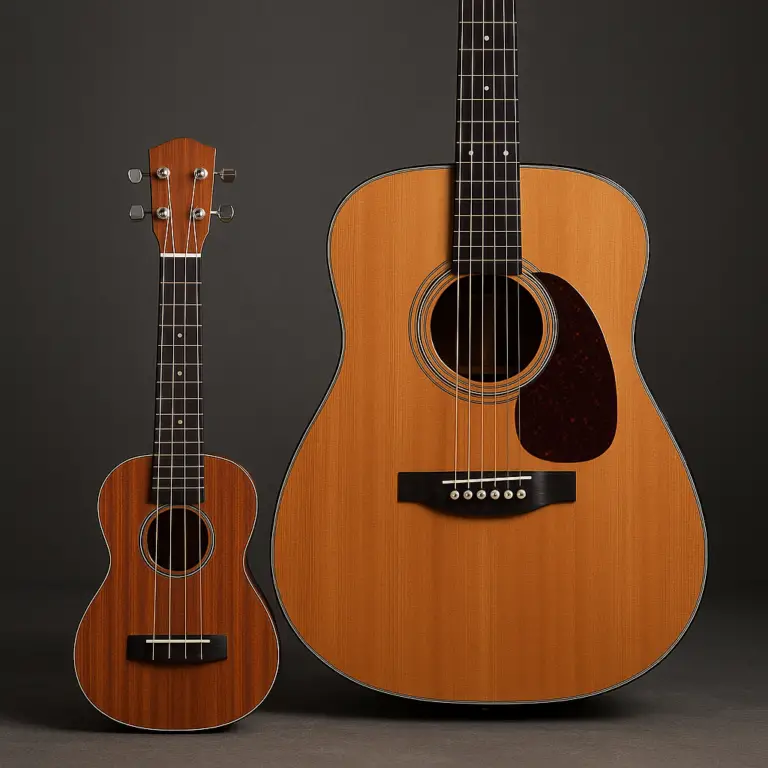
Size and construction affect feel, tone, and available pitch range, but they don’t make a song categorically off-limits. The standard ukulele sizes—soprano, concert, tenor, and baritone—offer different compromises.
Soprano, Concert, Tenor, and Baritone Ukules
| Size | General playing feel | Common use |
|---|---|---|
| Soprano | Compact, traditional feel; less room between frets | Bright strumming and portability |
| Concert | Slightly larger body and fingerboard | A comfortable all-purpose option |
| Tenor | More space for fretting and fingerstyle | Melody playing and fuller accompaniment |
| Baritone | Larger body and lower D–G–B–E tuning | Lower register and guitar-like chord familiarity |
Exact sound and comfort vary by instrument, strings, and setup. A larger size can provide more room for intricate fingering, but the player’s hand size and technique matter as much as the label. Try instruments in person when possible, or consult the maker’s specifications before buying.
Acoustic vs. Electric Ukules
An acoustic ukulele is simple to carry and play without an amplifier. An electric or electro-acoustic model is useful when you need more volume, effects, or a stage connection.
| Type | Benefit | Limitation |
|---|---|---|
| Acoustic | Portable, straightforward, naturally resonant | Limited volume and acoustic tone options |
| Electro-acoustic | Can connect to an amplifier or PA | Amplification depends on pickup and setup |
| Solid-body electric | Works with effects and stage gear | Needs amplification for normal performance volume |
A pickup changes how you amplify the signal, not the number of frets or notes available. If you’re comparing instrument families, our Guitar Brands Showcase and Acoustic Guitars category offer related buying guidance.
📚 Beginner-Friendly Ways to Learn Songs on Ukulele
You don’t need advanced theory to get started, but a few habits make learning songs much easier.
- Tune before practicing. A small tuning error can make correct chords sound wrong.
- Learn the chord changes first. Strum once per chord before adding a pattern.
- Practice transitions slowly. Move between two chords until the fingers find their places reliably.
- Use a metronome or steady backing track. Start slower than the recording.
- Learn the melody separately. This helps you understand what the chords are supporting.
- Sing or listen while you play. Your ear can catch wrong chords faster than a chart can.
- Record a short practice session. Listen for rushing, buzzing, or unclear chord changes.
The Kala ukulele resources and Fender beginner ukulele material can help with tuning and basic chord technique. Take care with chord websites: user reviews and ratings can flag confusing charts, but they are not proof that an arrangement is musically accurate. Compare the chart with a recording, official sheet music, or another reliable transcription.
🔎 Finding Accurate Ukulele Chords, Tabs, and Sheet Music
Different sources answer different questions:
- Chord charts are quick for accompaniment, but may omit rhythm and melody.
- Tabs show where to place fingers, but can contain transcription errors.
- Sheet music can be precise about pitch and rhythm, but may be written for another instrument or key.
- Official songbooks may offer more polished arrangements, though they may not be ukulele-specific.
- Tutorial videos show technique and timing, but arrangements can be simplified or altered.
Before trusting a chart, check:
- Is it explicitly for ukulele, or is it a guitar chart with chord names only?
- Does the key match the recording?
- Do the chords align with the melody?
- Is the tuning stated?
- Do multiple credible sources agree?
If the music is copyrighted, use authorized sheet music or licensed sources. The Music Publishers Association provides information about music publishing, while Musicnotes sells licensed sheet music for many instruments.
🚫 Common Myths About Ukulele Song Choices
| Myth | What’s more accurate |
|---|---|
| “Ukulele is only for cheerful songs.” | The instrument’s bright tone is versatile, and minor keys, slower tempos, and fingerpicking can create very different moods. |
| “You need a ukulele-specific song.” | You can adapt music written for other instruments, though the arrangement may change. |
| “A chord chart proves you can play the original.” | It may only provide a simplified accompaniment. |
| “More strings always mean a better arrangement.” | More strings add range and options, but a focused four-string arrangement can be musically complete. |
| “If a note is out of range, the song is impossible.” | You may move the note, change octave, transpose, or arrange a different part. |
The most useful question isn’t “Is this song allowed on ukulele?” It’s “Which parts can I preserve, and what will I change?” That turns a limitation into an arranging decision.
🧰 Troubleshooting: Why a Song Doesn’t Sound Right
If your version sounds wrong, check the basics before replacing the entire arrangement.
Check tuning and chord source
Use a reliable tuner and verify whether your instrument is in high-G, low-G, or baritone tuning. Then confirm that the chord diagrams match that tuning. A guitar chart may list the right chord names while showing fingerings that don’t apply to ukulele.
Check key and vocal range
If the chords seem correct but the song feels too high or low, the chart may be in a different key from the recording—or the key may not suit your voice. Transpose and test the chorus before learning the whole song.
Check rhythm and chord timing
A wrong strumming pattern can make correct chords feel unfamiliar. Listen for where the chord changes happen, not just how often they occur. Tap the pulse, then simplify the strum until the changes land cleanly.
Check the arrangement, not only the instrument
A solo ukulele may sound sparse beside a full-band recording. Try a melody line, a bass note at each chord change, or a fingerpicked pattern. If the original depends on effects or layered instruments, accept that your version will have its own character.
For equipment comparisons and buying advice, explore our Guitar Buying Guide. And if you’re troubleshooting a guitar part as well as the ukulele arrangement, our Guitar Brand Guides can help you compare instruments and setups.
✨ Quick Tips for Making Almost Any Song Work
- Start with the melody. If you can play or sing the tune, you already have the song’s strongest identity.
- Choose a playable key. A small transposition can turn an awkward chart into a comfortable one.
- Keep the important notes. Simplifying a chord is fine if the harmony still supports the melody.
- Move out-of-range notes by an octave. This often preserves a bass line or melody in a practical form.
- Try low-G for lower fingerstyle parts. It adds options, not unlimited bass range.
- Use rhythm to suggest the original style. A suitable groove can matter more than a complicated chord.
- Arrange for your role in the group. Let bass, guitar, or piano cover the parts your ukulele doesn’t need to duplicate.
- Trust your ears, then verify. A chart is a starting point; listening is part of the work.
So, can a ukulele play any song? It can play an arrangement of almost any song, provided you’re willing to work with its range, tuning, and sound. The next question is what kind of version you want: a faithful melody, a singalong, a fingerstyle miniature, or something entirely your own?