Support our educational content for free when you purchase through links on our site. Learn more
Is a Ukulele a Small Guitar? 🎸🪕

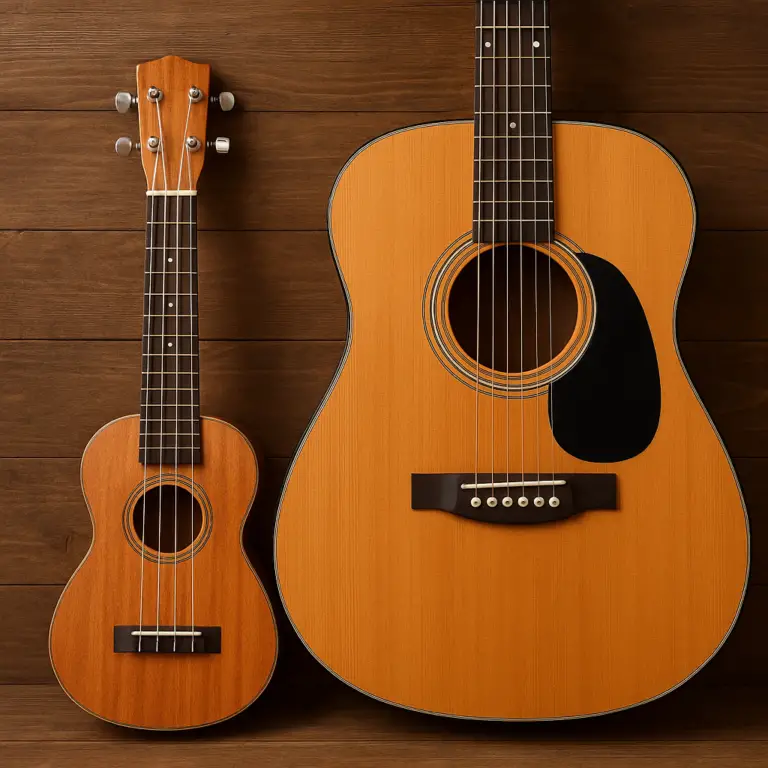
Is a ukulele a small guitar? No—it’s a distinct instrument, with its own tuning, four-string layout, history, and sound. The resemblance is real, but calling it a miniature guitar is a bit like calling a mandolin a pocket violin: there’s family resemblance, not a musical identity crisis.
The difference shows up as soon as you tune up. A standard ukulele usually uses G–C–E–A tuning, while a guitar typically has six strings tuned E–A–D–G–B–E. One Guitar Brands™ musician learned that the hard way by reaching for familiar guitar chord shapes on a ukulele—and getting a chord that sounded decidedly not familiar.
Key Takeaways
- A ukulele is not simply a small guitar. It’s a separate instrument with its own playing traditions and construction.
- Most ukules have four strings; most guitars have six. Their common tunings and chord shapes differ, too.
- Ukulele sizes range from soprano to baritone. Baritone ukules use D–G–B–E tuning, matching the guitar’s highest four strings.
- Some skills transfer. Rhythm, listening, and music theory help on both instruments, but use instrument-specific chord charts.
- Choose by sound and feel: a ukulele offers a compact, bright voice; a guitar generally gives you a wider range and deeper bass notes.
Table of Contents
- ⚡️ Quick Tips and Facts: Is a Ukulele a Small Guitar?
- 🎸 Ukulele vs. Guitar: The Short Answer
- 📜 Ukulele History and Its Hawaiian Roots
- 🎶 What Makes a Ukulele Different from a Guitar?
- Size, Shape, and Number of Strings
- Ukulele Tuning and Guitar Tuning Compared
- Chords, Scales, and Playing Techniques
- Sound and Sonic Character
- 🎼 Ukulele and Guitar Chords: What Transfers?
- 🪕 Ukulele Sizes: Soprano, Concert, Tenor, and Baritone
- 🎤 Famous Ukulele Players and the “Small Guitar” Nickname
- ✅ Is a Ukulele Easier to Learn Than a Guitar?
- 🎯 Which Instrument Should You Choose?
- Choose a Ukulele If…
- Choose a Guitar If…
- 🛒 Buying Your First Ukulele or Guitar
- 🧰 Care, Strings, and Tuning Tips
- Conclusion
- Recommended Links
- FAQ
- Is a ukulele just a tiny guitar?
- Can you play guitar songs on a ukulele?
- Can guitar players learn ukulele easily?
- Is a ukulele a good first instrument?
- Which ukulele size sounds most like a guitar?
- Reference Links
⚡️ Quick Tips and Facts: Is a Ukulele a Small Guitar?
Short answer: no. A ukulele may resemble a small guitar, but it is a distinct instrument with its own history, tuning, string arrangement, sound, and playing traditions. For a direct side-by-side look, see our guide to ukulele vs. guitar.
| Quick fact | Ukulele | Guitar |
|---|---|---|
| Typical string count | 4 | 6 |
| Common standard tuning | G–C–E–A, usually high-G rentrant tuning | E–A–D–G–B–E |
| Common acoustic sizes | Soprano, concert, tenor, baritone | Commonly full-size, plus smaller body and scale options |
| Typical character | Bright, compact, and often buoyant | Broader range, fuller low notes, and greater string range |
| Beginner-friendly? | Often quick to start strumming simple songs | More notes and strings to coordinate, but a huge repertoire |
- ✅ They share a familiar body shape and both can play melodies, chords, and accompaniment.
- ❌ A ukulele is not merely a guitar made smaller. Its standard tuning and four-string layout make it a different instrument.
- 🎶 A baritone ukulele is the largest common ukulele size and uses D–G–B–E tuning, matching the guitar’s highest four strings.
- 🪕 Guitar skills transfer, but guitar chord shapes don’t automatically produce the same chords on a standard ukulele.
For reliable instrument overviews, compare the Smithsonian’s ukulele collection with the Britannica overview of the guitar.
🎸 Ukulele vs. Guitar: The Short Answer
A ukulele is a close musical cousin of the guitar, not a miniature guitar. Both are fretted string instruments, and both can accompany singing or carry a melody. But their strings, tunings, dimensions, and sound are different enough that playing one does not feel exactly like playing the other.
A short version of the distinction:
Guitar: usually six strings, a wider pitch range, and standard tuning of E–A–D–G–B–E.
Ukulele: usually four strings, standard tuning of G–C–E–A, and a smaller scale in most models.
Kala’s guide puts the point plainly: “The ukulele is not a mini guitar.” That’s a useful distinction, though it doesn’t mean the instruments have nothing in common. The Kala article and Uke Like the Pros comparison both describe them as related but distinct instruments.
| If you’re asking… | The practical answer |
|---|---|
| Does a ukulele look like a small guitar? | Often, yes. Their body shapes can be similar. |
| Is it built and played exactly like a guitar? | No. Four strings and different tuning change the instrument’s logic. |
| Can a guitar player learn ukulele? | Absolutely. Rhythm, musical listening, and fretboard concepts transfer. |
| Can you use the same chord diagrams? | Not usually. Use diagrams labeled for the instrument and tuning you’re playing. |
| Is one “better”? | Neither universally. The right choice depends on the sound, repertoire, portability, and feel you want. |
The guitar wins on range and low-end depth; the ukulele wins on compactness and a distinctive, bright voice. But the answer gets more interesting when we look at the ukulele’s family tree.
📜 Ukulele History and Its Hawaiian Roots

The ukulele’s story is not “someone made a guitar smaller.” Its development is tied to Hawaian musical culture and to Portuguese immigrants who brought small, four-string instruments to Hawaiʻi in the late 19th century. The instrument evolved locally into a form associated strongly with Hawaiian music and identity.
The Smithsonian National Museum of American History’s ukulele collection offers historical context and examples of the instrument. The name is commonly translated as “jumping flea,” often linked to the quick movement of a player’s fingers, though accounts of the name’s origin vary.
The ukulele’s relatives
Ukulele history connects it to small Portuguese instruments such as the machete and cavaquinho, rather than describing it as simply a reduced guitar. The relationship is a reminder that instrument families overlap: shared shapes and playing methods don’t make two instruments identical.
| Feature | Historical context |
|---|---|
| Cultural home | Developed in Hawaiʻi and became closely associated with Hawaiian music |
| Influences | Portuguese small-string instruments are commonly cited |
| Modern forms | Soprano, concert, tenor, and baritone ukules are widely played |
| Continuing tradition | Used in traditional styles, pop, folk, jazz, education, and home music-making |
A ukulele can certainly be used to strum a pop song on the porch. It can also carry intricate melody and accompaniment. The sunny stereotype is only one color in its palette.
🎶 What Makes a Ukulele Different from a Guitar?
The differences are easiest to hear and feel when we separate them into construction, tuning, and playing experience. A guitar has more strings and usually a longer scale, while a ukulele’s shorter scale and four-string setup encourage different chord shapes and voicings.
Size, Shape, and Number of Strings
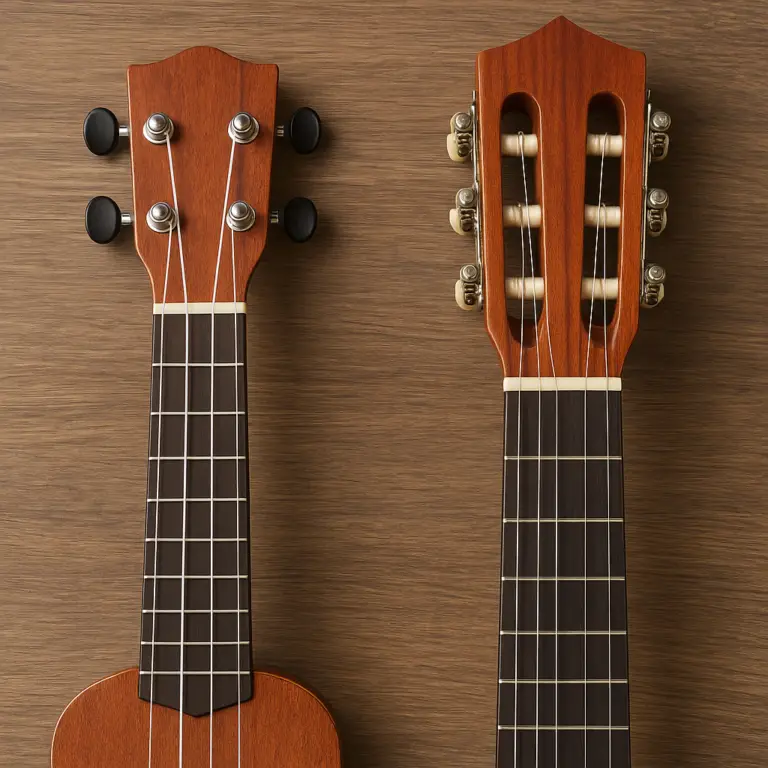
Most ukules have four strings; most guitars have six. Both commonly use a waisted, figure-eight body shape, but body size and scale length vary substantially across each instrument family.
| Instrument or size | Approximate overall length | Typical string count | Notes |
|---|---|---|---|
| Soprano ukulele | About 21 in | 4 | Compact, traditional size |
| Concert ukulele | About 23 in | 4 | Slightly more room than a soprano |
| Tenor ukulele | About 26 in | 4 | Longer scale and often a fuller voice |
| Baritone ukulele | About 30 in | 4 | Largest common size; often tuned D–G–B–E |
| Full-size classical guitar | About 38 in | 6 | Exact dimensions vary by design and maker |
These measurements are approximate: brands and individual models vary, and overall length is not the same as scale length. For a guitar with a shorter body or scale, browse our acoustic guitar guide and guitar buying guide.
Does smaller mean easier?
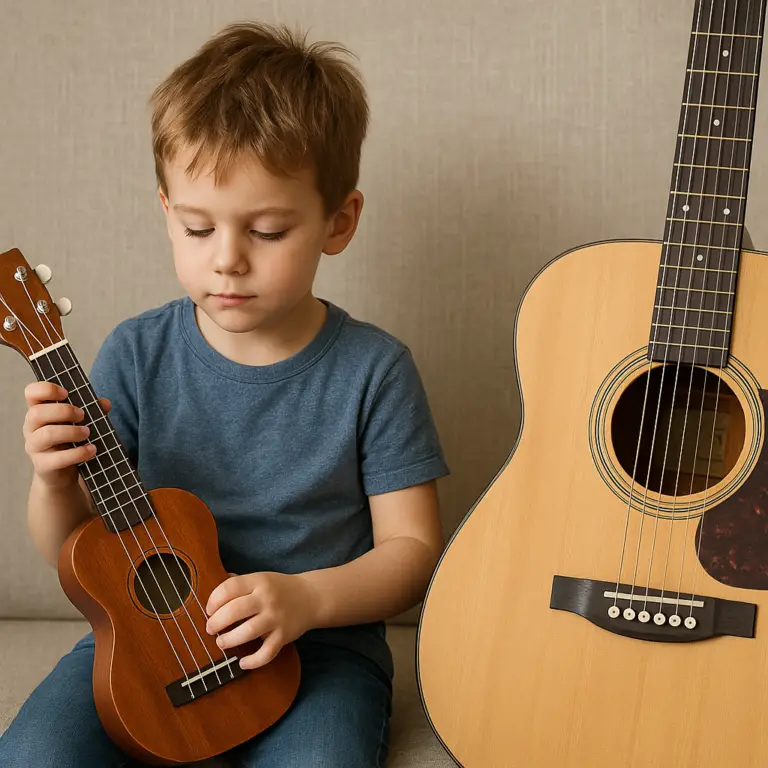
Not automatically. A shorter instrument may be lighter and easier to carry, but its strings and frets are closer together. Some players find ukulele chords easier because there are fewer strings and less stretching; others find the compact fretboard makes clean fretting trickier.
We’ve seen this firsthand: a new player may grab a soprano and love how it fits under the arm, then discover that a concert or tenor gives their fretting hand a little more breathing room. The most comfortable size is the one your hands can play cleanly, not necessarily the smallest one.
Ukulele Tuning and Guitar Tuning Compared
The standard ukulele tuning is G–C–E–A, read from the string closest to your chin to the string closest to the floor. On a common soprano, concert, or tenor setup, the G string is often tuned higher than the C string. That is called rentrant tuning and helps give the ukulele its characteristic bright, compact sound.
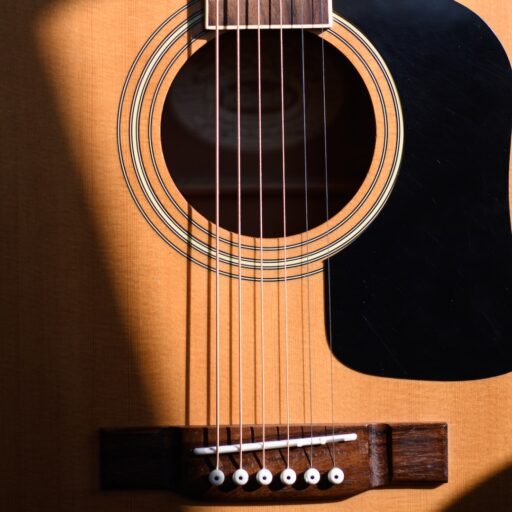
Standard guitar tuning, from lowest string to highest, is E–A–D–G–B–E. The pitch range and string relationships differ, so the same finger placement won’t generally create the same chord on both instruments.
| Instrument | Common tuning, low-to-high string order | Common detail |
|---|---|---|
| Guitar | E–A–D–G–B–E | Six strings; standard tuning spans a broad range |
| Soprano, concert, or tenor ukulele | G–C–E–A | Often high-G rentrant tuning |
| Low-G ukulele | G–C–E–A | G is an octave lower than high-G setup |
| Baritone ukulele | D–G–B–E | Matches the guitar’s highest four strings |
High-G and low-G ukules use the same letter names but differ by an octave on the G string. A low-G setup can offer a more linear low-to-high range and may suit some fingerstyle arrangements. Check the instrument’s setup and string set before buying: not every ukulele is strung for both options.
Chords, Scales, and Playing Techniques
Ukulele and guitar share musical ideas: notes, intervals, scales, rhythm, and chord theory. What changes is where those notes sit under your fingers.
A standard guitar chord diagram assumes six strings in guitar tuning. A standard ukulele chord diagram assumes four strings in ukulele tuning. Even when the chord has the same name, its voicing and finger shape may be different.
What transfers from guitar to ukulele?
- Rhythm and timing: Strumming patterns and groove carry over.
- Ear training: Recognizing chords, melody, and changes is useful on either instrument.
- Fretting fundamentals: Press close behind the fret, avoid unnecessary tension, and let notes ring clearly.
- Music theory: Chord names and scale concepts still apply.
- Chord shapes: Some shapes can be adapted, but don’t assume they produce the same chord.
What should you relearn?
- Tune the instrument correctly. Confirm whether you’re using standard or low-G ukulele tuning.
- Learn ukulele chord diagrams. Make sure the chart is for ukulele, not guitar.
- Check each string individually. Pluck the notes in the chord to find buzzing or muted strings.
- Build familiar progressions. Start with a few chords in the key of C or G, then add a steady strum.
- Listen to the voicing. The same song can feel different because the instruments emphasize different registers.
That final point is easy to miss: the chord name may stay the same while the arrangement changes its color.
Sound and Sonic Character
A ukulele often sounds bright, direct, and lively, especially with high-G tuning. A guitar can produce deeper bass notes and a broader range of chord voicings because it usually has two extra strings and a longer scale. Body size, wood, strings, construction, and playing technique all shape the final tone, so there are exceptions to every broad description.
| Sound quality | Ukulele | Guitar |
|---|---|---|
| Low-end depth | More limited on smaller sizes | Usually broader, especially on larger bodies |
| Attack | Often clear and immediate | Varies widely by body and string type |
| Chord texture | Compact, bright voicings are common | Wider voicings and more bass movement are available |
| Portability | Usually easy to carry | Varies from compact travel guitars to large acoustics |
| Musical identity | Often linked with buoyant strumming, but not limited to it | Used across an exceptionally broad range of styles |
The Kala comparison emphasizes the ukulele’s bright sound and the guitar’s fuller range. That’s a fair generalization, not a rule carved into the soundboard: a tenor ukulele with low-G strings can sound more grounded than a soprano, while guitars vary enormously from small-bodied parlors to deep dreadnoughts.
🎼 Ukulele and Guitar Chords: What Transfers?
Musical knowledge transfers better than finger shapes. If you know that a song uses C, F, and G, you already understand useful harmony. But guitar chord diagrams cannot usually be copied directly onto a standard ukulele, because the instruments have different numbers of strings and different tunings.
A simple example: a ukulele C chord is commonly played by fretting the A string at the third fret while the other strings remain open. A guitar C chord uses a different arrangement across six strings. The chord name is the same; the voicing and fingering are not.
| Skill or material | Transfers between instruments? | What to expect |
|---|---|---|
| Chord names | ✅ Yes | C, G, Am, and other chord names retain their musical meaning |
| Rhythm patterns | ✅ Yes | Strumming and timing concepts carry over |
| Reading chord diagrams | ⚠️ Partly | Learn to identify whether the diagram is for ukulele or guitar |
| Exact chord fingerings | ❌ Usually not | Different tuning and string count change the shapes |
| Scales and note names | ✅ With adaptation | Learn the notes on the new fretboard |
| Song arrangements | ⚠️ Often | You may need a new key, voicing, or fingering |
A practical way to adapt a guitar song
- Find the song’s chord names, not just the guitar tablature.
- Check the song key and vocal range. A ukulele arrangement may need transposing.
- Look up ukulele-specific chord shapes.
- Play the progression slowly, listening for clean notes and smooth chord changes.
- Adjust the strum or picking pattern to suit the ukulele’s range.
If you’re a guitarist, you’re not starting from zero. You’re bringing your musical map to a different landscape.
🪕 Ukulele Sizes: Soprano, Concert, Tenor, and Baritone
Ukules are commonly grouped into soprano, concert, tenor, and baritone sizes. The larger the instrument, the longer the scale generally becomes, giving fingers more space and often producing a fuller sound. Exact dimensions and tonal character vary by model.
| Size | Approximate length | Typical feel | Common tuning |
|---|---|---|---|
| Soprano | About 21 in | Small and compact; classic ukulele feel | G–C–E–A |
| Concert | About 23 in | A little more fretboard room | G–C–E–A |
| Tenor | About 26 in | More room and often a fuller voice | G–C–E–A |
| Baritone | About 30 in | Largest common size; closer to guitar in scale | D–G–B–E |
Which size should you choose?
- Soprano: Consider it if you want the smallest, lightest conventional size and enjoy its bright, compact sound.
- Concert: A useful middle ground if you want portability with a little more room.
- Tenor: A strong pick for players who prefer more fretboard space, fingerstyle work, or a fuller ukulele voice.
- Baritone: Worth trying if guitar-like tuning is appealing or the smaller sizes feel cramped.
Baritone tuning, D–G–B–E, matches the guitar’s top four strings from low to high. That makes note relationships more familiar to guitarists, but the baritone is still a ukulele: it has four strings, a distinct scale, and its own body and voice.
Before choosing, compare the feel in person if possible. We’ve found that a player who struggles to fit fingers between the frets on a soprano may settle happily on a concert or tenor. And if you want the closest ukulele-to-guitar tuning bridge, baritone is the one to audition.
🎤 Famous Ukulele Players and the “Small Guitar” Nickname
People call a ukulele a “small guitar” because the resemblance is obvious at a glance: fretted neck, sound hole, strings, and a compact body. But the nickname is a visual shortcut, not a precise description of the instrument.
The request’s linked Facebook post title asks, “Who says Ukules are ‘small guitars’? Here’s Willie Nelson with his …” The post itself is not publicly readable without access, so we can’t responsibly attribute a claim or quote its contents. You can view the Facebook post here.
That framing still points to a useful idea: musicians can use instruments in unexpected ways, and an artist’s choice of instrument doesn’t erase its musical differences. The ukulele’s sound and tuning remain distinct even when a famous player brings it into a setting where listeners expect a guitar.
For broader instrument and maker coverage, explore our Guitar Brands Showcase and Guitar Brand Guides.
✅ Is a Ukulele Easier to Learn Than a Guitar?
For many beginners, the ukulele is easier to start playing. Four strings, a smaller body, and some accessible chord shapes can help you strum a simple song quickly. That doesn’t mean every aspect is easier, or that a ukulele replaces a guitar if guitar is your goal.
The first video referenced in the article makes a similar practical comparison: it describes the ukulele as portable, easy to hold, and a little easier to get started on with simple chords, while emphasizing the guitar’s fuller sound, range, and large repertoire. See the featured video. Those are useful perspectives, not a universal test result—hands, setup, instrument quality, and practice habits matter.
| Beginner consideration | Ukulele | Guitar |
|---|---|---|
| Getting started | Often quick to learn a few basic chords | More strings and chord shapes to coordinate |
| Finger reach | Shorter scale on most sizes | Longer scale and wider reach on many models |
| Fret spacing | Compact; can feel crowded for some fingers | More room between frets, but wider stretches |
| String feel | Usually softer-feling synthetic strings | Steel strings can feel firm; nylon-string guitars are an alternative |
| Long-term range | Great for accompaniment and melody, with instrument-specific limits | Wider range and extensive styles, arrangements, and repertoire |
A realistic first-week practice plan
- Get the instrument in tune before each session.
- Learn two or three simple chords from a chart for your instrument.
- Practice changing between them slowly, keeping your fretting hand relaxed.
- Add a steady down-strum, then count a simple pulse aloud.
- Play a short song you enjoy rather than drilling shapes without music.
- Stop if your hand hurts. Mild fingertip sensitivity is common; sharp pain or persistent strain is a reason to rest and check your technique.
We’ve watched beginners light up when a two-chord song finally clicks. We’ve also watched players choose guitar because they wanted its bass notes and familiar repertoire. The best starter instrument is the one whose sound makes you pick it up tomorrow.
🎯 Which Instrument Should You Choose?
Choose based on what you want to hear, play, and carry. The ukulele is not a shortcut to guitar, and the guitar is not automatically the more serious choice. They are different tools for making music.
| Your priority | A sensible first choice |
|---|---|
| Lightweight portability | Ukulele |
| Bright four-string accompaniment | Ukulele |
| Guitar-like tuning on a ukulele | Baritone ukulele |
| Deep bass notes and a wider range | Guitar |
| Classic guitar repertoire and styles | Guitar |
| A compact instrument for casual travel | Ukulele or travel guitar |
| Learning guitar specifically | Start with a guitar that fits and feels comfortable |
Choose a Ukulele If…
A ukulele may suit you if you:
- Want a compact, easy-to-carry instrument.
- Like its bright, distinctive sound.
- Want to begin with a small number of chord shapes.
- Prefer to accompany singing with a light, percussive strum.
- Want to explore soprano, concert, tenor, or baritone options.
Brands such as Kala, Lanikai, and Cordoba make ukules in multiple styles and sizes. Try several sizes if you can; a tiny instrument is convenient, but convenience is only one part of comfort.
Choose a Guitar If…
A guitar may suit you if you:
- Want six-string range and fuller low notes.
- Have specific guitar songs, styles, or arrangements you want to learn.
- Want access to acoustic and electric guitar options.
- Prefer the fret spacing or body feel of a guitar.
- Are choosing between instruments mainly because you eventually want to play guitar.
Explore our acoustic guitar buying resources or broader Guitar Buying Guide. Guitar players who also want to branch into bass can browse our bass guitar guide.
🛒 Buying Your First Ukulele or Guitar
A good first instrument should stay in tune, feel comfortable, and make you want to practice. Fancy wood can be lovely, but correct setup and sensible sizing matter more when you’re learning.
What to check before you buy
- Choose your instrument family first. Buy a ukulele because you want ukulele sound and feel—not only because it looks like a small guitar.
- Try the size. Soprano, concert, and tenor feel different in the hands; baritone is worth considering if you want four strings with guitar-like tuning.
- Check tuning stability. Tune the instrument, play for a few minutes, and tune again.
- Inspect the action. Strings set too high can make fretting unnecessarily hard; strings set too low may buzz.
- Play each open string and several fretted notes. Listen for buzzing, dead notes, and uneven volume.
- Ask about setup and return policies. A basic setup can make a major difference in playability.
- Budget for essentials. A reliable tuner, a suitable case, and a spare set of correct strings are practical additions.
Starter models and brand families to compare
- Kala ukules offer a broad selection of soprano, concert, tenor, and baritone instruments.
- Lanikai ukules include options across common sizes and playing styles.
- Cordoba ukules let you compare ukulele designs from a brand also known for guitars.
- For guitars, compare acoustic options through our Acoustic Guitars category.
Shopping links
- Kala Ukules: Amazon | Guitar Center | Sweetwater | Kala Official Website
- Lanikai Ukules: Amazon | Guitar Center | Lanikai Official Website
- Cordoba Ukules: Amazon | Guitar Center | Cordoba Official Website
🧰 Care, Strings, and Tuning Tips
Ukulele or guitar, good care starts with correct strings, stable tuning, and sensible storage. A ukulele string set is not a tiny guitar string set: use strings made for the instrument, scale, and tuning you have.
Step-by-step tuning routine
- Confirm the tuning. Most soprano, concert, and tenor ukules use G–C–E–A; baritones commonly use D–G–B–E.
- Check the tuner setting. A chromatic tuner works well; verify the string names rather than relying on a vague preset.
- Pluck one string at a time. Let the note ring without striking other strings.
- Adjust gradually. Turn the tuning peg a little, then check the pitch again.
- Retune after stretching new strings. Fresh strings may settle as they are played.
- Recheck the whole instrument. Changing one string’s tension can slightly affect the others.
Care checklist
- ✅ Store the instrument in a case when it’s not being played.
- ✅ Avoid leaving it in a hot car or near a heater.
- ✅ Wipe sweat and fingerprints from the strings after playing.
- ✅ Replace strings that sound dull, fray, or won’t hold tuning.
- ❌ Don’t assume guitar strings fit a ukulele. Scale length, material, and tuning requirements differ.
- ❌ Don’t force a tuning peg if it feels stuck; inspect the tuner or ask a repair professional.
The Kala ukulele resources and Cordoba support information are useful starting points for brand-specific care and instrument details. For guitar-specific gear and upkeep, browse our Guitar Brand Guides.