Support our educational content for free when you purchase through links on our site. Learn more
Ukulele Meaning in Bengali: A Little Instrument, Explained 🎸


“Ukulele meaning in Bengali” is ইউকুলেলে—a small, typically four-stringed Hawaiian musical instrument. To explain it clearly, you can say চারটি তারবিশিষ্ট ছোটো হাওয়াইয়ান বাদ্যন্ত্র; it’s related to a guitar, but it isn’t simply a tiny guitar.
The word is sometimes explained as “jumping flea,” a lively origin story often linked to a player’s quick-moving fingers. That phrase is about the word’s possible history—not its Bengali meaning. And if you’ve ever heard a ukulele brighten a room with just a few chords, you’ll understand why the little instrument has such a big personality. 🎶
Key Takeaways
- Bengali meaning: ইউকুলেলে; descriptively, চারটি তারবিশিষ্ট ছোটো হাওয়াইয়ান বাদ্যন্ত্র.
- Bengali spelling: Commonly written ইউকুলেলে or ইউকুলেল.
- Not quite a guitar: A ukulele is a distinct string instrument, usually with four strings and its own common tunings.
- “Jumping flea” is an origin explanation, not the Bengali translation.
- English grammar: Ukulele is a noun; its usual plural is ukules.
Table of Contents
- ⚡️ Quick Tips and Facts: Ukulele Meaning in Bengali
- 🎸 What Does “Ukulele” Mean in Bengali?
- Ukulele বাংলা অর্থ and common Bengali translations
- Is “ইউকুলেলে” a Bengali word or a transliteration?
- 🗣️ Ukulele Pronunciation in English and Bengali
- How to pronounce ukulele syllable by syllable
- Common spelling and pronunciation mistakes
- 📜 Ukulele Meaning, Origin, and History
- Where the word “ukulele” comes from
- How the Hawaiian instrument became known worldwide
- 📖 Ukulele in an English–Bengali Dictionary
- Dictionary definition versus everyday Bengali meaning
- What to check in a reliable Bengali dictionary
- ✍️ Ukulele Meaning and Grammar in English
- Is ukulele a noun? Singular and plural forms
- Articles and common sentence patterns: a ukulele, the ukulele
- Ukulele as a subject, object, and musical instrument
- 💬 Ukulele Examples with Bengali Translation
- Simple English–Bengali sentences using “ukulele”
- Everyday conversation and classroom examples
- How to describe playing or learning the ukulele
- 🎼 Ukulele vs. Guitar: Meaning and Differences
- Size, strings, sound, and tuning
- Choosing the right Bengali word for each instrument
- 🔎 12 Related Musical Instrument Words in Bengali
- 1. Guitar
- 2. Violin
- 3. Piano
- 4. Banjo
- 5. Mandolin
- 6. Drum
- 7. Flute
- 8. String
- 9. Chord
- 10. Melody
- 11. Musician
- 12. Instrument
- 📚 Ukulele Vocabulary by Topic
- Parts of a ukulele and their Bengali names
- Playing techniques and music terms
- Ukulele sizes and common types
- 🧩 Common Phrases and Prepositions with “Ukulele”
- Play the ukulele, learn on a ukulele, and other natural phrases
- Which prepositions work with ukulele?
- 🎭 Ukulele Idioms, Expressions, and Figurative Uses
- Are there common English idioms with “ukulele”?
- Related music expressions and their Bengali meanings
- 🔍 Commonly Searched English-to-Bengali Music Words
- Ukulele, guitar, and instrument vocabulary searches
- How to search for Bengali meanings and pronunciations
- ✅ How to Use “Ukulele” Correctly
- Quick translation tips for Bengali speakers
- Mistakes to avoid in meaning, spelling, and grammar
- 🏁 Conclusion
- 🔗 Recommended Links
- ❓ FAQ
- What is the Bengali meaning of ukulele?
- How do you write ukulele in Bengali?
- Is a ukulele the same as a guitar?
- How do you pronounce ukulele?
- Does “ukulele” have a Bengali synonym?
- 📑 Reference Links
⚡️ Quick Tips and Facts: Ukulele Meaning in Bengali
- Ukulele means ইউকুলেলে in Bengali; a clear descriptive translation is চারটি তারবিশিষ্ট ছোটো হাওয়াইয়ান বাদ্যন্ত্র—a small, usually four-stringed Hawaiian instrument related to the guitar.
- It is most naturally written in Bengali as ইউকুলেলে or ইউকুলেল. These are transliterations, not traditional Bengali instrument names.
- The dictionary-style phrase “ছোটো হাওয়াই গিটার” is useful for explaining the instrument, but a ukulele is not simply a small guitar: its tuning, feel, and sound differ.
- In English, the usual plural is ukules. You may also see ukes informally. One competing dictionary lists ukules, but ukules is the standard form in common English usage.
- Pronunciation varies: both “oo-kuh-LAY-lay” and “you-kuh-LAY-lee” are heard in English. The Hawaiian pronunciation is closer to ʻukulele; local language and accent influence how it is said.
- For more detail, see our ukulele meaning guide and the English–Bengali dictionary entry. 🎶
| Quick fact | Helpful answer |
|---|---|
| Bengali writing | ইউকুলেলে / ইউকুলেল |
| Bengali explanation | চারটি তারবিশিষ্ট ছোটো হাওয়াইয়ান বাদ্যন্ত্র |
| Part of speech | Noun |
| Typical strings | Four |
| Common English plural | Ukules |
| Informal short form | Uke |
🎸 What Does “Ukulele” Mean in Bengali?
The clearest Bengali explanation is চারটি তারবিশিষ্ট ছোটো হাওয়াইয়ান বাদ্যন্ত্র: “a small Hawaiian musical instrument with four strings.” Many dictionaries shorten this to চারটি তারবিশিষ্ট ছোটো হাওয়াই গিটার (“a small four-stringed Hawaiian guitar”), which is easy to understand but not quite the whole story.
A ukulele belongs to the plucked string-instrument family. You play it by strumming or picking its strings, much as you might a guitar, but it has its own construction, tuning, and characteristic bright tone. The Smithsonian’s National Museum of American History documents ukules as distinct instruments, while the Encyclopaedia Britannica overview describes the instrument and its Hawaiian association.
Ukulele বাংলা অর্থ and common Bengali translations
| Bengali wording | Meaning or use | How helpful is it? |
|---|---|---|
| ইউকুলেলে | Bengali-script rendering of “ukulele” | Best for naming the instrument |
| ইউকুলেল | A shorter transliteration found in some Bengali dictionary entries | Understandable variant |
| চারটি তারবিশিষ্ট ছোটো হাওয়াই গিটার | Small Hawaiian guitar with four strings | Handy dictionary-style description |
| চার-তারের ছোট হাওয়াইয়ান বাদ্যন্ত্র | Small four-string Hawaiian instrument | Clear, neutral explanation |
| ছোট চার-তারের তারবাদ্য | Small four-stringed string instrument | Useful when explaining its musical family |
The wording “চারটি তারবিশিষ্ট ছোটো হাওয়াই গিটার” appears in entries from English-Bangla.com and eDictionaryBD. It works well as a compact gloss. For accuracy, though, we prefer “ছোট হাওয়াইয়ান তারবাদ্য” when explaining the instrument to someone who might otherwise mistake it for a miniature guitar.
Is “ইউকুলেলে” a Bengali word or a transliteration?
ইউকুলেলে is a Bengali-script spelling of a borrowed name. It represents the English word ukulele using Bengali letters; it is not a native Bengali word formed from Bengali roots.
That is common with instrument names. Bengali speakers may say গিটার, ভায়োলিন, or পিয়ানো rather than inventing a separate traditional term. When a word names a specific instrument that has no widely established Bengali equivalent, transliteration is often the clearest choice.
🗣️ Ukulele Pronunciation in English and Bengali
In Bengali, you can approximate the name as ইউ-কু-লে-লে. In English, pronunciation varies by region and speaker: you may hear “oo-kuh-LAY-lay” or “you-kuh-LAY-lee.” For the Hawaiian language, the initial mark in ʻukulele represents a glottal stop, a brief catch in the voice; see the University of Hawaiʻi’s ʻokina pronunciation guide.
How to pronounce ukulele syllable by syllable
Try this relaxed four-beat practice:
- Say ইউ (“you”).
- Add কু (“koo”).
- Say লে (“leh” or “lay,” depending on your accent).
- Repeat the final লে.
- Join the sounds smoothly: ইউ-কু-লে-লে.
The emphasis often falls near the third syllable in English pronunciations, but there is no need to turn the word into a tongue-twister contest. If you’re learning the instrument alongside the name, this beginer-friendly Bengali ukulele video offers basic guidance on choosing a ukulele and getting started.
Common spelling and pronunciation mistakes
- Don’t confuse spelling with meaning: ইউকুলেলে names the instrument; it does not translate its literal word history.
- Don’t assume there is only one English pronunciation. Accents differ.
- Avoid calling every ukulele a “guitar.” That shorthand can help a beginner picture it, but the instruments are not interchangeable.
- Use “ukules” as the regular plural. Although English-Bangla.com’s entry lists ukules, standard English usage overwhelmingly favors ukules; the Cambridge Dictionary is a useful pronunciation and usage reference.
📜 Ukulele Meaning, Origin, and History

The word ukulele is associated with Hawaiʻi and a small string instrument that developed there in the late 19th century. Its story connects Hawaiian music with Portuguese instruments and migration—one reason the instrument’s name and history can’t be reduced to “little guitar.”
Where the word “ukulele” comes from
A popular interpretation translates ukulele as “jumping flea.” One explanation connects uku (“flea”) and lele (“jumping” or “leaping”) with the quick movement of a player’s fingers. Another account attributes the nickname to a person whose energetic playing reminded observers of a jumping flea.
The competing sources do not tell this story in exactly the same way. Treat “jumping flea” as a popular explanation, not a certain word-for-word translation with one proven origin story. Hawaiian word meanings, historical accounts, and later retellings can be blended together in casual explanations. For context on Hawaiian language and history, consult the University of Hawaiʻi’s Hawaian-language resources and Britannica’s ukulele history overview.
Some online dictionary summaries also give the phrase “the gift that came here.” That is another interpretation you may encounter, but it should not be presented as the instrument’s Bengali meaning or as a universally agreed etymology. When answering “ukulele meaning in Bengali,” define the instrument first; discuss the debated origin separately.
How the Hawaiian instrument became known worldwide
The ukulele became closely associated with Hawaiian music and culture, then gained audiences beyond Hawaiʻi. Its compact size, four strings, and approachable chord shapes helped it find a place in homes, classrooms, ensembles, and popular music.
The instrument is also more varied than its cheerful reputation suggests. A soprano uke can sound bright and compact, while larger concert and tenor models offer more room for the fretting hand and a fuller voice. We’ve seen players start with a small soprano, love its portability, then switch to a concert because their fingers wanted a little more elbow room. The instrument stays the same family; the playing experience changes.
📖 Ukulele in an English–Bengali Dictionary
Dictionary entries are useful for a fast translation, but they often compress several ideas into a few words. Compare the definition, spelling, part of speech, and examples before deciding which Bengali wording fits your sentence.
Dictionary definition versus everyday Bengali meaning
Two English–Bengali references give a similar core definition:
- English-Bangla.com describes it as “চারটি তারবিশিষ্ট ছোটো হাওয়াই গিটার”—a small Hawaiian guitar with four strings.
- eDictionaryBD gives “চারটি তারবিশিষ্ট ছোটো হাওয়াই গিটার.”
- Uptoword’s Bengali entry also describes a small four-string Hawaiian instrument and includes the alternate literal interpretation “the gift that came here.”
The dictionary descriptions agree on the instrument’s small size, four strings, and Hawaiian association. Their differences are mostly about how much they explain. For an everyday conversation, ইউকুলেলে is enough if your listener knows the instrument. For a translation exercise or first introduction, add a short explanation: চারটি তারবিশিষ্ট ছোটো হাওয়াইয়ান বাদ্যন্ত্র.
What to check in a reliable Bengali dictionary
When comparing a dictionary entry, check:
- Part of speech: ukulele is a noun.
- Bengali spelling: Is it a transliteration, a description, or both?
- Definition: Does it identify the instrument clearly?
- Example sentence: Does the Bengali sentence sound natural?
- Plural and pronunciation: Are these supplied, and do they match reliable English references?
- Origin claims: Are etymologies presented as disputed interpretations or as unquestionable facts?
A concise bilingual entry can be right about the basic meaning while leaving out useful context. That’s why we compare dictionary definitions with instrument references such as Britannica and collection records from the Smithsonian National Museum of American History.
✍️ Ukulele Meaning and Grammar in English
Is ukulele a noun? Singular and plural forms
Ukulele is a countable noun. You can say a ukulele, one ukulele, or three ukules.
| Form | Example |
|---|---|
| Singular | a ukulele |
| Plural | ukules |
| Informal short form | uke / ukes |
| Bengali-script rendering | ইউকুলেলে |
A competing entry lists ukules as a plural, but learners should use ukules in standard writing. The Cambridge Dictionary’s ukulele entry provides a dependable model for spelling and pronunciation.
Articles and common sentence patterns: a ukulele, the ukulele
Use a when introducing one ukulele for the first time:
- I bought a ukulele. — আমি একটি ইউকুলেলে কিনেছি।
- She is learning to play a ukulele. — সে ইউকুলেলে বাজানো শিখছে।
Use the when the instrument is already known or when speaking about the instrument as a category:
- The ukulele is smaller than most guitars. — ইউকুলেলে বেশিরভাগ গিটারের চেয়ে ছোট।
- He put the ukulele on the table. — সে ইউকুলেলেটি টেবিলের ওপর রাখল।
In natural Bengali, articles such as a and the do not always need a direct one-word equivalent. Context, classifiers such as একটি, and sentence structure carry the meaning.
Ukulele as a subject, object, and musical instrument
- Subject: The ukulele sounds bright. — ইউকুলেলের সুর উজ্জ্বল শোনায়।
- Object: I play the ukulele. — আমি ইউকুলেলে বাজাই।
- After a preposition: She sat with her ukulele. — সে তার ইউকুলেলে নিয়ে বসেছিল।
- As a modifier: ukulele lesson — ইউকুলেলে শেখার পাঠ।
In standard English, people commonly say play the ukulele when referring to playing the instrument generally. Play a ukulele can refer to a particular instrument or introduce one in context.
💬 Ukulele Examples with Bengali Translation
Examples make a dictionary meaning useful. Notice that Bengali translations often keep ইউকুলেলে as the instrument’s name, then use Bengali grammar around it.
Simple English–Bengali sentences using “ukulele”
| English sentence | Bengali translation |
|---|---|
| She plays the ukulele. | সে ইউকুলেলে বাজায়। |
| He bought a small ukulele. | সে একটি ছোট ইউকুলেলে কিনেছে। |
| The ukulele has four strings. | ইউকুলেলেতে চারটি তার আছে। |
| My sister is learning the ukulele. | আমার বোন ইউকুলেলে বাজানো শিখছে। |
| They played a song on the ukulele. | তারা ইউকুলেলেতে একটি গান বাজিয়েছিল। |
| This ukulele sounds bright. | এই ইউকুলেলের সুর উজ্জ্বল। |
Everyday conversation and classroom examples
- Do you play the ukulele? — তুমি কি ইউকুলেলে বাজাও?
- Yes, I’m learning a few chords. — হ্যাঁ, আমি কয়েকটি কর্ড শিখছি।
- What instrument is that? — ওটা কী বাদ্যন্ত্র?
- It’s a ukulele, a small four-string instrument. — এটা ইউকুলেলে, ছোট চার-তারের একটি বাদ্যন্ত্র।
- Can you bring your ukulele tomorrow? — তুমি কি কাল তোমার ইউকুলেলে আনতে পারবে?
The English-Bangla.com dictionary example gives a similar sentence: “She learned to play a simple melody on her ukulele.” Its Bengali translation is “সে তার ইউকুলেলেতে একটি সহজ সুর বাজাতে শিখেছিল।”
How to describe playing or learning the ukulele
Useful expressions include:
- play the ukulele — ইউকুলেলে বাজানো
- strum a ukulele — ইউকুলেলের তারে ঝংকার তোলা
- learn ukulele chords — ইউকুলেলের কর্ড শেখা
- tune a ukulele — ইউকুলেলে সুরে বাঁধা
- a ukulele player — ইউকুলেলে বাদক
- a ukulele lesson — ইউকুলেলে শেখার পাঠ
A little language note from our music-room experience: learners sometimes say “I am playing ukulele” without an article. In casual speech you’ll hear it, but “I’m learning to play the ukulele” is the safer, more standard phrasing.
🎼 Ukulele vs. Guitar: Meaning and Differences
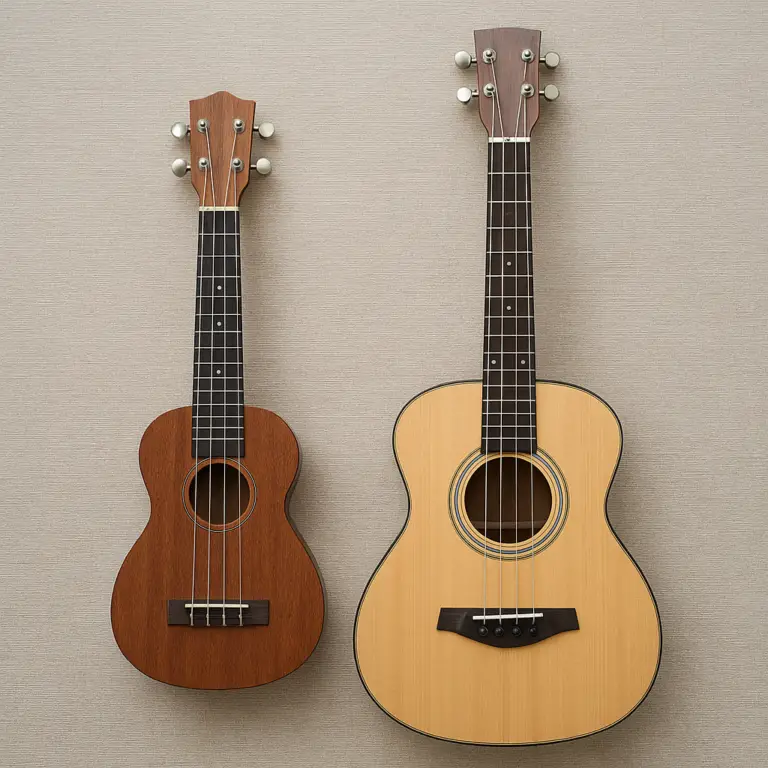
Calling a ukulele a “small guitar” is a handy first approximation, not a complete definition. The distinction matters both when translating the word and when choosing an instrument.
| Feature | Ukulele | Guitar |
|---|---|---|
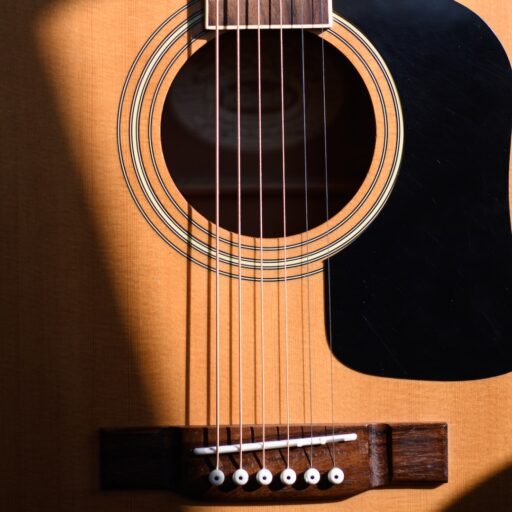
| Typical strings | Four | Usually six for a standard guitar |
| Scale and body | Smaller overall, with several size options | Typically larger, with a longer scale |
| Common tuning | Often G–C–E–A, though variations exist | Standard guitar tuning commonly E–A–D–G–B–E |
| Sound | Bright, light, and compact | Broader range and more low-end depth |
| Beginner feel | Compact chord shapes; smaller body | More room between strings, but wider stretches can be needed |
| Bengali explanation | ছোট চার-তারের হাওয়াইয়ান বাদ্যন্ত্র | সাধারণত ছয়-তারের গিটার |
These are typical descriptions, not rules for every instrument. Alternate tunings and unusual models exist. For more guitar-focused comparisons and buying guidance, browse our Acoustic Guitars and Guitar Buying Guide sections.
Size, strings, sound, and tuning
A standard ukulele is typically strung with four strings. Many common models use G–C–E–A tuning, though the exact string setup can vary. A standard six-string guitar has a broader range and different tuning. The Kala ukulele guide explains common ukulele tuning, while Fender’s guitar resources cover guitar fundamentals.
What this means for your hands: a ukulele can feel comfortable to carry and quick to strum, but its close string spacing may take some adjustment. A guitar may offer a familiar sound and wider repertoire, yet its larger body and chord stretches can feel like a bigger first climb.
Choosing the right Bengali word for each instrument
- Use ইউকুলেলে for a ukulele.
- Use গিটার for a guitar.
- Use ছোটো হাওয়াই গিটার only as an explanatory dictionary-style description.
- Avoid treating হাওয়াই গিটার as a perfect one-to-one synonym in every context, because readers may interpret it as a guitar rather than a distinct ukulele.
The English–Bengali dictionary entry is concise and useful, but in a detailed explanation we’d keep the instrument’s name and clarify its four-string construction.
🔎 12 Related Musical Instrument Words in Bengali
These nearby words help you describe the ukulele, compare it with other instruments, or follow a music lesson in English and Bengali.
| English word | Bengali meaning or common rendering | Connection |
|---|---|---|
| Guitar | গিটার | Related plucked string instrument |
| Violin | বেহালা / ভায়োলিন | Bowed string instrument |
| Piano | পিয়ানো | Keyboard instrument |
| Banjo | ব্যাঞ্জো | Plucked string instrument |
| Mandolin | ম্যান্ডোলিন | Plucked string instrument |
| Drum | ঢোল / ড্রাম | Percussion instrument |
| Flute | বাঁশি / ফ্লুট | Wind instrument |
| String | তার | Part of a string instrument |
| Chord | কর্ড / স্বরসমষ্টি | Several notes played together |
| Melody | সুর | A sequence of musical notes |
| Musician | সংগীতশিল্পী / বাদ্যকর | Person who makes or performs music |
| Instrument | বাদ্যন্ত্র | General word for a musical device |
1. Guitar
Guitar — গিটার. A guitar is a stringed instrument, commonly with six strings. It is related to the ukulele in how it is played, but it is a separate instrument. See the Fender guitar learning resources for beginner terminology.
2. Violin
Violin — বেহালা / ভায়োলিন. The violin usually produces sound when a bow moves across its strings. Unlike the ukulele, it is not generally played by strumming.
3. Piano
Piano — পিয়ানো. A piano uses keys to activate internal hammers that strike strings. It is a helpful contrast when sorting instruments by how they produce sound.
4. Banjo
Banjo — ব্যাঞ্জো. A banjo is a plucked instrument known for its distinctive construction and bright tone. Its exact design varies by type.
5. Mandolin
Mandolin — ম্যান্ডোলিন. A small plucked string instrument, often with paired strings. It is related to the ukulele in playing technique, but not the same instrument.
6. Drum
Drum — ঢোল / ড্রাম. A drum is a percussion instrument. ঢোল can refer to traditional Bengali drums, while ড্রাম is often used for modern drum-kit pieces or the general English loanword.
7. Flute
Flute — বাঁশি / ফ্লুট. A flute is a wind instrument. বাঁশি is a familiar Bengali word for a flute, particularly a bamboo flute.
8. String
String — তার. A ukulele’s strings are plucked or strummed to create sound. The word also appears in phrases such as string instrument — তারবাদ্য.
9. Chord
Chord — কর্ড / স্বরসমষ্টি. A chord is a group of notes sounded together. Beginners often learn a few basic ukulele chords before strumming a full song.
10. Melody
Melody — সুর. A melody is a sequence of notes that listeners recognize as the tune. The dictionary example about learning a simple melody on a ukulele illustrates the word naturally.
11. Musician
Musician — সংগীতশিল্পী / বাদ্যকর. Use সংগীতশিল্পী for a broad, natural translation. বাদ্যকর more specifically suggests someone who plays an instrument.
12. Instrument
Instrument — বাদ্যন্ত্র. This is the general Bengali word for a musical instrument. It gives the most accurate category when you want to explain a ukulele without calling it a guitar.
📚 Ukulele Vocabulary by Topic
Parts of a ukulele and their Bengali names
| English part | Bengali meaning |
|---|---|
| Body | দেহ / বডি |
| Neck | গলা / নেক |
| Headstock | হেডস্টক |
| Tuning pegs | সুর মেলানোর পেগ |
| Strings | তার |
| Fret | ফ্রেট |
| Fretboard | ফ্রেটবোর্ড |
| Bridge | ব্রিজ |
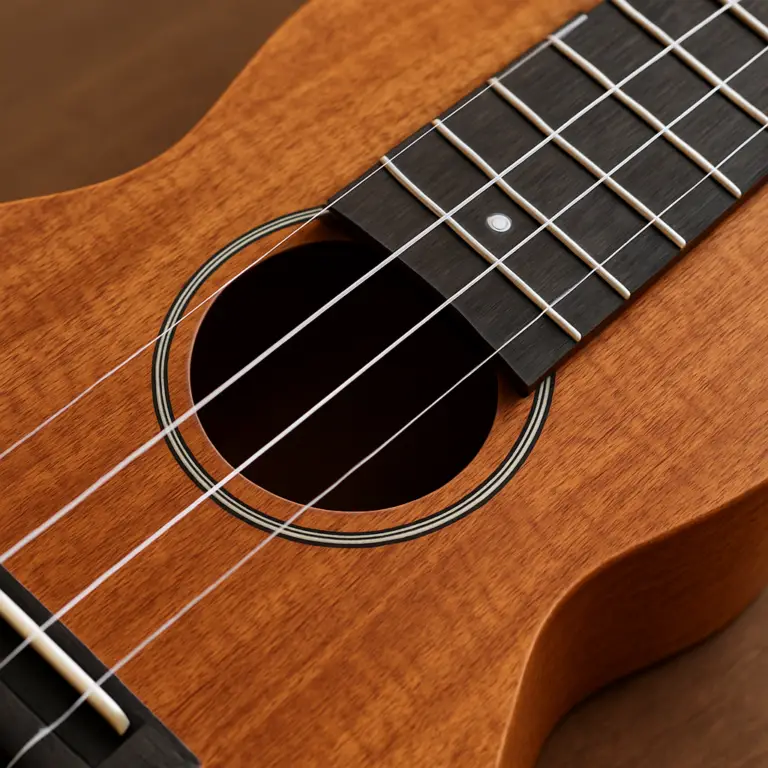
| Sound hole | শব্দের ছিদ্র / সাউন্ড হোল |
Not every player needs to memorize the parts on day one. But if someone says “the string is buzzing near the bridge,” knowing the vocabulary makes the conversation much less mysterious. Manufacturers such as Kala and Fender show instrument features and care guidance on their official sites.
Playing techniques and music terms
| English term | Bengali explanation |
|---|---|
| Strumming | তারে ছন্দময় ঝংকার তোলা |
| Picking | আলাদা আলাদা তারে নোট বাজানো |
| Tuning | সুর মেলানো |
| Chord | একসঙ্গে বাজানো কয়েকটি স্বর |
| Rhythm | তাল |
| Melody | সুর |
| Practice | অনুশীলন |
| Performance | পরিবেশনা |
The beginner’s path often goes like this: hold the instrument → tune it → learn a simple chord → change between chords → strum in time. A cheerful little instrument still asks for regular practice; the ukulele is friendly, not psychic. 🎵
Ukulele sizes and common types
| Type | General description | What players often notice |
|---|---|---|
| Soprano | Small, classic size | Compact feel and bright sound |
| Concert | Slightly larger | A bit more room for the fretting hand |
| Tenor | Larger body and scale | Fuller sound and more fretboard space |
| Baritone | Largest common size | Deper sound; often uses different tuning |
These are general categories, and details vary by maker and model. The Kala guide to ukulele sizes offers a useful overview. If you’re shopping, compare comfort, tuning stability, construction, and setup rather than choosing by size name alone. Our Guitar Brand Guides and Guitar Brands Showcase offer more instrument-brand context.
🧩 Common Phrases and Prepositions with “Ukulele”
Play the ukulele, learn on a ukulele, and other natural phrases
| English phrase | Bengali meaning |
|---|---|
| play the ukulele | ইউকুলেলে বাজানো |
| strum a ukulele | ইউকুলেলের তারে ঝংকার তোলা |
| learn to play the ukulele | ইউকুলেলে বাজানো শেখা |
| a song on the ukulele | ইউকুলেলেতে একটি গান |
| a ukulele player | ইউকুলেলে বাদক |
| tune the ukulele | ইউকুলেলে সুরে বাঁধা |
| ukulele music | ইউকুলেলের সংগীত |
Which prepositions work with ukulele?
- Play the ukulele: the usual phrase for playing the instrument.
- Play a song on the ukulele: on identifies the instrument used.
- Sit with a ukulele: with describes having or carrying the instrument.
- Learn from a ukulele teacher: from introduces the teacher.
- Practice on a ukulele: on is natural when focusing on the instrument used for practice.
Examples:
- She played the melody on her ukulele. — সে তার ইউকুলেলেতে সুরটি বাজিয়েছিল।
- He practices on a concert ukulele. — সে কনসার্ট সাইজের ইউকুলেলেতে অনুশীলন করে।
- I’m learning to play the ukulele. — আমি ইউকুলেলে বাজানো শিখছি।
🎭 Ukulele Idioms, Expressions, and Figurative Uses
Are there common English idioms with “ukulele”?
There are no widely established everyday English idioms built specifically around the word “ukulele.” It usually appears literally, as the name of an instrument. That’s worth saying plainly: a dictionary page’s “idioms” heading does not mean every listed instrument has a famous idiom attached to it.
Related music expressions and their Bengali meanings
These common music expressions are more useful:
- Strike a chord — মনের সঙ্গে মিলে যাওয়া / আবেগে সাড়া জাগানো
- Play by ear — শুনে শুনে বাজানো
- Keep the beat — তাল ধরে রাখা
- Out of tune — সুরের বাইরে
- In harmony — সুরের মিল রেখে
They are related to music generally, not special ukulele idioms. For example, “the song struck a chord with me” is figurative; it does not mean someone literally hit a ukulele chord.
🔍 Commonly Searched English-to-Bengali Music Words
People searching “ukulele meaning in Bengali” may also be looking for pronunciation, spelling, a sentence example, or the difference between a ukulele and a guitar. A useful answer covers all four instead of handing you one unexplained transliteration.
Ukulele, guitar, and instrument vocabulary searches
| Search phrase | Quick answer |
|---|---|
| ukulele meaning in Bengali | ইউকুলেলে; a small four-string Hawaiian instrument |
| ukulele বাংলা অর্থ | ছোট চার-তারের হাওয়াইয়ান বাদ্যন্ত্র |
| ukulele Bengali spelling | ইউকুলেলে / ইউকুলেল |
| ukulele pronunciation in Bengali | ইউ-কু-লে-লে |
| guitar meaning in Bengali | গিটার |
| musical instrument meaning in Bengali | বাদ্যন্ত্র |
| ukulele plural | ukules |
| play the ukulele meaning | ইউকুলেলে বাজানো |
How to search for Bengali meanings and pronunciations
For a fuller result, search the word plus the type of help you need:
- Meaning: “ukulele meaning in Bengali”
- Bengali spelling: “ukulele Bengali spelling”
- Pronunciation: “ukulele pronunciation”
- Usage: “play the ukulele sentence Bengali”
- Comparison: “ukulele vs guitar strings and tuning”
Then compare at least one bilingual dictionary with a reliable English or music reference. This helps separate the instrument’s meaning from its popular etymology.
✅ How to Use “Ukulele” Correctly
Quick translation tips for Bengali speakers
- Name it: Write ইউকুলেলে when you mean the instrument.
- Explain it: Add চারটি তারবিশিষ্ট ছোটো হাওয়াইয়ান বাদ্যন্ত্র if readers may not know the name.
- Keep guitar and ukulele distinct: They are related instruments, not alternate names for the same instrument.
- Translate the sentence naturally: English articles such as a and the may not need separate Bengali words.
- Separate meaning from etymology: “Jumping flea” is a popular origin explanation, not the Bengali definition.
- Use the standard plural: Write ukules in ordinary English.
Mistakes to avoid in meaning, spelling, and grammar
- ❌ “Ukulele means guitar.”
✅ It means a distinct, usually four-stringed instrument related to the guitar. - ❌ “Jumping flea is the Bengali translation.”
✅ It is a popular explanation of the word’s origin; the Bengali instrument meaning is ইউকুলেলে or a descriptive phrase. - ❌ “Ukules” is the safest plural.
✅ Use ukules in standard English. - ❌ “Hawaian guitar” explains every detail.
✅ It is a useful shorthand, but হাওয়াইয়ান তারবাদ্য avoids implying that it is simply a guitar. - ❌ Assuming every ukulele has identical tuning or sound.
✅ Tuning and tone can vary by size, model, string setup, and playing style.
The key question that often remains is why dictionaries use “small Hawaiian guitar” when musicians insist a ukulele is its own instrument. The short answer: the phrase is an accessible description, not a claim that both instruments are identical. We’ll keep that distinction in view when summarizing the meaning.