Support our educational content for free when you purchase through links on our site. Learn more
What Does the Ukulele Symbolise? 🌺


What does the ukulele symbolise? Most often, it represents joy, creativity, community, and Hawaiian musical heritage—but its meaning changes with the music, player, and setting. It’s more than a cheerful little sound: the ukulele’s story connects Portuguese instrument-making with the musical culture that took root in Hawaiʻi.
We’ve watched a simple ukulele strum turn a room of hesitant beginners into a group singing together. That easygoing image is part of its charm, but it’s only one note in the story: the ukulele can also express individuality, nostalgia, and serious musical skill.
Key Takeaways
- The ukulele often symbolises joy, optimism, creativity, and connection.
- Its Hawaiian identity comes from a history of cultural exchange and local musical tradition.
- Popular culture often casts it as playful or carefree, but the instrument can express a wide range of moods and styles.
- Its meaning depends on context: who plays it, what they play, and the cultural story behind the music.
Table of Contents
- ⚡️ Quick Tips and Facts: What Does the Ukulele Symbolise?
- 🌺 The Ukulele’s Hawaiian Roots and History
- From Portuguese Braguinha to Hawaiian ʻUkulele
- What Does the Word “ʻUkulele” Mean?
- 🎶 The Ukulele’s Core Symbolism
- Joy, Optimism, and Lightheartedness
- Aloha, Welcome, and Hawaiian Identity
- Community, Connection, and Making Music Together
- Simplicity, Creativity, and Accessible Music
- Nostalgia, Childhood, and Playfulness
- 🌊 The Ukulele in Hawaiian Music and Culture
- Its Place in Traditional and Contemporary Hawaiian Music
- Cultural Meaning, Respect, and Common Misconceptions
- 🎬 The Ukulele in Popular Culture
- The Ukulele in Movies, Television, and Advertising
- How Pop, Folk, and Internet Music Shaped Its Image
- 💛 What the Ukulele Can Symbolise in Different Contexts
- Ukules in Art, Literature, and Visual Design
- The Ukulele as a Gift or Personal Keepsake
- What a Ukulele in a Dream Might Represent
- 🪕 Why People Choose to Learn the Ukulele
- A Friendly First Instrument
- A Way to Build Confidence and Share Music
- 🎼 Ukulele Types, Sounds, and What They Suggest
- Soprano, Concert, Tenor, and Baritone Ukules
- How Tonewoods, Tuning, and Playing Style Affect the Mood
- 🌴 Ukulele Festivals and Community Gatherings
- Hawaian Ukulele Events and Cultural Celebrations
- How to Join a Ukulele Group or Festival
- ✨ How to Honor the Ukulele’s Meaning
- Play Hawaiian Music with Cultural Awareness
- Choose, Care for, and Share an Instrument Thoughtfully
- 🧭 Conclusion
- 🔗 Recommended Links
- ❓ FAQ
- Does the ukulele symbolise happiness?
- Is the ukulele a symbol of Hawaii?
- What does “ukulele” literally mean?
- Why is the ukulele associated with the beach and aloha?
- Does the ukulele have spiritual or healing symbolism?
- What does a ukulele represent as a gift?
- 📚 Reference Links
⚡️ Quick Tips and Facts: What Does the Ukulele Symbolise?
The ukulele can symbolise joy, creativity, connection, and Hawaiian musical heritage—but its meaning depends on who is playing it and where. It isn’t a single fixed emblem: the same four strings might suggest a carefree beach scene in a film, personal self-expression in a school hallway, or a living musical tradition in Hawaiʻi.
For a deeper look at the word and its interpretations, see our guide to ukulele meaning.
| Common association | What the ukulele may represent | Helpful context |
|---|---|---|
| 🌺 Hawaiʻi | Hawaiian identity, musical heritage, and the spirit of aloha | Its history in Hawaiʻi is central, though the instrument’s immediate ancestors came from Portugal. |
| 😊 Cheerfulness | Joy, optimism, and a lighthearted mood | A familiar association, not the only emotion the instrument can express. |
| 🤝 Community | Shared music, welcome, and connection | Group playing is approachable, but the instrument can also be a deeply personal companion. |
| 🎨 Creativity | Individual expression and experimentation | The ukulele appears across pop, folk, jazz, and other styles. |
| 🧸 Nostalgia | Childhood, playfulness, and simpler times | Films and advertising often lean on this image, sometimes as a stereotype. |
A useful first distinction: symbolism is not the same as origin. The instrument is strongly associated with Hawaiʻi, but the story of how it arrived and became part of Hawaiian music is more layered. We’ll get to that shortly—and it also explains why “tropical relaxation” is only part of the picture.
If you’re comparing instruments as well as meanings, our Guitar Buying Guide and Acoustic Guitars guides offer useful context for how a small four-string instrument differs from a guitar.
🌺 The Ukulele’s Hawaiian Roots and History

From Portuguese Braguinha to Hawaiian ʻUkulele
The ukulele’s story is a story of cultural exchange. Portuguese immigrants brought small, four-string instruments related to the braguinha, also known as the machete de braga, to Hawaiʻi in the late 19th century. Hawaiian musicians and makers made the instrument their own, shaping its sound and place in local music.
The Smithsonian National Museum of American History documents ukulele instruments in its collections, while the Bishop Museum preserves and interprets Hawaiʻi’s cultural history. These sources help anchor the story in more than the familiar souvenir-shop version.
King David Kalākaua, who reigned from 1874 to 1891, supported Hawaiian arts and music. The ukulele gained prominence during his era, including in performances at royal gatherings. The Smithsonian’s overview of the ukulele describes its development and growing popularity in Hawaiʻi.
That history gives the instrument a richer meaning than “a little guitar from the islands.” The ukulele reflects adaptation: a musical idea that crossed oceans, then became part of a distinct Hawaiian sound and cultural history. That does not make its origins exclusively Hawaiian; it does make its Hawaiian identity real and significant.
What Does the Word “ʻUkulele” Mean?
The Hawaiian word ʻukulele is often translated as “jumping flea.” One popular explanation connects the name to the quick movement of a player’s fingers across the strings. It’s a memorable image, but explanations of the word’s origin vary.
The Hawaian language resource Ulukau and the Hawaian Dictionary by Mary Kawena Pukui and Samuel H. Elbert are better places to check Hawaiian-language meanings than a catchy internet anecdote. Treat “jumping flea” as a commonly repeated interpretation, not a settled explanation of the instrument’s entire history.
A name can be fun without being the whole story. In this case, the lively sound and fast-moving fingers fit the nickname—but the instrument’s cultural significance comes from its history, use, and the people who play it, not from the translation alone.
🎶 The Ukulele’s Core Symbolism
Joy, Optimism, and Lightheartedness
The ukulele’s bright, compact sound is often used to suggest happiness, playfulness, and optimism. Writers and film-makers may reach for it when they want a scene to feel warm, whimsical, or carefree. The music- and screen-focused overview from Music Rooms describes the instrument as an emblem of “joy, nostalgia, and a sense of whimsy.”
That’s a useful description of a popular association, not a rule about what the instrument must mean. A ukulele can accompany a tender ballad, a bluesy arrangement, or a melancholy song just as readily as a sunny singalong. Sound shapes expectations; the player shapes the meaning.
Aloha, Welcome, and Hawaiian Identity
In Hawaiʻi, the ukulele can evoke musical heritage and a sense of place. A K. C. Hawaii cultural overview calls it “a representation of the heart and soul of Hawaii.” That phrase captures a common sentiment, while the instrument’s history shows why it carries meaning beyond a cheerful tourist image.
The word aloha has rich meanings and uses in Hawaiian language and culture. It should not be reduced to “hello,” a beach slogan, or a ukulele sound effect. The University of Hawaiʻi at Mānoa’s Hawaiian language resources offer a starting point for learning about Hawaiian language with greater care.
The ukulele may symbolize aloha when it is used to welcome people, share music, and foster connection—but no instrument can stand in for an entire culture. That distinction lets us celebrate its place in Hawaiʻi without flattening Hawaiian identity into palm trees and postcards.
Community, Connection, and Making Music Together
A ukulele circle can turn a roomful of strangers into a roomful of people trying to find the same chord. That’s part of the instrument’s appeal: it is portable, relatively approachable, and easy to bring into a group setting.
We’ve seen new players relax when everyone is strumming the same simple progression. Nobody has to be a virtuoso for the music to work; the shared rhythm is often the point. This makes the ukulele a natural symbol of belonging, collaboration, and welcome.
That meaning also appears in fiction. In Stargirl, the ukulele is associated with the character’s individual expression and joyful willingness to connect with others. GradeSaver’s study guide describes it as a vehicle for freedom of expression and a way of bringing colour to a world that feels black and white. It’s a literary interpretation, but it illustrates how the instrument can signify both being yourself and reaching out.
Simplicity, Creativity, and Accessible Music
With four strings and a small body, the ukulele can make the first steps into music feel less intimidating. “Accessible” doesn’t mean “limited,” though. Players use it for pop, folk, jazz, indie, and arrangements that stretch well beyond the familiar island strum.
Artists including Israel Kamakawiwoʻole, Jake Shimabukuro, Jason Mraz, and Vance Joy have helped audiences hear different possibilities in the instrument. Listen to the range rather than assuming that every ukulele song should sound alike. The ʻUkulele Festival Hawaiʻi also showcases performers and styles that stretch the instrument’s public image.
The ukulele can therefore symbolize creative permission: a reminder that you can begin with a few chords, then follow your curiosity wherever it leads. For advice on choosing a first instrument, our Guitar Brand Guides can help you compare manufacturers and instrument features.
Nostalgia, Childhood, and Playfulness
Because it’s small and often heard in upbeat arrangements, the ukulele is sometimes used to suggest childhood, innocence, or old-fashioned fun. In popular culture, that can be charming—or lazy shorthand.
The film The Flapper (1920), for example, is discussed in the Music Rooms article as using the instrument to suggest youthful rebellion and a carefree spirit. Meanwhile, its role in stories such as Stargirl can highlight a character’s eccentricity and independent voice.
Nostalgia is one possible meaning, not the ukulele’s default setting. A mature performance can be subtle, technically demanding, or emotionally complex. The instrument’s small body doesn’t put a ceiling on the music.
🌊 The Ukulele in Hawaiian Music and Culture
Its Place in Traditional and Contemporary Hawaiian Music
The ukulele became closely associated with Hawaiian music, but Hawaiian music itself is not a single sound or a frozen historical style. It includes evolving traditions, different performance contexts, and contemporary musicians who combine influences individual ways.
The ukulele can accompany mele (song or chant), hula, family gatherings, and modern recordings. Its sound is often associated with the warm, lilting feel of Hawaiian music, but the instrument is also capable of intricate melodic playing. For a striking example, listen to virtuoso performances by Jake Shimabukuro.
A useful caution: an instrument’s presence in a performance does not make every song “traditional Hawaiian music.” Context matters—including the song’s language, composer, history, and performance practice. The Bishop Museum and ʻIolani Palace provide historical and cultural context for exploring Hawaiʻi beyond a soundtrack.
Cultural Meaning, Respect, and Common Misconceptions
A ukulele can be a meaningful connection to Hawaiian music and history. It can also be marketed as a generic tropical souvenir. Those two things are not the same.
Keep these points in mind:
- ✅ Recognize the Portuguese roots and Hawaiian development. Both are part of the instrument’s history.
- ✅ Learn the music’s context. Look up the song, composer, language, and tradition before describing it as Hawaiian.
- ✅ Support Hawaiian musicians and cultural institutions. Listening to local artists is a better introduction than relying only on stereotypes.
- ❌ Don’t treat “aloha” as a decorative synonym for “vacation.” It has cultural and linguistic depth.
- ❌ Don’t assume every ukulele performance is cheerful or traditional. The instrument has a broad expressive range.
The K. C. Hawaii article describes a ukulele as a “tangible piece of Hawaiian culture” for visitors. A thoughtfully chosen instrument can indeed remind its owner of a place, a musician, or a meaningful experience. But a souvenir is not a substitute for understanding the culture it evokes. The most respectful keepsake is paired with curiosity.
🎬 The Ukulele in Popular Culture
The Ukulele in Movies, Television, and Advertising
On screen, a few bright strums can do a lot of storytelling work. A ukulele can signal a laid-back mood, introduce a quirky character, soften a scene, or provide a comic contrast. It may also serve as a genuine musical voice rather than a quick visual gag.
The Music Rooms guide to ukules in movies and television discusses appearances in titles including Shallow Hal, Get Out, The Good Place, Scrubs, How I Met Your Mother, and A Boy Called Sailboat. In Scrubs, musician and actor Kate Micucci played Stephanie Gooch, a character whose ukulele performance helped establish her unusual, music-loving personality.
The same tool can create very different effects. A song can make a scene feel tender; an incongruous strum can make it funny or unsettling. The instrument’s meaning on screen depends on the scene, not just its sound.
The first YouTube video embedded above, “The Ukulele: Clearly Explained!!!” by StatQuest with Josh Starmer, takes a playful approach to the question of what a ukulele is. It may be a helpful palate cleanser after all this symbolism—especially if your mental image still includes a tiny guitar wearing sunglasses.
How Pop, Folk, and Internet Music Shaped Its Image
Recordings, online tutorials, and short-form videos have helped the ukulele travel far beyond Hawaiʻi. Popular artists have introduced it to new listeners, while creators use it for covers, original songs, and quick musical sketches.
That visibility has two sides:
| How popular culture helps | Where it can oversimplify |
|---|---|
| Introduces new listeners to the instrument | Can reduce it to a “cute” or comic prop |
| Shows a range of performers and genres | Can confuse a tropical mood with Hawaiian culture |
| Makes basic learning resources easier to find | Can encourage rushed, context-free copying |
| Helps players share performances and find communities | Can make online popularity seem like the whole tradition |
The practical takeaway? Enjoy the playful image, then listen beyond it. Explore Hawaiian artists, contemporary performers, and musicians using the instrument in unexpected styles. Our Guitar Brands Showcase is another place to browse instrument makers and musical identities.
💛 What the Ukulele Can Symbolise in Different Contexts
Ukules in Art, Literature, and Visual Design
In a story or illustration, a ukulele might symbolize a character’s individuality, warmth, independence, or desire to connect. The details around it matter: Who plays it? What song do they choose? Is the performance shared, private, welcome, or disruptive?
The Stargirl example is especially useful because the instrument is not simply a shorthand for “happy.” It helps express a character who refuses to blend in and uses music to interact with the people around her. That combination of self-expression and generosity gives the symbol more depth than a cheerful soundtrack alone.
In visual design, the instrument may stand for music, travel, beach holidays, or Hawaiʻi. If you’re making a poster, brand, or piece of art, think about whether the intended reference is musical, personal, or cultural. A ukulele graphic can suggest any of these—but it can also unintentionally flatten Hawaiʻi into a tourist motif.
The Ukulele as a Gift or Personal Keepsake
As a gift, a ukulele can say “let’s make music,” “I support your creativity,” or “here’s a reminder of a place we love.” Its meaning comes from the relationship and story behind it—not from the instrument alone.
Before gifting one, consider the recipient’s hands, musical goals, and interest in learning. A beginner-friendly instrument that stays in tune is more thoughtful than a beautiful one that is frustrating to play.
| Gift consideration | What to check | Why it matters |
|---|---|---|
| Size and comfort | Soprano, concert, tenor, or baritone; neck feel and reach | Comfort can make practice more inviting |
| Playability | Smooth fret ends, reasonable string height, stable tuning | A difficult setup can discourage a new player |
| Sound | Bright, warm, or fuller tone | Choose a sound the recipient will enjoy hearing |
| Setup and support | Ask about setup, return policy, and accessories | A tuner and a few lessons can be more useful than extra decoration |
| Cultural context | Learn the instrument’s Hawaiian history | Makes a place-inspired gift more thoughtful |
Well-known makers include Kala, Lanikai, Flight, and Martin. Their instruments vary in design and sound, so treat brand names as a starting point—not a guarantee that every model suits every player.
What a Ukulele in a Dream Might Represent
Dream meanings aren’t universal or scientifically fixed. If a ukulele appears in a dream, it may reflect your personal associations: a loved one, an upcoming trip, a wish to make music, or a memory of a carefree moment.
Ask yourself:
- What was the mood? Joyful, awkward, peaceful, or tense?
- Who was playing? You, someone you know, or a stranger?
- What did the sound bring to mind? A place, a relationship, or a particular song?
- What is happening in your life now? The dream may echo a desire for connection or creativity.
The most useful interpretation is the one grounded in your own experience. A ukulele dream is not a universal prediction; it’s a prompt to notice what music and playfulness mean to you.
🪕 Why People Choose to Learn the Ukulele
A Friendly First Instrument
Many people choose the ukulele because it is compact and has fewer strings than a standard six-string guitar. Basic chords can be accessible to new players, and the instrument is easy to carry to a lesson, gathering, or park.
That said, beginners still benefit from a well-set-up instrument. Poor tuning stability or high string action can make practice feel like a wrestling match with a very small opponent. The Ukulele Underground learning community and Kala’s beginner resources can help players get oriented.
Try this simple first-week plan:
- Learn the parts. Identify the headstock, tuning pegs, nut, frets, bridge, and body.
- Tune before each session. Standard ukulele tuning is commonly G–C–E–A; baritone ukules are often tuned D–G–B–E.
- Practise two or three chords. Move slowly and make each string ring cleanly.
- Change chords without stopping. Start with a relaxed, steady count.
- Add a simple strum. Keep your wrist loose; speed is not the goal.
- Play a song you enjoy. Motivation matters more than collecting chords.
Learning can symbolise patience, curiosity, and the courage to be a beginner. That’s a pretty good return from a little wooden box with four strings.
A Way to Build Confidence and Share Music
Playing for yourself can be restorative; playing with others can build confidence and connection. Some learners enjoy structured lessons, while others learn by ear, from friends, or through online tutorials. There’s no single proper route.
For a first group session:
- Choose a song with a simple chord progression.
- Agree on the tempo and count-in.
- Keep the strum simple enough for everyone to follow.
- Let beginners skip difficult changes rather than stop the whole song.
- Make room for different voices and playing styles.
Progress is not only measured in speed or technique. If you can keep time, finish a song, or make someone smile, you’re already making music. And if the ukulele starts a lifelong interest in string instruments, our Bass Guitars and acoustic-guitar guides can help you explore what comes next.
🎼 Ukulele Types, Sounds, and What They Suggest
Soprano, Concert, Tenor, and Baritone Ukules
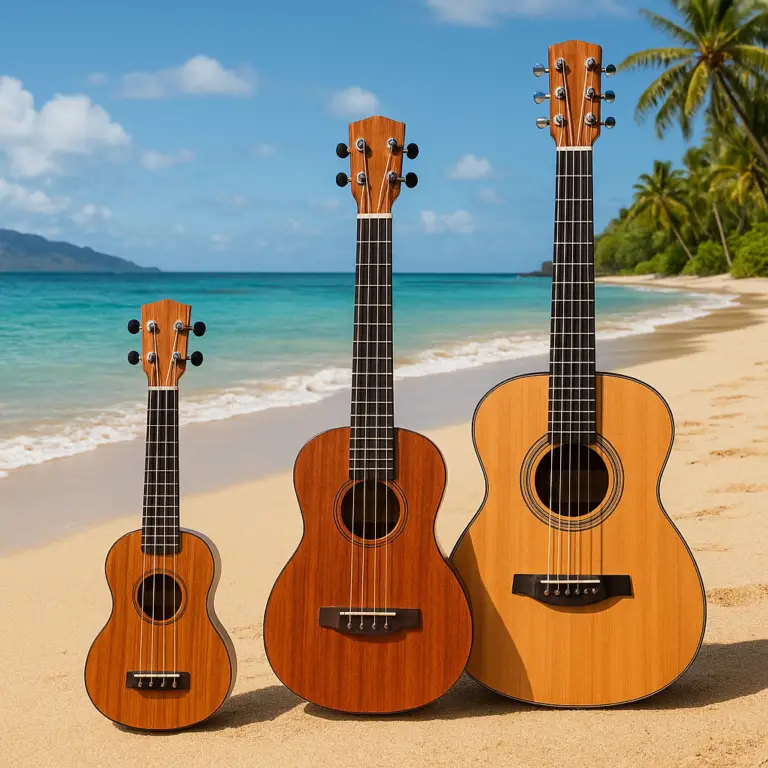
Ukulele sizes influence feel and tone, though construction, strings, and playing style matter too. “Smallest equals happiest” is not a rule of acoustics—just a convenient stereotype.
| Type | General character | Common tuning | Good fit for |
|---|---|---|---|
| Soprano | Compact, bright, classic ukulele sound | G–C–E–A | Portability and a traditional small-bodied feel |
| Concert | A little more body and room for the fretting hand | G–C–E–A | Players wanting a compact instrument with more space |
| Tenor | Fuller voice and longer scale | G–C–E–A, sometimes low-G | Fingerstyle, melodic playing, and players who prefer more room |
| Baritone | Larger body, warmer tone, guitar-like tuning | D–G–B–E | Guitarists seeking familiar chord shapes and lower register |
These are broad tendencies, not guarantees. A well-made soprano can sound rich; a budget tenor can disappoint. When choosing, play one if possible and check whether the neck feels comfortable.
How Tonewoods, Tuning, and Playing Style Affect the Mood
The way a ukulele sounds—and the mood listeners attach to it—depends on several interacting choices:
- Wood and construction: Mahogany often gives a warm, rounded sound; koa is associated with Hawaiian instruments and can produce a lively, balanced tone. Actual results depend on the instrument’s design and build.
- Strings: Nylon and fluorocarbon strings differ in feel, brightness, and response. New strings may take time to settle.
- Tuning: Standard high-G tuning gives the usual re-entrant ukulele sound; low-G adds a lower note and can expand melodic range.
- Technique: A soft fingerpicked passage may feel intimate, while a brisk strum can sound celebratory.
- Arrangement: Chords, tempo, lyrics, and other instruments shape the emotion as much as the ukulele itself.
The symbol isn’t built into the wood. It emerges from the sound, the song, and the setting. For instrument comparisons, consult makers such as Kala, Lanikai, and Martin, and compare their specifications rather than choosing by appearance alone.
🌴 Ukulele Festivals and Community Gatherings
Hawaian Ukulele Events and Cultural Celebrations
Festivals bring performers, learners, instrument makers, and audiences together. ʻUkulele Festival Hawaiʻi is a long-running Oʻahu event featuring musicians and community performances; check the official festival site for current details, schedules, and event information.
A festival can show the ukulele’s many sides: group singalongs, virtuoso playing, local music, and contemporary arrangements. It also offers a chance to hear from performers directly rather than relying on a single outside description of what Hawaiian music “should” sound like.
How to Join a Ukulele Group or Festival
You don’t need a perfect strum or a custom instrument to join in. Start here:
- Look for local music schools, libraries, community centres, and ukulele clubs.
- Check the event’s level and format. Some gatherings welcome beginners; others feature concerts or workshops.
- Bring a tuned instrument and a tuner. A clip-on tuner is handy in a noisy room.
- Review songs or chord sheets in advance, if the group provides them.
- Ask before recording or photographing performers. Respect local event guidelines and artists’ wishes.
- Listen as well as play. You’ll learn the group’s rhythm and musical etiquette faster.
For events in Hawaiʻi, follow official organizers for the latest information. Schedules change, and a festival page is more reliable than an old social post.
✨ How to Honor the Ukulele’s Meaning
Play Hawaiian Music with Cultural Awareness
A respectful approach can be both simple and rewarding:
- Find out who wrote the song. Learn the composer’s name and, when available, the song’s history.
- Understand the lyrics. If they are in ʻōlelo Hawaiʻi, use trustworthy language resources such as Wehewehe and seek context beyond a word-for-word translation.
- Listen to Hawaiian performers. Compare interpretations and notice that style varies.
- Avoid treating hula, mele, or aloha as interchangeable decorations. Each has its own cultural meaning.
- Credit artists and teachers. Give proper attribution when sharing a performance or lesson.
- Stay open to correction. Cultural learning is ongoing, not a certificate you earn after one song.
The point isn’t to make music feel intimidating. It’s to let appreciation deepen the experience. Curiosity is part of respect.
Choose, Care for, and Share an Instrument Thoughtfully
If you’re buying a ukulele for yourself or someone else, prioritize playability and sound over novelty. Try different sizes, inspect tuning stability, and ask about setup. A beginner may appreciate a tuner, a protective case, and a short lesson more than decorative extras.
For a place-inspired gift, include a note explaining the instrument’s history and why you chose it. Consider adding music by Hawaiian artists or a book that gives context—not as a substitute for listening, but as an invitation to learn.
The best ukulele is the one someone wants to pick up, play, and keep learning from. Its meaning can begin with a gift or a first chord; what matters is the care and connection that follow.