Support our educational content for free when you purchase through links on our site. Learn more
Ukulele or Guitar: Which Is Easier to Learn? 🎸

For most beginners, the ukulele is easier to start playing: it has four strings, many simple chord shapes, and usually feels gentler on the fingers. But if your goal is guitar riffs, deeper bass notes, or a wider range of styles, starting with guitar may be easier in the long run because you’ll be learning the instrument you actually want to play.
So, ukulele or guitar, which is easier? Think of the ukulele as a friendly shortcut to your first sing-along and the guitar as a bigger musical toolbox. We’ve seen beginners beam after nailing a ukulele chord in minutes—and guitar learners light up when a familiar riff finally clicks. The right choice depends on which sound makes you want to keep practicing.
Key Takeaways
- Ukulele is usually easier to begin, especially for basic chords and casual strumming.
- Guitar offers a broader range for bass lines, riffs, fingerstyle, and diverse musical styles.
- Comfort matters: try different ukulele and guitar sizes, and check that the strings aren’t unusually hard to press.
- Your musical goal should guide your choice. Pick the instrument you’re most excited to play, not just the one people call easier.
- Both take practice. A few focused sessions each week can build chord changes, rhythm, and confidence.
Table of Contents
- ⚡️ Quick Tips and Facts: Ukulele vs. Guitar
- 🎸 Why Ukulele and Guitar Feel Different: A Little Instrument History
- 🤔 Ukulele or Guitar: Which Is Easier to Learn?
- How Size, Strings, and Tuning Affect Beginners
- First Chords and Songs: What You Can Play Quickly
- 🖐️ Which Instrument Is Easier on Your Fingers?
- Finger Pain, Hand Size, and Fretboard Reach
- Strumming, Picking, and Building Coordination
- 🎵 Ukulele vs. Guitar Sound, Tuning, and Musical Styles
- How Ukulele and Guitar Tunings Compare
- Songs and Genres That Suit Each Instrument
- 📚 Learning Curve: Practice Time, Lessons, and Progress
- How Long Does It Take to Learn Basic Chords?
- Learning by Ear, Online, or with a Teacher
- 💰 Ukulele vs. Guitar: Cost, Accessories, and Upkeep
- Choosing a Beginner Instrument That Stays in Tune
- Strings, Cases, Tuners, and Other Essentials
- 🧳 Portability, Volume, and Playing at Home
- 👨 👩 👧 Which Is Better for Kids, Adults, and Different Hand Sizes?
- 🎯 Choose the Instrument That Fits Your Musical Goals
- When a Ukulele Is the Better First Instrument
- When a Guitar Is the Better First Instrument
- Can You Learn Ukulele and Guitar Together?
- ✅ Beginner-Friendly Practice Tips for Either Instrument
- 🏁 Conclusion
- 🔗 Recommended Links
- ❓ FAQ: Ukulele or Guitar, Which Is Easier?
- Is ukulele easier than guitar for beginners?
- Can guitar players easily learn ukulele?
- Is ukulele or guitar better for learning chords?
- Which instrument is better for singing along?
- Should I learn ukulele before guitar?
- 📖 Reference Links
Quick Tips and Facts: Ukulele vs. Guitar
If you’re weighing ukulele vs. guitar, here’s our quick answer: the ukulele is usually easier to start playing, while the guitar offers a wider range of sounds and playing possibilities. The better first instrument is the one whose music makes you want to pick it up again tomorrow.
| Beginner question | Ukulele | Guitar |
|---|---|---|
| Strings | 4 | Usually 6 |
| Typical beginner tuning | G–C–E–A | E–A–D–G–B–E |
| First open chords | Often fewer fingers | More stretches and finger combinations |
| Finger pressure | Usually lighter | Usually greater, especially on steel strings |
| Portability | Small and easy to carry | Larger, though travel-size models exist |
| Sound | Bright, compact, often associated with re-entrant tuning | Broader range, fuller low end, more tonal variety |
| Best quick win | Simple chord songs and strumming | Chords, bass notes, riffs, fingerstyle, and more |
A few useful truths before we get into the details:
- ✅ Four strings and a smaller fretboard can make basic ukulele chords easier to form.
- ✅ A guitar is not automatically “too hard” for beginners. A properly set-up instrument makes a considerable difference.
- ❌ A small instrument is not necessarily right for every hand. A soprano ukulele can feel cramped; a concert or tenor may suit you better.
- ❌ Easy first chords don’t mean every ukulele technique is easy. Fast chord changes, clean picking, and rhythm still take practice.
- 🎯 Pick by sound and musical goals, not by a contest-style winner. The ukulele and guitar share some skills, but they are different instruments with different strengths.
For our broader instrument and gear coverage, see the Guitar Buying Guide and Acoustic Guitars.
🎸 Why Ukulele and Guitar Feel Different: A Little Instrument History

The modern ukulele developed in Hawaii in the late 19th century, drawing on Portuguese small-guitar traditions. The guitar has a much longer and broader history, with many shapes, string types, tunings, and playing traditions. The Smithsonian National Museum of American History has ukules in its collection, while the Metropolitan Museum of Art traces the guitar’s long evolution.
That history matters because these instruments aren’t simply “the same thing, but one has two fewer strings.” They developed different voices and musical roles.
The ukulele’s standard four-string tuning often includes a high G string above the C string. This is called re-entrant tuning: the strings don’t rise in pitch from lowest to highest in the usual guitar-like order. That distinctive setup helps create the ukulele’s buoyant, bright sound.
The guitar, with six strings and a wider pitch range, can combine low bass notes, chords, melody, and rhythm in more ways at once. That versatility is a major strength, but it also gives beginners more strings and more options to manage.
A thoughtful perspective comes from Got A Ukulele’s discussion of the “ukulele versus guitar” debate. Its point is that “which is easier?” can be the wrong question if it turns into a contest. The useful question is which instrument fits the music you want to make. We agree. Easier can get you started; enjoyment keeps you practicing.
🤔 Ukulele or Guitar: Which Is Easier to Learn?
For many beginners, ukulele is easier to begin: basic chords often use fewer fingers, the instrument is compact, and nylon strings usually feel gentler than steel guitar strings. But “easier” depends on what you’re trying to do.
If your goal is to strum a few songs with friends, a ukulele may give you a faster first win. If you want to play rock riffs, accompany yourself with bass notes, or learn a broad range of guitar styles, the guitar may be the more direct path—even if its early finger exercises feel tougher.
| Skill or challenge | Often easier on | Why |
|---|---|---|
| Forming a few basic open chords | Ukulele | Fewer strings and often simpler shapes |
| Reaching across the fretboard | Depends | Ukules are smaller, but can feel cramped |
| Playing low bass notes | Guitar | It has more low strings and a wider range |
| Carrying the instrument | Ukulele | Smaller and lighter |
| Learning varied techniques | Guitar offers more range | Six strings allow more bass, chord, and melody combinations |
| Getting started with casual strumming | Often ukulele | Common beginner chord shapes are accessible |
| Matching a particular guitar song or riff | Guitar | You’re learning on the instrument the arrangement was written for |
A comparison video can help you hear the difference rather than just read about it. In the featured video, the instructor contrasts the instruments’ sound, strumming, fingerpicking, and portability, describing the ukulele’s beachy feel while pointing out the guitar’s versatility. Treat “anything you can play on ukulele, you can also play on guitar” as a useful broad idea, not a literal rule: the notes can often be adapted, but the tuning, range, voicings, and arrangement may change.
How Size, Strings, and Tuning Affect Beginners
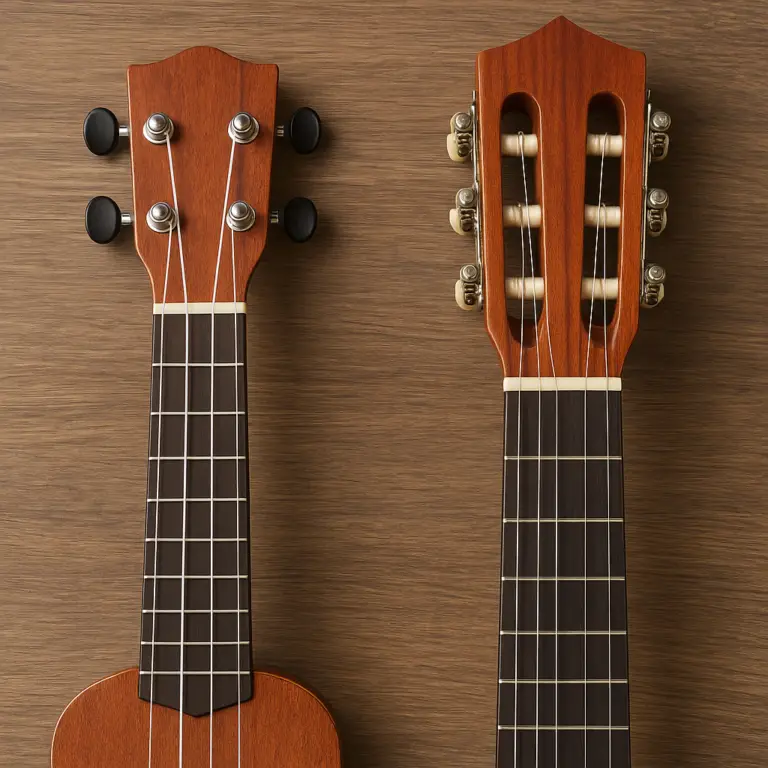
A typical ukulele has four strings; a standard guitar has six. That difference affects both the physical task and the way you learn chord shapes.
| Feature | Ukulele | Standard guitar |
|---|---|---|
| String count | 4 | 6 |
| Common tuning | G–C–E–A | E–A–D–G–B–E |
| Neck and body | Smaller overall | Larger overall |
| Common beginner string feel | Nylon or fluorocarbon; generally flexible | Steel strings on many acoustics; classical guitars use nylon |
| Low-note range | More limited | Broader low end |
| Chord learning | Many common shapes are compact | Many shapes require more fingers or wider stretches |
A beginner steel-string acoustic guitar can be harder on fingertips than a ukulele. Yet string material is not the whole story: action—the height of the strings above the frets—also affects how much pressure you need. High action can make even a good guitar frustrating. Ask a music shop or guitar technician to check the setup if the strings feel unusually difficult to press.
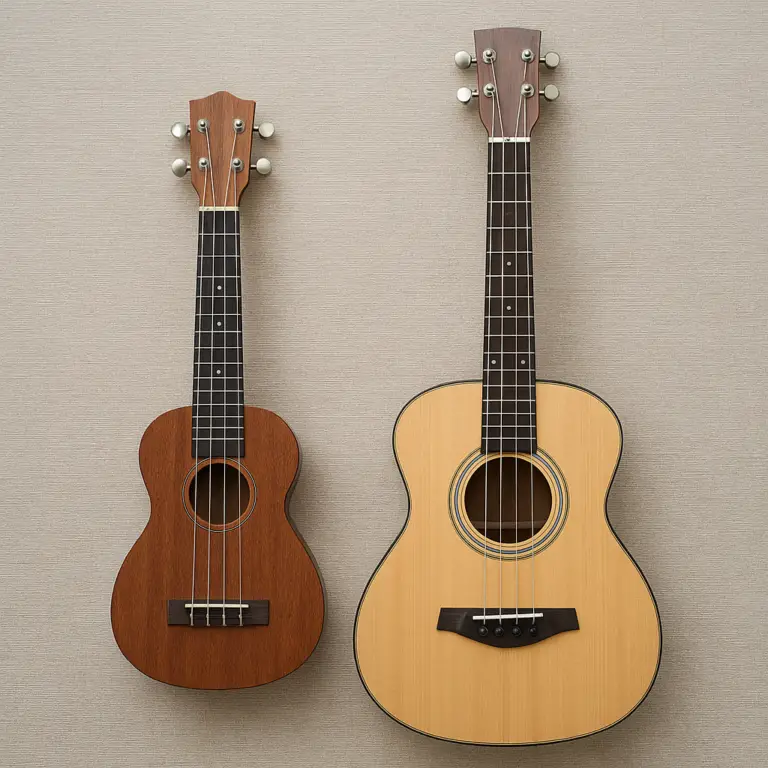
Likewise, don’t assume the smallest ukulele is the best one. Ukules commonly come in soprano, concert, tenor, and baritone sizes. A concert or tenor can offer more room for your fretting hand. Baritone ukules also use different tuning, commonly D–G–B–E, so familiar soprano or concert chord shapes don’t translate in the same way.
First Chords and Songs: What You Can Play Quickly
The ukulele has a reputation for fast beginner progress because a number of familiar chords can be played with one or two fingers. On guitar, some first chords also come quickly, but shapes such as F major and B minor can require more finger strength or coordination.
A quick chord win is motivating, but it’s not the whole musical journey. Switching between chords in time, keeping a steady strum, and muting unwanted strings are separate skills on either instrument.
Try this simple first-song routine:
- Choose three or four chords from a beginner song you genuinely enjoy.
- Learn each chord separately. Place your fingertips close behind the frets, without pressing directly on top of them.
- Check every string with a slow, one-string-at-a-time strum. Listen for buzzing or muted notes.
- Practice two-chord changes without strumming. Aim for relaxed, accurate movement rather than speed.
- Add a steady down-strum, counting evenly. Slow is fine; uneven is what makes the song woble.
- Bring in the full progression and keep going through mistakes. The rhythm matters more than a perfect first pass.
Sites such as JustinGuitar offer structured guitar lessons, and The Ukulele Site provides ukulele resources and instrument guidance. Look for lessons that demonstrate hand position and timing, not just chord diagrams.
🖐️ Which Instrument Is Easier on Your Fingers?
For many new players, a ukulele’s strings feel less demanding, particularly compared with a steel-string acoustic guitar. But fingertip tenderness is common when you start fretting any stringed instrument. Your fingers are learning a new job; they aren’t issuing a formal complaint.
A classical guitar with nylon strings may feel gentler than a steel-string acoustic, though its neck can be wider. A low-quality setup can make either instrument needlessly difficult. Comfort comes from the combination of string feel, neck dimensions, action, and technique.
Finger Pain, Hand Size, and Fretboard Reach
Mild fingertip soreness is normal at first. Sharp pain, numbness, or pain that continues after you stop is a sign to rest and reassess your technique or instrument setup.
Try these comfort checks:
- Press only hard enough to make a clean note. Beginners often squeeze much harder than necessary.
- Keep the thumb relaxed behind the neck rather than clamping the instrument.
- Use short practice sessions and stop when your hand becomes tense.
- Check the fit in person, if possible. A soprano ukulele is wonderfully portable, but its close fret spacing can be awkward for larger fingers.
- Ask about a setup if a guitar needs unusually heavy pressure. The Fender guitar-care guide provides general maintenance information; a technician can evaluate action and intonation on your specific instrument.
Hand size doesn’t decide which instrument you can play. Small hands can play guitar; large hands can play ukulele. The real question is whether you can reach the shapes comfortably and keep your wrist relaxed.
Strumming, Picking, and Building Coordination
Strumming a simple four-chord pattern can feel approachable on a ukulele. Picking adds a different challenge: you need to target individual strings cleanly, control dynamics, and coordinate both hands.
The guitar has extra strings to navigate, particularly in fingerstyle playing, but it also offers room for bass lines and melody at the same time. The ukulele can be fingerpicked beautifully too; its smaller string set doesn’t make it a “strumming-only” instrument.
A practical progression for either instrument:
- Start with a steady pulse. Count “1, 2, 3, 4” while tapping your foot.
- Strum open strings before adding chord changes.
- Use a metronome at a comfortable tempo and increase speed only when the rhythm remains relaxed.
- Practice one change at a time—for example, C to G on ukulele or Em to G on guitar.
- Record 30 seconds of playing. It’s easier to hear timing and string noise when your hands aren’t busy playing.
🎵 Ukulele vs. Guitar Sound, Tuning, and Musical Styles
Sound may be the deciding factor. Ukulele tone is often bright, light, and immediate; guitar can provide a wider range from deep bass notes to shimmering chords. But neither instrument belongs to one mood or genre. Ukules can be used in jazz, folk, pop, and classical-inspired arrangements; guitars can sound delicate, punchy, warm, or thunderous depending on the instrument and technique.
| Musical goal | Ukulele | Guitar |
|---|---|---|
| Bright, compact chord sound | A natural fit | Possible, but usually fuller and lower |
| Strong bass-and-chord accompaniment | More limited low end | A clear advantage |
| Simple sing-along strumming | Excellent | Excellent |
| Fingerstyle with bass and melody | Possible, with a distinctive range | Broad range of arrangements |
| Guitar-specific riffs and parts | Usually requires adaptation | Direct fit |
| Easy transport for casual playing | Excellent | Possible with a travel guitar |
For a wider look at acoustic instruments, browse our Acoustic Guitars category and Guitar Brand Guides.
How Ukulele and Guitar Tunings Compare
Standard ukulele tuning is usually G–C–E–A, read from the string closest to your face to the one nearest the floor while you hold the instrument. Standard guitar tuning is E–A–D–G–B–E.
The ukulele’s high-G setup is commonly re-entrant: the G string can be higher in pitch than the C string next to it. Some players use a low-G setup instead, which extends the lower register and changes the instrument’s sound.
The ukulele’s tuning also means chord shapes are not simply guitar shapes with two strings removed. Some chord names and finger patterns may look familiar, but the instruments’ intervals, string order, and pitch ranges differ. Baritone ukulele tuning adds another wrinkle because it is commonly tuned D–G–B–E.
Use a reliable chromatic tuner or an instrument-specific tuner. A clip-on tuner from brands such as Snark or D’Addario can help you tune accurately without needing to identify pitches by ear.
Songs and Genres That Suit Each Instrument
Choose a few songs you love before you buy. Search for beginner arrangements and see whether you like the sound and feel of the instrument playing them.
- Ukulele: pop sing-alongs, folk, island styles, light accompaniment, and compact chord arrangements.
- Acoustic guitar: folk, country, rock, singer-songwriter material, blues, and fingerstyle.
- Electric guitar: rock, blues, jazz, metal, and amplified lead playing.
- Either instrument: melody, chord accompaniment, songwriting, and plenty of cross-genre experimentation.
If a song is available only as guitar tab, a ukulele player can sometimes adapt the melody or chord progression, but the original voicing may not fit the ukulele’s range. Conversely, a guitar can reproduce many ukulele chord progressions, though it will sound fuller and lower. That’s why the “same song” can feel like a different arrangement rather than a straight copy.
📚 Learning Curve: Practice Time, Lessons, and Progress
There is no universal number of days after which you’ll “know” an instrument. Progress depends on how often you practice, what you practice, whether your instrument is comfortable, and what you count as success.
A few minutes of focused practice most days usually beats one exhausting weekend session. For beginners, consistency builds muscle memory and rhythm without turning your fingertips into the main character.
How Long Does It Take to Learn Basic Chords?
Many learners can begin forming a few basic chords in their first sessions. Making clean changes in time takes longer, and playing smoothly while singing adds another layer of coordination.
| Practice goal | A useful early target |
|---|---|
| Learn a few open chords | Memorize shapes and make each note ring |
| Change between two chords | Move deliberately without losing the beat |
| Strum a simple pattern | Keep a steady pulse for a full song |
| Play a complete beginner song | Recover from small mistakes and stay in time |
| Add singing | Keep the accompaniment steady while your voice follows the melody |
Treat these as milestones, not promises or deadlines. A learner who practices daily may progress differently from someone who plays once a week. Guitar chord changes can take extra effort for some beginners; ukulele chord changes can still be tricky when the rhythm speeds up or the shapes involve more fingers.
Learning by Ear, Online, or with a Teacher
There’s no single best learning method. The strongest approach is the one that keeps you practicing and gives you feedback before bad habits settle in.
- In-person teacher: Helpful for posture, hand tension, and immediate correction.
- Online course: Convenient and often structured; choose one that explains rhythm and technique as well as chords.
- Tabs and chord charts: Useful references, but they rarely show every nuance of timing or tone.
- Learning by ear: Builds listening skills and musical independence, though it can feel slow at first.
- A playing partner or group: Great for motivation and rhythm, especially if you’re comfortable making mistakes in public.
For guitar, Fender Play and JustinGuitar offer lesson resources. For ukulele, The Ukulele Site and Ukulele Underground have learning materials and community resources. Compare teaching styles before committing; a clear instructor is worth more than a flashy lesson intro.
💰 Ukulele vs. Guitar: Cost, Accessories, and Upkeep
Both instruments can be found in beginner-friendly and high-end versions, so don’t choose by price alone. A low-cost instrument with sharp fret ends, unstable tuning, or uncomfortable action can slow learning. A dependable instrument that feels good in your hands is the better value.
We recommend trying instruments in person where possible. Our Guitar Buying Guide covers the practical questions that help you make a confident choice.
Choosing a Beginner Instrument That Stays in Tune
For a ukulele, try established makers such as Kala, Lanikai, and Cordoba. For acoustic guitar, Yamaha, Fender, and Taylor offer instruments across a range of styles and sizes.
When trying an instrument, check:
- Tuning stability: Tune it, play for a while, and check again.
- String feel: Can you fret a note without excessive pressure?
- Neck comfort: Does your hand reach the chords without strain?
- Fret quality: Look and feel for sharp fret ends or rough spots.
- Action: Are the strings an unreasonable distance from the frets?
- Sound: Do you like its tone? You’ll hear it often.
- Build and finish: Check for loose hardware, cracks, or obvious defects.
A solid-wood instrument can have a different response and aging behavior than a laminate model, but construction material alone doesn’t guarantee it will be the right beginner choice. Comfort, setup, and sound matter more than a label.
Strings, Cases, Tuners, and Other Essentials
A basic kit can stay simple:
- Tuner: A clip-on chromatic tuner is convenient for both instruments.
- Case or gig bag: Protects the instrument during transport.
- Spare strings: Strings wear out and can break; use a set suitable for your model.
- Picks: Optional for guitar and ukulele, depending on your sound and technique.
- Strap: Useful if you play standing or want more support.
- Music stand: Helps you avoid twisting around to read a phone or book.
Ukules and guitars use different string sets, so don’t buy based on appearance alone. Check the instrument maker’s recommendations. The D’Addario string guide and manufacturers’ support pages can help you identify compatible sets.
🧳 Portability, Volume, and Playing at Home
Ukules are easy to carry and store, and a small soprano or concert model can fit into spaces where a full-size acoustic guitar would feel inconvenient. Travel guitars and compact acoustics narrow the gap, but a ukulele is still the smaller companion.
Volume depends on the instrument and how you play. A small acoustic ukulele is usually quieter than a full-size acoustic guitar, but both can be heard in a quiet room. If you live with other people, practice at a considerate time, use a soft touch, or explore a silent or electric instrument setup with headphones.
| Situation | Convenient option |
|---|---|
| Travel light | Ukulele |
| Practice quietly with headphones | Electric guitar with headphone-compatible gear |
| Play unamplified with a group | Guitar often has more acoustic projection |
| Store in a small room | Ukulele |
| Play outdoors casually | Either; protect both from heat, moisture, and knocks |
An instrument’s portability is useful only if you actually take it with you. That’s one reason a small ukulele can encourage more frequent playing. A travel guitar may be the better compromise if you want guitar’s range in a more compact format.
👨 👩 👧 Which Is Better for Kids, Adults, and Different Hand Sizes?
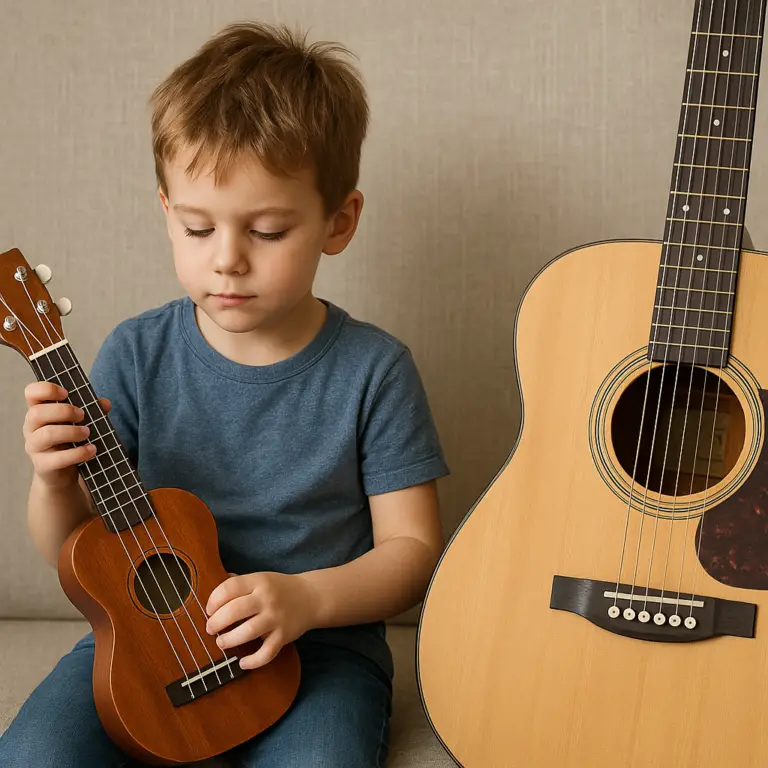
Age alone doesn’t determine the right instrument. Fit, interest, attention span, and the music the player enjoys matter more. A child who dreams of playing guitar may be less motivated by a ukulele, even if the ukulele is physically easier to hold.
For younger players, consider:
- A properly sized instrument rather than an adult full-size guitar.
- Comfortable string action and a manageable neck.
- A stable tuning system, so lessons don’t become a constant tuning rescue.
- Short, fun practice sessions.
- A song or style the learner already likes.
For adults, the same advice applies. If a guitar feels large, try a smaller-body acoustic or a short-scale model. If a soprano ukulele feels cramped, try concert or tenor. Ask a music teacher or reputable shop to help assess fit.
The Yamaha guitar guide and the Kala ukulele range show the variety of sizes and styles available. There’s no prize for choosing the smallest instrument; there is a real benefit to choosing one that feels comfortable.
🎯 Choose the Instrument That Fits Your Musical Goals
The online debate can make this choice sound more dramatic than it is. The author of Got A Ukulele’s “I’m Tired of Ukulele Versus Guitar” argues against turning the instruments into rivals. That’s a useful reminder: the best choice is the one that serves your music and makes you want to play.
When a Ukulele Is the Better First Instrument
Choose a ukulele if you:
- Want a small, portable instrument.
- Prefer bright, compact chord accompaniment.
- Want a gentle-feling introduction to fretting strings.
- Are excited by ukulele music and its distinctive tone.
- Want a practical instrument for casual singing and group playing.
The trade-off is a narrower low-note range and fewer strings for bass-heavy arrangements. Those aren’t flaws; they’re part of the instrument’s character.
When a Guitar Is the Better First Instrument
Choose a guitar if you:
- Want to play guitar-specific songs, riffs, and arrangements.
- Like having bass notes, chords, and melody available across a broader range.
- Want to explore acoustic or electric styles.
- Don’t mind spending extra time on early chord shapes and finger strength.
- Prefer a fuller-bodied sound.
The guitar’s additional strings give you more possibilities, but also more to manage. A comfortable setup and a sensibly sized instrument can make the start much easier.
For more guitar-maker comparisons and brand information, visit our Guitar Brands Showcase and Guitar Brand Guides.
Can You Learn Ukulele and Guitar Together?
Yes, but give each instrument its own practice time. Skills such as rhythm, listening, chord awareness, and finger coordination carry over. Chord shapes and tuning don’t transfer one-to-one, so expect to learn each instrument’s fretboard and habits separately.
A practical two-instrument routine:
- Spend the first few weeks focusing one instrument.
- Learn its tuning, basic chords, and steady strumming.
- Add the second instrument once you have a comfortable routine.
- Keep separate chord notes or song sheets for each.
- Compare arrangements by sound, not just by matching finger shapes.
If you already play guitar, the ukulele may feel approachable, but the high-G tuning and different string layout can surprise you. If you start on ukulele, guitar will still require adaptation—especially for the lower strings, wider chord shapes, and different scale length.
✅ Beginner-Friendly Practice Tips for Either Instrument
A few thoughtful minutes can accomplish more than an hour of frustrated strumming. Try this 15-minute session:
- Tune up (2 minutes). Check every string with a tuner.
- Warm up (2 minutes). Play single notes slowly, keeping your fingers relaxed.
- Practice chord shapes (3 minutes). Form each chord and check for clean notes.
- Work on transitions (4 minutes). Move between two chords without rushing.
- Play a song (3 minutes). Keep the rhythm going, even if a chord buzzes.
- Finish with something fun (1 minute). Play a riff, a favorite chord, or a section you enjoy.
Keep a tiny practice log: write down what felt easier, what needs attention, and one thing you enjoyed. That last part matters. If your notes read like a list of grievances, change the song or slow the exercise down.
For more instrument-care and buying advice, explore our Guitar Buying Guide and Acoustic Guitars.
🏁 Conclusion

We’re not writing off either instrument: the ukulele is often easier to begin, while the guitar offers a wider range and broader musical toolkit. If compact chord songs, portability, and a bright sound appeal to you, start with a ukulele. If guitar riffs, low bass notes, and a fuller range are what you hear in your head, start with guitar and make sure the instrument fits comfortably.
Most importantly, don’t choose an instrument just because someone called it easy. Try both if you can, play a few chords, and notice which sound makes you smile. That’s the question the “battle of strings” can’t answer for you.
🔗 Recommended Links
Beginner-friendly instruments to explore
- Kala ukules: Amazon | Guitar Center | Kala Official Website
- Lanikai ukules: Amazon | Guitar Center | Lanikai Official Website
- Cordoba ukules and guitars: Amazon | Guitar Center | Cordoba Official Website
- Yamaha acoustic guitars: Amazon | Guitar Center | Yamaha Official Website
- Fender acoustic guitars: Amazon | Guitar Center | Fender Official Website
- Taylor acoustic guitars: Amazon | Guitar Center | Taylor Official Website
Useful learning and buying resources
- JustinGuitar lessons
- Fender Play
- The Ukulele Site
- Ukulele Underground
- Guitar Brands™ Guitar Buying Guide
- Guitar Brands™ Acoustic Guitars
❓ FAQ: Ukulele or Guitar, Which Is Easier?

Is ukulele easier to learn than guitar for beginners?
Often, yes, for the first few chords and simple strumming. A ukulele has four strings, a compact neck, and many beginner chord shapes that need only a few fingers. That can make it easier to get through a simple song early on.
But “easier” changes with your goal. If you want to play guitar riffs or bass-heavy arrangements, guitar is the more direct instrument to learn. The best comparison is not which one is universally easy; it’s which one makes the music you want with a learning curve you’re willing to work through.
Read more about “Ukulele vs. Guitar for a Child: Which Fits Best? 🎸”
How long does it take to learn ukulele compared with guitar?
There’s no reliable fixed timeline. Many learners can start forming beginner chords in their first practice sessions on either instrument. Playing clean changes in time, keeping a steady rhythm, and accompanying a full song takes repeated practice.
Ukulele beginners may find some chord shapes quicker to pick up. Guitar beginners may need more time for some stretches and steel-string pressure, but progress varies considerably. Practice frequency, instrument setup, and lesson quality matter more than a promise of mastering either instrument in a particular number of weeks.
Read more about “Is a Ukulele Just a Small Guitar? 🎸”
Which is easier to play chords on, a ukulele or a guitar?
For many beginners, common ukulele chords are easier to form because the instrument has fewer strings and some shapes use fewer fingers. Guitar has more strings and often requires more complex finger placement, though it also has simple beginner chords.
The challenge is not only making a chord shape. You also need to make every note ring cleanly and switch chords without losing the beat. A guitar with high action can feel especially difficult, so check setup before blaming your hands.
Read more about “Is Ukulele Tuned the Same as Guitar? 🎸”
Which instrument is better for singing along?
Both work well. A ukulele is convenient for light, portable chord accompaniment, while a guitar can give singers a wider range of chord voicings and a stronger low end. The right choice depends on the sound you want and the songs you sing.
Try playing the same song on each instrument if possible. The ukulele may feel bright and buoyant; the guitar may feel fuller. Your voice, preferred key, and arrangement can matter as much as the instrument.
Read more about “Ukulele vs Guitar 🎸 Which One Should You Choose?”
Can guitar players easily learn ukulele?
Many guitar players find the ukulele approachable, especially if they already understand rhythm, chord changes, and fretboard basics. However, the tuning and chord shapes are different, and re-entrant high-G tuning can take a little adjustment.
Don’t assume that guitar fingering patterns transfer unchanged. Learn the ukulele’s tuning, basic chord diagrams, and strumming approach on their own terms.
Read more about “Is the Ukulele Actually Hawaiian? 🌺”
Should beginners learn ukulele before learning guitar?
You don’t need to learn ukulele first. It can be a friendly starting point if you want an accessible introduction to chord playing, but it does not eliminate the guitar’s separate learning curve. If guitar is the instrument you genuinely want, start with guitar and choose one that fits your hands comfortably.
Starting with ukulele may build useful rhythm and coordination. Starting with guitar gives you direct practice on the instrument you want to play. Motivation beats a detour taken only because someone said it would be easier.
Read more about “Ukulele Meaning in Bengali: A Little Instrument, Explained 🎸”
Are ukulele strings easier on your fingers than guitar strings?
Usually, ukulele strings feel gentler than steel strings on a standard acoustic guitar. But classical guitars use nylon strings, and instrument setup—including string height—can change how hard either instrument feels to play.
Some fingertip tenderness is common when learning. Rest if you feel sharp pain or numbness, and ask a music shop or technician to check the setup if fretting feels unusually difficult.
Read more about “Hybrid Ukulele-Guitar Instruments: 7 Types 🎸”
Is a ukulele suitable for adults with large hands?
Yes. Try concert or tenor sizes if a soprano feels cramped. Ukulele sizes differ in neck length and fret spacing, so the most comfortable choice depends on your hands and playing style. Test a few if you can; there’s no need to squeeze your fingers into the smallest model.
Read more about “🎸 4 Ukule Types: Find Your Perfect Match (2026)”
📖 Reference Links
- Smithsonian National Museum of American History: Ukulele collection
- The Metropolitan Museum of Art: The guitar
- Got A Ukulele: “I’m Tired of Ukulele Versus Guitar”
- Music Stack Exchange: Between a guitar and a ukulele, what should one consider when choosing a new instrument?
- Fender guitar maintenance resources
- Yamaha acoustic guitars
- Kala ukules
- Cordoba instruments
- D’Addario strings and accessories