Support our educational content for free when you purchase through links on our site. Learn more
Ukulele vs. Guitar for a Child: Which Fits Best? 🎸

For ukulele vs guitar for a child, choose the instrument your child is excited to play, then make sure it fits their hands and body. A ukulele is often a lighter, more approachable starting point; a properly sized guitar may be the better first instrument for a child already dreaming of guitar songs and riffs.
We’ve seen the same moment in music shops: a child picks up a ukulele, strums one cheerful chord, and grins. Then another tries a guitar and immediately asks how to play theme from their favorite game. That first spark matters. Four strings can make early chords feel simpler, but enthusiasm is what brings a kid back for practice.
The quick verdict: Try both if you can. If your child is undecided, ukulele is a friendly place to start. If they’re set on guitar, don’t make them take a ukulele detour—find a comfortable size and help them build the skills one step at a time.
Key Takeaways
- Choose for interest and fit, not age alone. Hand size, comfort, and musical motivation matter more than a strict starting-age rule.
- Ukulele often offers an easier physical start: it’s compact, has four strings, and many beginner chords use simple finger shapes.
- Guitar offers a broader range of sounds and styles, but its six strings and larger body may take more coordination and reach.
- Neither instrument is just a stepping stone. Ukulele and guitar are both rewarding instruments, and skills transfer only partly between them.
- Try before you buy. A trial lesson or visit to a music shop can help you check posture, fret reach, and string comfort.
- A good setup matters. The right size, comfortable string action, and an appropriate string type can make learning easier on either instrument.
Table of Contents
- ⚡️ Quick Tips and Facts
- 🎸 Ukulele vs. Guitar for a Child: The Big Picture
- 🕰️ How Ukules and Guitars Found Their Way into Kids’ Music
- 🎶 Meet the Instruments: Ukulele and Guitar Basics
- Ukulele sizes and types for children
- Guitar sizes and types for children
- Strings, tuning, and what those differences mean
- ⚖️ Ukulele vs. Guitar: A Kid-Friendly Comparison
- Size, weight, and comfort
- String feel, finger reach, and chord shapes
- Sound, volume, and playing at home
- Portability and taking an instrument to lessons
- Cost, accessories, and ongoing expenses
- Tuning, care, and maintenance
- 👧 Age, Height, Hand Size, and Readiness
- Choosing an instrument by age and growth
- Right-handed and left-handed children
- When to try a music lesson or rental
- 🌟 Why Kids Often Start with Ukulele
- 🎸 Why Guitar May Be the Better First Instrument
- 📈 Learning Curve: First Chords, Songs, and Practice
- Which instrument is easier for a child to learn?
- Building rhythm, coordination, and musical foundations
- Practice routines that keep kids motivated
- 🎵 Songs and Musical Styles for Ukulele and Guitar
- 🔭 Long-Term Learning: Switching or Playing Both
- 🛒 How to Choose a Child’s First Ukulele or Guitar
- A simple instrument-fit checklist
- What to look for in a beginner instrument
- Common buying mistakes to avoid
- 🧰 Essential Accessories and Instrument Care
- What a young ukulele player needs
- What a young guitarist needs
- How to clean and store a child’s instrument
- 🏡 Making Music Together: Family Activities and Motivation
- 🧠 How Learning an Instrument Supports Rhythm and Cognitive Skills
- ✅ Making the Right Choice for Your Child
- Conclusion
- Recommended Links
- FAQ
- Is ukulele or guitar easier for a child to learn?
- What age can a child start ukulele or guitar?
- Should a child learn ukulele before guitar?
- Is ukulele better for small hands?
- What size guitar or ukulele should I buy?
- Can a child learn both instruments?
- How much practice does a child need?
- Reference Links
⚡️ Quick Tips and Facts
Our short answer to “ukulele vs guitar for a child”: choose the instrument your child wants to pick up, then make sure it fits their body. For a side-by-side overview, see our ukulele vs. guitar guide.
| Quick question | Ukulele | Guitar |
|---|---|---|
| How many strings? | Usually 4 | Usually 6 |
| Typical beginner feel | Smaller, lighter, and often gentler on fingertips | Larger, with more strings and greater stretch; nylon-string models can be gentler than steel-string acoustics |
| Early learning | Many basic chords are physically simple | More initial finger reach and coordination, but the right size and lesson approach matter |
| Musical reach | Pop, folk, singalongs, and plenty more | Broad range: pop, rock, blues, folk, classical, country, and beyond |
| Best first test | Can your child comfortably hold it and enjoy its sound? | Can your child reach the strings and frets without straining? |
- Try both before buying if you can. A music shop or trial lesson can reveal more than an age chart.
- Age is a clue, not a rule. Hand size, attention span, interest, and instrument fit matter too.
- A ukulele can be an excellent first instrument, but it is not a required “practice guitar.” If your child is excited about guitar, a properly sized guitar may be the better choice.
- The first YouTube video embedded above, “Guitar VS Ukulele for kids? 5 Questions to Help you Choose the Best First Instrument for your Child”, offers a useful 8-minute, 27-second checklist for families weighing the options.
- For related instrument-buying advice, visit our Guitar Buying Guide and Acoustic Guitars sections.
🎸 Ukulele vs. Guitar for a Child: The Big Picture
This isn’t a contest in which the winner gets a tiny crown and the loser has to tune the family piano. Ukulele and guitar are both real, expressive instruments; they simply offer different routes into music.
The ukulele often makes early chord playing feel approachable because it has four strings and a compact body. Guitar gives children access to a wider range of sounds, repertoire, and playing styles, but its size and six-string layout can ask more of small hands at first.
Two useful perspectives from music educators capture the trade-off:
- MusicPandit encourages families to let children “hold and play each briefly” and judge comfort as well as interest.
- Notey makes a helpful distinction: the instrument that is easier to start is not always the one a child most wants to keep learning.
We agree with both. Quick early success can build confidence, but genuine curiosity fuels practice long after the first three-chord song. The trick is finding the instrument that balances comfort, motivation, and musical goals for your particular kid.
🕰️ How Ukules and Guitars Found Their Way into Kids’ Music
The ukulele is closely associated with Hawaiian music and culture; its modern form developed from Portuguese instruments brought to Hawaiʻi in the late 19th century. Its small size and bright sound helped it travel well beyond the islands. The Smithsonian National Museum of American History documents the instrument’s place in American musical history.
The guitar has a much longer and broader family history, with related plucked string instruments appearing across cultures over centuries. Today, guitars appear in everything from classical recitals and folk sessions to rock bands and bedroom songwriting.
For children, that history matters less than one practical question: what music makes them want to play? A kid captivated by a Taylor Swift song, a film theme, or a school rock band may be drawn straight to guitar. Someone who wants to sing along with friends at camp may love the ukulele’s compact, easy-to-carry charm. Neither preference needs to be justified in a tiny courtroom.
🎶 Meet the Instruments: Ukulele and Guitar Basics
Ukulele sizes and types for children
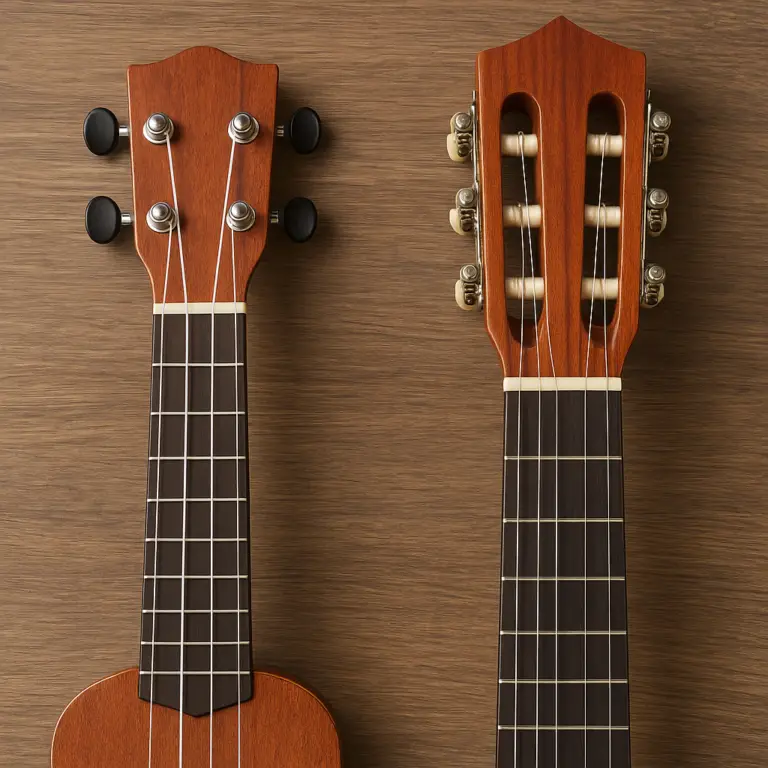
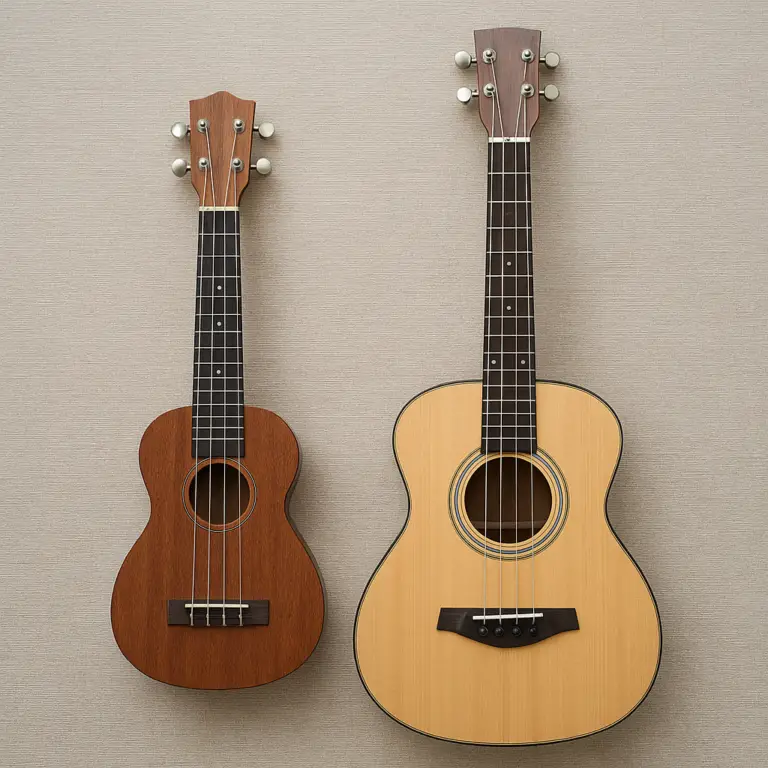
Ukules typically come in four common sizes. Bigger does not automatically mean better: the best fit lets your child hold the instrument naturally and reach the frets without contorting.
| Ukulele size | General feel | What to consider for a child |
|---|---|---|
| Soprano | Smallest, bright and classic ukulele sound | Compact, but its short fret spacing can feel cramped for some older children |
| Concert | A little larger, with more room on the fretboard | Often a practical middle ground for a growing beginner |
| Tenor | Larger body and longer fretboard, with a fuller tone | May suit older children who want more room to play |
| Baritone | Largest common size; usually tuned differently from soprano, concert, and tenor | More guitar-like in scale, but its different tuning means chord shapes and song resources may differ |
Most soprano, concert, and tenor ukules use G–C–E–A tuning. Baritone ukules are commonly tuned D–G–B–E, like the highest four strings of a guitar. Check the maker’s specifications before purchasing: tuning and string materials can vary.
A well-made beginner instrument from brands such as Kala, Lanikai, or Cordoba can be a better choice than a novelty ukulele that looks like a toy but struggles to stay in tune.
Guitar sizes and types for children
Guitars come in multiple body and scale sizes. A 1/2- or 3/4-size guitar may fit a child better than a full-size instrument, but these labels are not perfect measures of fit across brands. Have the child hold the guitar and fret a few notes if possible.
| Guitar type | Strings and feel | Child-friendly considerations |
|---|---|---|
| Classical guitar | Usually nylon strings; often a wider neck | Softer-feling strings can be kind to fingertips, though the neck width may challenge small hands |
| Steel-string acoustic | Steel strings; bright, projecting sound | Can require more fingertip pressure; look for an appropriately sized body and a comfortable setup |
| Electric guitar | Usually steel strings, with amplified sound | Often has a slimmer body and lower string action; it needs an amplifier or headphone-compatible practice setup |
| Travel or parlor guitar | Compact body, typically acoustic | Easier to carry than many full-size guitars; still check the scale length and string feel |
For a child interested in acoustic playing, explore our Acoustic Guitars guides. If electric guitar is the dream, brands such as Yamaha, Squier, and Ibanez offer beginner-oriented options across different sizes and styles.
Strings, tuning, and what those differences mean
A standard ukulele has four strings; a standard guitar has six. That difference affects chord shapes, tuning, and how many notes a player can combine—not the musical worth of either instrument.
Many ukules use nylon or other synthetic strings. Classical guitars also use nylon strings, while most steel-string acoustic and electric guitars use steel strings. String material alone doesn’t determine how easy an instrument is: action height, string gauge, scale length, and setup all affect playability.
Standard guitar tuning is E–A–D–G–B–E. Standard ukulele tuning for soprano, concert, and tenor is generally G–C–E–A. The different tuning means a chord shape learned on ukulele will not simply work as the same chord shape on guitar. Rhythm, listening, and basic musical understanding can transfer; fingerings usually need to be learned for the new instrument.
⚖️ Ukulele vs. Guitar: A Kid-Friendly Comparison
| Factor | Ukulele | Guitar |
|---|---|---|
| Physical size | Usually compact and lightweight | Ranges from child-size to full-size; bulkier overall |
| Basic chord entry | Some common beginner chords use only one or two fingers | Common chords often involve more strings, finger placement, or stretch |
| Fingertip comfort | Synthetic strings often feel gentle, but pressure and fit still matter | Nylon-string classical models can be gentler; steel strings may feel tougher at first |
| Musical range | Broad enough for songwriting, singing, and many popular styles | Wider range of genres, tones, and ensemble roles |
| Portability | Easy to carry in a gig bag | More awkward on buses, in small cars, or on crowded school mornings |
| Practice volume | Often quieter acoustically | Acoustic guitars can project more; electric guitars can be practiced at controlled volume with suitable equipment |
| Long-term pathway | Can be studied deeply and played professionally | Extensive options across acoustic, classical, electric, bass, and ensemble playing |
Size, weight, and comfort
Comfort is not a small detail. If a child has to hunch, lift a shoulder, or stretch awkwardly just to hold the instrument, practicing becomes a wrestling match.
Check that your child can:
- Sit or stand with a relaxed posture.
- Support the instrument without gripping it tightly.
- Reach the fretboard comfortably.
- Press a string without twisting the wrist sharply.
- See and place fingers without the instrument sliding away.
A smaller ukulele is easier to carry, but it isn’t automatically more comfortable: some children find a soprano fretboard cramped. A compact guitar may feel more natural to a child whose hands are ready for its neck. Fit beats the label on the box.
String feel, finger reach, and chord shapes
Ukulele’s four strings can simplify the first few chord shapes. For example, a common C-major ukulele chord can be played with one finger. That’s encouraging, but it doesn’t mean every ukulele song is effortless or that guitar is off-limits.
Guitar asks for different finger placements, and some open chords require several fingers. A child may need time to build fingertip comfort and coordinate both hands. A nylon-string classical guitar can soften the initial experience compared with a typical steel-string acoustic; a teacher or shop can also check whether the strings sit comfortably above the frets.
Don’t dismiss a child’s complaints as lack of effort. Sore fingertips are common early on, but sharp pain, persistent hand strain, or a wrist that must bend uncomfortably calls for a fit and technique check.
Sound, volume, and playing at home
A ukulele’s acoustic sound is often gentle and bright. A steel-string acoustic guitar can sound fuller and carry farther across a room. Electric guitar gives families the most volume control, provided the child has an appropriate amp or headphone setup.
| Home-practice situation | A practical option |
|---|---|
| Shared room or quiet household | Ukulele or electric guitar with headphones |
| Singing along without amplification | Ukulele, classical guitar, or acoustic guitar, depending on desired volume |
| Child wants a band-style sound | Electric guitar and a suitable practice amp |
| Family members need quiet at different times | Agree on practice windows; use headphones with compatible equipment |
No instrument is magically silent. Even an unpluged electric guitar makes a soft string sound, and an enthusiastic ukulele strummer can still make the dog reconsider its life choices. The useful question is whether the instrument’s sound suits your home and practice routine.
Portability and taking an instrument to lessons
The ukulele wins the backpack-friendly round. It is easy to take to a lesson, a family trip, or a singalong. A child-size guitar is still portable, but its case takes up more space and is less convenient for small hands to carry.
If your child will travel with an instrument, consider a padded gig bag, a safe way to carry it, and whether it fits in your vehicle or storage area. A compact instrument that actually makes it to lessons is more useful than a theoretically perfect one that lives behind the coats.
Cost, accessories, and ongoing expenses
Beginer ukules generally require fewer accessories and are often less expensive to maintain. Guitars may need a case, tuner, picks or a footstool, and—if electric—an amplifier and cable. But price alone can’t tell you whether an instrument is suitable: an inexpensive instrument with poor tuning stability or uncomfortable string height can make learning unnecessarily frustrating.
Plan for:
- A reliable tuner or tuning app.
- A protective case or gig bag.
- Replacement strings when needed.
- A strap if the child will play standing, where appropriate.
- A guitar stand or safe storage spot.
- An amplifier and cable for electric guitar.
Ask a teacher or reputable music shop to check setup before blaming tiny fingers for a difficult instrument. Browse our Guitar Buying Guide for more help choosing a beginner instrument.
Tuning, care, and maintenance
All string instruments need tuning. New strings can drift in pitch while they settle, and frequent playing, temperature changes, and handling can affect tuning. A clip-on tuner makes the task less mysterious.
A simple care routine:
- Wash and dry hands before playing.
- Wipe strings and the instrument with a clean, soft cloth after practice.
- Keep the instrument away from heaters, damp areas, and direct sun.
- Store it in a case or on a stable stand.
- Ask an adult or teacher to handle string changes and setup until the child is comfortable doing so safely.
Avoid household cleaners, furniture polish, and excess moisture. Follow the manufacturer’s instructions, especially for a painted finish or a specific wood treatment.
👧 Age, Height, Hand Size, and Readiness
Choosing an instrument by age and growth
You’ll see suggested starting ages ranging from roughly four or five for ukulele to six or seven for guitar. Those are common starting points, not rules. A motivated six-year-old might do well on a small, well-set-up guitar; an older child may prefer a ukulele and enjoy it for years.
| What to consider | Why it matters |
|---|---|
| Hand size and reach | Determines whether the child can fret notes without straining |
| Attention span | Helps shape lesson length and practice expectations |
| Musical interest | Motivation makes regular practice more likely |
| Posture and instrument fit | Supports comfort and healthy technique |
| Teacher’s experience | Helps match the instrument, songs, and teaching style to the child |
Instead of asking only “How old should my child be?”, ask: Can they hold this instrument comfortably, stay curious for a short lesson, and enjoy the sound they make?
Right-handed and left-handed children
Most guitars are set up for right-handed playing, but left-handed models are available. Many beginners can learn on a right-handed guitar, but don’t force a child into a position that feels uncomfortable just to avoid shopping for the correct model.
Ukules are often easier to turn or restring than guitars, but reversing the strings changes their order and may require a proper setup. If your child is strongly left-handed, ask a teacher to let them try both orientations before choosing.
When to try a music lesson or rental
A trial lesson helps answer the practical questions: Can your child reach the strings? Do they enjoy the instrument’s sound? Does the teaching style suit them?
If possible, borrow or rent before buying. Let the child try both instruments in a relaxed setting, not while everyone is hungry and a salesperson is hovering like a guitar-shaped hawk. A good teacher can help assess size, posture, and readiness without treating age as a hard cutoff.
The Napa School of Music comparison also recommends trying the instruments and emphasizes that children’s readiness varies. Its advice complements the age ranges above: the child’s fit and interest are more informative than a calendar date.
🌟 Why Kids Often Start with Ukulele
Benefits
- Compact and light: Easier to hold and carry for many children.
- Four strings: Fewer strings to coordinate at the start.
- Gentler string feel: Many models use synthetic strings that feel softer than steel strings.
- Quick musical payoff: Simple chord shapes can help a beginner play along with songs early.
- Easy to bring along: It can join family trips, lessons, and informal singalongs.
- A full instrument, not a toy: Ukulele offers plenty of room for rhythm, melody, singing, and more advanced playing.
Trade-offs
- Small models can feel cramped to some hands.
- Different tuning means guitar chord shapes won’t transfer directly.
- A child who is set on electric guitar or a particular guitar-centered style may feel that ukulele is a detour.
- Its gentle volume may not provide the band sound the child wants.
Ukulele is a strong choice when a child wants an approachable first step, likes its sound, or wants to sing and strum. It is a poor choice only when it replaces the instrument the child is genuinely excited to learn.
🎸 Why Guitar May Be the Better First Instrument
Guitar offers a huge musical playground: acoustic songwriting, classical repertoire, pop, blues, country, rock, jazz, and electric sounds. If your child is already asking to play a guitar part from a favorite song, honoring that enthusiasm may matter more than choosing the instrument with the gentlest first week.
Benefits
- Broad repertoire and style choices: Children can follow many musical interests as they grow.
- Long-term pathways: Acoustic, classical, electric, and band playing offer different directions.
- Early motivation can outweigh difficulty: A child who wants guitar may happily work through its first challenges.
- Flexible beginner choices: Nylon-string and smaller-scale models can make guitar more accessible.
Trade-offs
- Six strings bring more coordination and chord shapes to learn.
- A poorly fitted guitar can make practice uncomfortable.
- Steel-string acoustics may feel demanding on new fingertips.
- Electric guitar requires additional gear for amplified sound.
The National Association for Music Education provides resources on music education and learning; families can also ask local teachers how they adapt instruction to young players. Don’t confuse “more challenging at first” with “too difficult.” The right size, setup, and teaching approach can make a meaningful difference.
For guitar-related brand features and comparisons, explore Guitar Brands Showcase and Guitar Brand Guides.
📈 Learning Curve: First Chords, Songs, and Practice
Which instrument is easier for a child to learn?
Ukulele is often easier to begin physically, especially for a small child: fewer strings, compact dimensions, and accessible beginner chord shapes can help. But guitar may be easier to stick with if a child is already excited about guitar music.
That distinction resolves an apparent disagreement among beginner guides. MusicPandit and Napa School of Music emphasize ukulele’s comfortable entry for many young learners. Notey challenges the idea that age alone should keep children away from guitar, pointing out that motivation and instruction style can make a young guitarist’s start manageable. They are answering slightly different questions: which instrument often offers faster early progress, and which instrument best matches a child’s longer-term interest.
Building rhythm, coordination, and musical foundations
Both instruments can help children practice:
- Keeping a steady beat.
- Coordinating the fretting and strumming hands.
- Listening for changes in pitch and rhythm.
- Following a song structure.
- Building fine-motor control and musical confidence.
Ukulele can introduce chord-and-rhythm ideas that make later musical learning familiar. Guitar builds its own technique and reaches into a wider range of ensemble roles. Some skills transfer; fingerings and tuning usually do not.
Practice routines that keep kids motivated
Short, positive sessions are often more useful than a long practice battle. Start with a predictable routine and adjust it to the child’s age and teacher’s advice.
- Tune together. Make tuning part of the routine rather than a surprise problem.
- Warm up briefly. Play open strings, a simple rhythm, or an easy melody.
- Work one small goal. Try a chord change, a short riff, or a few bars of a song.
- Finish with a favorite. Ending on an enjoyable piece gives practice a nicer final note.
- Praise effort and curiosity. Notice persistence, careful listening, or a new chord—not only flawless playing.
The NAM Foundation shares resources about music making and music education. For practice at home, celebrate small wins: the first clean chord change is a real milestone, even if the family cat remains unimpressed.
🎵 Songs and Musical Styles for Ukulele and Guitar
Both instruments can play melodies and accompany singing, but their sounds and ranges differ.
| A child is drawn to… | Try… | Why it may fit |
|---|---|---|
| Camp songs and singalongs | Ukulele or acoustic guitar | Both can accompany singing; ukulele is especially portable |
| Rock riffs and electric sounds | Electric guitar | Amplification and effects expand the sound palette |
| Classical repertoire | Classical guitar | Nylon strings and established classical technique suit this path |
| Pop songwriting | Either | Ukulele is simple to carry; guitar offers a broader range of voicings and tones |
| Blues or country | Guitar, or either for simplified accompaniment | Guitar has a long tradition in both styles; ukulele can still strum songs |
| Film and game themes | Either | Choose based on the arrangement and the child’s preferred sound |
A child doesn’t need to pick a genre for life. Let them explore music they already love, then introduce new styles once the instrument feels familiar. The best beginner song is often the one that makes a child say, “Can we learn the next bit?”
🔭 Long-Term Learning: Switching or Playing Both
Starting on ukulele does not prevent a child from learning guitar later. Rhythm, listening, song structure, and confidence holding a stringed instrument can carry over. Chord shapes, tuning, neck feel, and much of the finger technique need to be learned anew.
Starting on guitar also doesn’t rule out ukulele. Guitar players often enjoy the ukulele’s portability and different sound, while ukulele players may find guitar a natural next exploration.
A sensible transition plan:
- Keep the first instrument if the child still enjoys it.
- Introduce the second instrument through a trial lesson or borrowed instrument.
- Learn its tuning and basic technique from the beginning.
- Use familiar songs to connect the old experience with new fingerings.
- Avoid framing the change as “graduating” from one instrument to a better one.
A ukulele is not merely a stepping stone, and guitar is not automatically the more serious choice. The child’s goals decide what comes next.
🛒 How to Choose a Child’s First Ukulele or Guitar
A simple instrument-fit checklist
Take your child to a music shop or lesson and check:
- Can they sit or stand with comfortable posture?
- Can they reach the frets without stretching painfully?
- Does the body feel manageable against their torso?
- Can they make a clean note or simple chord with guidance?
- Do they like the sound enough to want to try again?
- Is the instrument light enough for them to carry safely?
If the answer to several fit questions is no, try a different size or style. Don’t buy a full-size instrument “to grow into” if the child cannot play it comfortably now.
What to look for in a beginner instrument
Prioritize comfortable playability, reliable tuning, and a size that suits the child. A teacher or music-store technician can check string height, tuning stability, and whether the instrument is in good working order.
Brands with established instrument ranges include Yamaha, Cordoba, Kala, Lanikai, and Squier. Brand names alone don’t guarantee a perfect fit, so try the specific model when possible.
Common buying mistakes to avoid
❌ Buying by age alone. Children of the same age can differ in reach and comfort.
❌ Choosing a toy-looking instrument over a playable one. Decorative features are fun; poor tuning and uncomfortable strings are less fun.
❌ Assuming all ukulele strings or guitar strings feel the same. Materials and setup vary.
❌ Buying too large for future growth. A child needs an instrument they can play now.
❌ Treating ukulele as a compulsory guitar pre-course. Choose it because the child wants to play it, not because they must earn access to guitar.
❌ Ignoring the child’s musical interests. A technically sensible instrument that never leaves its case is not a bargain in any meaningful sense.
🧰 Essential Accessories and Instrument Care
What a young ukulele player needs
- Clip-on tuner: Helps with standard tuning and makes pitch visible.
- Padded case or gig bag: Protects the instrument during lessons and travel.
- Soft cleaning cloth: Wipes away fingerprints and moisture after playing.
- Spare strings: Useful when a string breaks or wears out; choose the correct set for the instrument.
- Music stand: Optional, but helpful for lessons and printed music.
What a young guitarist needs
- Tuner and protective case: The basic kit for most acoustic and electric players.
- Picks: Optional; children can try fingers, picks, or both, depending on the music.
- Strap: Useful for standing practice when properly fitted.
- Amplifier and cable: Needed for electric guitar; a headphone-friendly practice option can help at home.
- Footstool or support: A teacher may recommend one for classical posture.
- String-changing help: An adult or music technician can handle changes while a child is learning.
How to clean and store a child’s instrument
- Wipe the strings and body with a clean, dry, soft cloth after playing.
- Keep food, drinks, and sticky fingers away from the instrument.
- Store it in a case or stable stand, away from direct sun, radiators, and damp spaces.
- Don’t use household sprays or polish unless the manufacturer says they’re suitable.
- Ask a teacher or technician about cleaning products for a particular finish.
These simple habits help keep an instrument comfortable and ready for practice. For more guitar care and buying advice, browse our Guitar Brand Guides.
🏡 Making Music Together: Family Activities and Motivation
Family music time doesn’t require everyone to play the same instrument. One person can strum a ukulele, another can sing, and someone else can tap a steady beat on the kitchen table—preferably not the good table.
Try these low-pressure activities:
- Chord-change challenge: See how many smooth changes a child can make between two easy chords.
- Family singalong: Let the child choose the song and set the pace.
- Rhythm echo: Clap a short pattern and invite the child to copy it on strings or by tapping.
- Song detective: Listen for verse, chorus, and repeated patterns.
- Mini performance: Invite the child to play one song for a willing audience, with no demand for perfection.
Keep the child in charge of some choices. Leting them choose a song, practice spot, or instrument can make music feel like their activity rather than another household assignment.
🧠 How Learning an Instrument Supports Rhythm and Cognitive Skills
Playing music involves listening, movement, timing, memory, and attention. A child may have to coordinate both hands, follow a beat, remember a chord sequence, and notice when a song changes section—all in the same little musical moment.
Research on music education examines links between music training and skills such as listening and cognitive development, but no single instrument guarantees a particular academic outcome. A balanced reason to choose music is that it offers a structured, creative activity children can enjoy and improve at over time.
The National Association for Music Education and the NAM Foundation offer broader resources on music learning. For families, the most useful measure is often simple: does the child enjoy making music, feel supported, and want to keep learning?
✅ Making the Right Choice for Your Child
Use this decision guide as a starting point, not a verdict handed down by the Council of Tiny Musicians:
| If your child… | Consider… | Reason |
|---|---|---|
| Wants something small and easy to carry | Ukulele | Compact body and four strings make it convenient |
| Is eager to play guitar songs or riffs | Guitar | Their interest may carry them through the early learning curve |
| Has small hands and wants to explore music | Try a soprano or concert ukulele, plus a properly sized guitar | Fit varies; compare both in person |
| Wants to sing and strum with family | Either | The best choice depends on the desired sound and comfort |
| Is discouraged by fingertip pressure | Ukulele or nylon-string classical guitar | Both may offer a gentler feel, depending on setup |
| Wants electric sounds and band playing | Electric guitar | Directly supports that musical goal |
| Is undecided | Borrow, rent, or book a trial lesson | A hands-on test beats guessing from online dimensions |
Our confident recommendation: let the child’s interest choose the direction, and let comfort choose the specific instrument. If they’re undecided, ukulele is often an approachable first try. If their eyes light up at the guitar, choose a well-fitted guitar and give them patient, enjoyable instruction. The question isn’t which instrument is universally best; it’s which one this child will be glad to pick up tomorrow.