Support our educational content for free when you purchase through links on our site. Learn more
🎸 How Ukulele Tuning Compares to Guitar

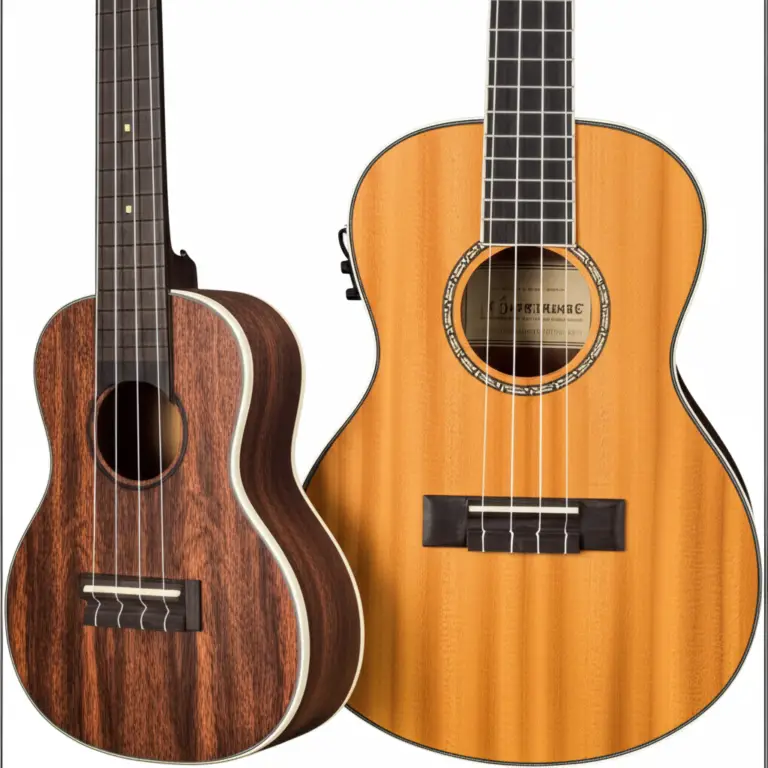
How does the tuning of a ukulele compare to a guitar? A standard soprano, concert, or tenor ukulele is usually tuned G–C–E–A, while a standard guitar uses E–A–D–G–B–E. The ukulele has four strings, sits in a generally higher register, and often uses a re-entrant high-G string that gives its strumming that unmistakable sparkle.
The closest tuning match is the baritone ukulele, typically tuned D–G–B–E, just like the guitar’s highest four strings. That makes baritone ukulele especially friendly for guitarists, while standard ukulele requires you to learn new chord shapes and a different fretboard map.
We learned this the slightly amusing way: a familiar guitar fingerpicking pattern can sound perfectly “wrong” on a high-G ukulele, even when every note is technically in tune. The culprit is the re-entrant string, which places a higher G where your guitar-trained brain expects a low bass note. Switch to low-G tuning, and suddenly that same pattern behaves far more like a compact guitar arrangement.
- Standard ukulele tuning is G–C–E–A, compared with E–A–D–G–B–E for a standard guitar.
- Baritone ukulele tuning is D–G–B–E, matching the guitar’s highest four strings.
- High-G re-entrant tuning creates the bright, bouncy ukulele sound.
- Low-G tuning offers a fuller bass response and feels more natural for guitarists and fingerstyle players.
- A ukulele has four strings instead of six, making basic tuning quicker but requiring different chord shapes.
- You can use the same chord names on both instruments, but their physical fingerings usually differ.
- Ukulele tuning is not simply guitar tuning with two strings removed; scale length, string tension, octave placement, and instrument design all affect the result.
- Choose high-G for traditional strumming and low-G for melody, fingerstyle, and guitar-like arrangements.
Table of Contents
- ⚡️ Quick Tips and Facts: Ukulele vs. Guitar Tuning
- The Short Answer
- Standard Tuning at a Glance
- Why the Ukulele Sounds Higher
- 🎼 Ukulele and Guitar Tuning: The Essential Background
- How String Count and Instrument Size Affect Pitch
- A Brief History of Ukulele and Guitar Tuning
- What “Standard Tuning” Really Means
- 🎸 How Does the Tuning of a Ukulele Compare to a Guitar?
- Ukulele Standard Tuning: G–C–E–A
- Guitar Standard Tuning: E–A–D–G–B–E
- The Musical Relationship Between Ukulele and Guitar Strings
- High-G and Low-G Ukulele Tuning Explained
- Why Ukulele Tuning Is Similar to the Guitar’s Highest Four Strings
- 🧭 Ukulele Tuning Systems and Variations
- Soprano, Concert, Tenor, and Baritone Ukulele Tuning
- Baritone Ukulele vs. Guitar Tuning
- Alternative Ukulele Tunings: D-Tuning and Slack-Key
- Open Tunings and Specialty Ukulele Setups
- 📋 Ukulele and Guitar Tuning Compared: Complete Reference Tables
- String-by-String Note Comparison
- Octave and Frequency Differences
- Chord Shape Equivalency Chart
- Tuning Comparison by Ukulele Size
- 🔧 How to Tune a Ukulele Correctly
- Using a Clip-On Tuner or Smartphone App
- Tuning a High-G Ukulele Step by Step
- Tuning a Low-G Ukulele Step by Step
- Tuning by Ear with a Reference Pitch
- How to Check Intonation After Tuning
- 🎯 Guitar Tuning Fundamentals for Ukulele Players
- The Guitar’s E–A–D–G–B–E Arrangement
- Why Guitar Tuning Is Less Symetrical
- How Guitarists Can Adapt to Ukulele Tuning
- 🎹 Ukulele Chord Shapes Compared with Guitar Chords
- Which Guitar Chords Transfer Directly
- Why Familiar Guitar Shapes Sound Different
- Transposing Guitar Chords for Ukulele
- Common Chord Shape Mistakes
- 🎵 Navigating the Ukulele Fretboard
- Ukulele Note Layout for Guitar Players
- Finding Octaves, Intervals, and Root Notes
- Reading Ukulele Tablature and Chord Diagrams
- Using a Low-G String for Guitar-Style Melodies
- 🔢 9 Practical Ways Ukulele Tuning Differs from Guitar Tuning
- 1. The Ukulele Has Four Strings
- 2. Standard Ukulele Tuning Uses a Rentrant High-G String
- 3. Ukulele Tuning Is Centered on G–C–E–A
- 4. Guitar Strings Cover a Wider Pitch Range
- 5. Ukulele Chord Shapes Are Usually More Compact
- 6. Ukulele Chords May Use Different Voicings
- 7. Baritone Ukulele Tuning Closely Matches the Guitar
- 8. Ukulele Strings Require Different Tension and Gauges
- 9. Transposing Between Instruments Is Often Necessary
- 🪕 Ukulele Strings, Tension, and Setup
- High-G vs. Low-G String Sets
- Can You Put Guitar Strings on a Ukulele?
- How String Material Changes Tone
- When to Replace Ukulele Strings
- Bridge, Nut, and Intonation Considerations
- 🎼 Alternative Tunings for Different Musical Styles
- Low-G for Fingerpicking and Arrangements
- D-Tuning for a Brighter Traditional Sound
- Open-C and Other Experimental Tunings
- Choosing a Tuning for Strumming, Jazz, Blues, or Classical Playing
- 🎤 How Tuning Changes Ukulele Tone and Playability
- Rentrant Tuning and the Classic Ukulele Sound
- Low-G Tuning and a Fuller Bass Response
- Scale Length, Neck Feel, and Fret Spacing
- How Tuning Influences Singing and Song Keys
- 🧑 🎓 Learning Ukulele After Playing Guitar
- Skills That Transfer Immediately
- New Techniques You Need to Learn
- A Simple Practice Routine for Guitarists
- Avoiding Guitar Muscle Memory Traps
- 🧑 🏫 Learning Guitar After Playing Ukulele
- What Ukulele Players Already Understand
- Adjusting to Six Strings and Wider Stretching
- Building Guitar Chord Vocabulary
- 🧰 Ukulele Tuning Problems and Troubleshooting
- Why a Ukulele Will Not Stay in Tune
- Fixing Sharp or Flat Notes
- New String Stretching and Tuning Stability
- Diagnosing Buzzing, Dead Notes, and Poor Intonation
- When to Visit a Qualified Luthier
- ✅ Best Tuners, Apps, and Accessories for Accurate Tuning
- Clip-On Tuners vs. Chromatic Tuner Apps
- Useful Ukulele Tuning Tools
- How to Tune Quietly Before a Performance
- Tuning Tips for Recording and Live Shows
- 🎶 Playing the Same Song on Ukulele and Guitar
- Matching Chords Across Both Instruments
- Keeping the Original Key
- Using a Capo on Guitar and Ukulele
- When to Use a Transposition Chart
- 🌎 Ukulele Tuning Traditions Around the World
- Hawaian Ukulele Tuning Practices
- Modern Pop, Folk, and Classroom Tuning
- Regional Preferences and Instrument Sizes
- ❓ Frequently Asked Ukulele and Guitar Tuning Questions
- Is a Ukulele Tuned Like the Top Four Guitar Strings?
- Can a Guitarist Use the Same Chords on Ukulele?
- Is Ukulele Tuning Easier Than Guitar Tuning?
- Should I Choose High-G or Low-G Tuning?
- Can You Tune a Ukulele to Guitar Notes?
- Why Does My Ukulele Sound Out of Tune at Higher Frets?
- Which Instrument Is Easier to Learn?
- 🏁 Conclusion: Which Tuning Is Right for You?
- 🔗 Recommended Links
- 💬 FAQ
- 📚 Reference Links
If you landed here from our ukulele guide, here is the answer before we get delightfully nerdy: a standard ukulele is not tuned exactly like a standard guitar, but it shares useful relationships with guitar tuning.
- Soprano, concert, and tenor ukules: usually G–C–E–A
- Re-entrant ukulele tuning: g–C–E–A, with the high-G string placed physically first
- Baritone ukulele: usually D–G–B–E, matching the guitar’s highest four strings
- Standard guitar: E–A–D–G–B–E
- Ukulele tuning is generally higher, shorter, and more compact than guitar tuning.
- A ukulele has four strings, while a guitar has six, so there are fewer notes to manage, but the re-entrant high-G string can initially scramble a guitarist’s instincts.
- High-G tuning creates the familiar bright, bouncy ukulele sound.
- Low-G tuning gives a tenor or concert ukulele a more guitar-like bass-to-treble range.
- Chord shapes do not automatically transfer by name. A guitar C chord shape played on a standard ukulele produces a different voicing and may represent a different chord.
The Short Answer
Ukulele tuning is simpler in string count but different in pitch layout. Standard guitar tuning descends mostly in perfect fourths from low E to high E, with one major-third interval between G and B. Standard ukulele tuning uses G–C–E–A, a compact arrangement commonly voiced with a high-G or low-G fourth string.
That means a guitarist can transfer:
- Strumming technique ✅
- Rhythm knowledge ✅
- Many chord concepts ✅
- Scale and interval awareness ✅
But you must relearn:
- String names ❌
- Chord shapes ❌
- Fretboard landmarks ❌
- The feel of a high-G re-entrant string ❌
The closest direct tuning relationship is baritone ukulele to the guitar’s top four strings: D–G–B–E. The standard soprano, concert, and tenor ukulele is instead G–C–E–A, which is five semitones above those baritone notes.
Standard Tuning at a Glance
| Instrument | Strings, low to high by pitch | Common configuration | Practical character |
|---|---|---|---|
| Soprano ukulele | G–C–E–A | Often high-G/re-entrant | Bright, percussive, compact |
| Concert ukulele | G–C–E–A | High-G or low-G | Balanced and versatile |
| Tenor ukulele | G–C–E–A | High-G or low-G | More room for melody and fingerstyle |
| Baritone ukulele | D–G–B–E | Usually linear | Lower, warmer, guitar-like |
| Guitar | E–A–D–G–B–E | Linear | Broad range and substantial bass |
The word “low” causes endless confusion. Guitarists usually mean the lowest-pitched string. Ukulele players may also refer to the string’s physical position. On a high-G ukulele, the physically uppermost string can be higher in pitch than the next string, despite being called the fourth string. The Ukulele Underground forum discussion captures this terminology problem well: “top” and “bottom” can describe location, while “high” and “low” describe pitch.
Why the Ukulele Sounds Higher
Three big factors are working together:
- Shorter scale length: A ukulele’s vibrating string length is considerably shorter than most guitars.
- Lighter strings: Nylon, fluorocarbon, or composite ukulele strings are designed for the instrument’s smaller body and lower tension requirements.
- Higher standard tuning: G–C–E–A places the instrument in a brighter register than the guitar’s full E–A–D–G–B–E range.
It is not simply a “tiny guitar.” A soprano ukulele is designed around a distinct musical voice. Its compact body, re-entrant tuning, and soft synthetic strings produce a quick, chirpy response. A guitar brings more low-frequency energy, sustain, and harmonic weight.
That distinction becomes especially clear when comparing a nylon-string baritone ukulele with a steel-string tenor guitar tuned D–G–B–E. As players in the Ukulele Underground tenor-guitar discussion point out, identical pitches do not make identical instruments. Construction, scale length, string material, neck width, and body size still control the feel and tone.
Understanding the comparison requires separating pitch, string order, and chord shapes. Musicians often blend these ideas together, then wonder why a familiar guitar shape sounds like a musical pancake on ukulele.
The Acoustical Society of America explains the central principle: pitch depends on factors including string length, tension, and mass per unit length. That is why changing a string or scale length affects the instrument even when the tuning name stays the same.
How String Count and Instrument Size Affect Pitch
A guitar has six strings and typically spans from low E2 to high E4 in standard tuning. A standard high-G ukulele occupies a much narrower and higher practical range, although the exact range depends on scale length, tuning, fret count, and string setup.
| Factor | Guitar | Ukulele | Result |
|---|---|---|---|
| String count | Six | Four | Ukulele has fewer simultaneous notes |
| Typical materials | Steel or nylon | Nylon, fluorocarbon, composite | Different tension and tone |
| Scale length | Longer | Shorter | Ukulele feels more compact |
| Bass response | Stronger | Limited, especially on soprano | Guitar supports fuller low-end chords |
| Re-entrant option | Uncommon in standard playing | Common in high-G tuning | Ukulele strums have a distinctive sparkle |
| Chord density | Broad voicings | Compact voicings | Ukulele arrangements emphasize rhythm and upper harmony |
A guitar’s extra low strings are not decorative luggage. The low E and A strings supply bass roots, walking lines, drone notes, and fuller chord inversions. Remove them and you change the instrument’s musical job.
A Brief History of Ukulele and Guitar Tuning

The modern ukulele developed in Hawaiʻi from Portuguese instruments including the machete, rajão, and braguinha. The Smithsonian Institution documents the ukulele’s cultural history and its movement from Portuguese immigrant communities into Hawaiian music.
Guitar tuning evolved through several historical stages and regional traditions. Modern six-string guitar standard tuning became dominant because it balances practical chord shapes, scale patterns, and playable intervals. It was never the only option: drop D, DADGAD, open G, open D, Nashville tuning, and many other systems remain common.
Ukulele tuning reflects its own history rather than being a guitar tuning with two strings removed. The high-G configuration is especially important. That short, high fourth string creates a top-down rhythmic “snap” in strumming patterns.
This is why the forum phrase “Guitars are just big ukules with 2 bass strings” is musically amusing but incomplete. It captures the family resemblance, yet ignores re-entrant tuning, scale length, construction, and the way players voice chords.
What “Standard Tuning” Really Means
“Standard” means the most widely accepted reference tuning for a particular instrument, not the only correct tuning.
- Guitar standard: E–A–D–G–B–E
- Common ukulele standard: G–C–E–A
- Baritone ukulele standard: D–G–B–E
- Traditional D tuning: A–D–F♯–B, often associated with older ukulele practice
Standard tuning helps teachers, songbooks, chord charts, tuners, and ensembles communicate. It does not dictate your creativity. The first video’s perspective, available through the featured video, makes the point enthusiastically: “Tuning is FUN!” Its DADA example uses an open D–A–D–A arrangement to create a drone-like, resonant sound inspired by open guitar tunings such as DADGAD.
The sensible rule is simple: experiment freely, but label the tuning clearly before handing your instrument to another musician.
Here is the core comparison in musical terms.
Ukulele Standard Tuning: G–C–E–A
For soprano, concert, and tenor ukules, the most common tuning is:
- Fourth string: G or high-g
- Third string: C
- Second string: E
- First string: A
In high-G re-entrant tuning, the G is higher than the C. In low-G linear tuning, the G is lower than the C, producing a more conventional low-to-high sequence.
High-G layout
Physical string order: G C E A
Pitch relationship: high low mid high
``

### Low-G layout

```text
Physical string order: G C E A
Pitch relationship: low lower mid high
``

The note names remain the same. The **octave of G changes**, which dramatically alters arpeggios, fingerstyle lines, and chord texture.

## [Guitar Standard Tuning: E–A–D–G–B–E](#guitar-standard-tuning-e-a-d-g-b-e)

A guitar’s standard tuning, from lowest pitch to highest, is:

```text
6th string: E
5th string: A
4th string: D
3rd string: G
2nd string: B
1st string: E
``

The intervals are:

| Guitar string pair | Interval |
|---|---|
| E to A | Perfect fourth |
| A to D | Perfect fourth |
| D to G | Perfect fourth |
| G to B | Major third |
| B to E | Perfect fourth |

That major-third break between G and B is why guitar scale and chord shapes require special care. Ukulele players inherit a different compact relationship, and high-G re-entrant tuning adds another twist.

## [The Musical Relationship Between Ukulele and Guitar Strings](#the-musical-relationship-between-ukulele-and-guitar-strings)

The **baritone ukulele** uses D–G–B–E, matching the guitar’s highest four strings:

| Baritone ukulele | Guitar equivalent |
|---|---|
| D | 4th guitar string |
| G | 3rd guitar string |
| B | 2nd guitar string |
| E | 1st guitar string |

This means a guitarist can often transfer **baritone ukulele chord shapes directly**, although the voicing and physical feel still differ.

A standard G–C–E–A ukulele is five semitones above D–G–B–E. If you place a capo at the guitar’s fifth fret and use the highest four strings, those strings become:

```text
D → G
G → C
B → E
E → A
``

That is why the [Guitar Buying Guide](https://www.guitarbrands.org/category/guitar-buying-guide/) is useful for understanding capos, scale length, and setup choices before attempting clever string experiments.

## [High-G and Low-G Ukulele Tuning Explained](#high-g-and-low-g-ukulele-tuning-explained)

| Feature | High-G | Low-G |
|---|---|---|
| G octave | Higher G | Lower G |
| Sound | Sparkly, percussive | Fuller, smoother |
| Best for | Strumming, traditional uke texture | Fingerstyle, melody, guitarists |
| Arpeggios | Jumps upward at the fourth string | Descends naturally |
| String replacement | High-G set required | Low-G set required |
| Compatibility | Some arrangements assume it | Some arrangements sound incomplete without it |

A personal example from our Guitar Brands™ bench: when we first moved a familiar fingerpicked folk pattern from guitar to a high-G tenor ukulele, the melody kept jumping upward at exactly the wrong moment. Nothing was “out of tune.” The tuning was doing precisely what it was designed to do. Switching to a low-G set restored the descending bass movement, while high-G remained superior for brisk strumming.

# [🧭 Ukulele Tuning Systems and Variations](#ukulele-tuning-systems-and-variations)

Ukulele tuning depends on **body size, musical tradition, string type, and playing goal**. The name printed on the headstock does not tell the complete story.

## [Soprano, Concert, Tenor, and Baritone Ukulele Tuning](#soprano-concert-tenor-and-baritone-ukulele-tuning)

| Ukulele size | Common tuning | Typical use | Tuning notes |
|---|---|---|---|
| Soprano | G–C–E–A | Traditional strumming | Usually high-G |
| Concert | G–C–E–A | General-purpose playing | High-G or low-G |
| Tenor | G–C–E–A | Fingerstyle, stage use | High-G or low-G |
| Baritone | D–G–B–E | Guitar-like playing | Usually linear |

The larger the ukulele, the more room there is for a longer scale and richer low end. That does not mean a tenor ukulele must be low-G. Many performers prefer a high-G tenor for its punchy attack and wider fretboard.

## [Baritone Ukulele vs. Guitar Tuning](#baritone-ukulele-vs-guitar-tuning)

A baritone ukulele is the closest mainstream ukulele to a guitar in tuning. Its D–G–B–E arrangement corresponds to the guitar’s top four strings, but the comparison ends there if we discuss construction.

| Feature | Baritone ukulele | Six-string guitar |
|---|---|---|
| Strings | Four | Six |
| Standard pitches | D–G–B–E | E–A–D–G–B–E |
| Common strings | Nylon or fluorocarbon | Steel or nylon |
| Scale | Shorter | Longer |
| Bass range | Reduced | Extended |
| Chord transfer | Strong from guitar top-four shapes | Full six-string voicings |
| Tone | Warm and compact | Broader and more projecting |

The forum comparison that a DGBE tenor guitar can be “basically a steel string baritone uke” is useful as a tuning shortcut, but not as a construction rule. A steel-string tenor guitar may have significantly more volume and sustain, while a nylon-string baritone ukulele is typically softer and easier on the fingertips.

## [Alternative Ukulele Tunings: D-Tuning and Slack-Key](#alternative-ukulele-tunings-d-tuning-and-slack-key)

Common alternatives include:

- **D tuning:** A–D–F♯–B
- **Low-G:** G–C–E–A with a lower-octave G
- **Open C variants:** C–G–C–G or related arrangements
- **DADA/open drone concepts:** D–A–D–A, depending on instrument range and string suitability
- **Slack-key-inspired tunings:** customized for drones, melodic movement, and open-string harmony

Do not blindly force a standard set into an extreme tuning. String tension, intonation, nut slots, and neck relief all matter. For setup principles, the [Fender string-care guide](https://www.fender.com/articles/maintenance/how-to-change-guitar-strings) offers useful general maintenance guidance, although ukulele string gauges and tensions differ from guitar specifications.

## [Open Tunings and Specialty Ukulele Setups](#open-tunings-and-specialty-ukulele-setups)

Open tunings make a chord when the strings are played without fretting. They can simplify slide playing and create sustained drones, but they also reduce the number of instantly available chord options unless you understand intervals.

The featured video’s DADA concept is attractive because repeated intervals create an atmospheric, suspended quality. On a ukulele, though, the exact feasibility depends on:

- Scale length
- String gauge
- Intended pitch
- Neck and bridge construction
- Whether the string set is designed for the tuning

**Never assume a guitar string set is safe for a ukulele.** The instrument’s bridge and neck are built around particular tension ranges.

# [📋 Ukulele and Guitar Tuning Compared: Complete Reference Tables](#ukulele-and-guitar-tuning-compared-complete-reference-tables)

## [String-by-String Note Comparison](#string-by-string-note-comparison)

| Position | Standard ukulele | Baritone ukulele | Standard guitar |
|---|---|---|---|
| Highest/first string | A | E | E |
| Second string | E | B | B |
| Third string | C | G | G |
| Fourth string | G or high-g | D | D |
| Fifth string | None | None | A |
| Sixth string | None | None | E |

This table reveals the major shortcut:

- **Baritone ukulele = guitar’s highest four strings**
- **Standard G–C–E–A ukulele = baritone arrangement raised five semitones**

## [Octave and Frequency Differences](#octave-and-frequency-diferences)

Approximate open-string frequencies using equal temperament are shown below. Exact values can vary with tuning reference, such as A=440 Hz versus another concert pitch.

| Note | Approximate frequency |
|---|---:|
| G3 | 196.00 Hz |
| C4 | 261.63 Hz |
| E4 | 329.63 Hz |
| A4 | 440.00 Hz |
| D3 | 146.83 Hz |
| G3 | 196.00 Hz |
| B3 | 246.94 Hz |
| E4 | 329.63 Hz |
| Low guitar E2 | 82.41 Hz |

A high-G ukulele’s G is commonly around **G4**, approximately 392 Hz, rather than G3. That single octave change helps explain why high-G strumming sounds so bright.

The [NIST reference on musical pitch and frequency](https://www.nist.gov/pml/time-and-frequency-division/popular-links/time-frequency-z) provides the broader measurement context: frequency is measured in hertz, or cycles per second.

## [Chord Shape Equivalency Chart](#chord-shape-equivalency-chart)

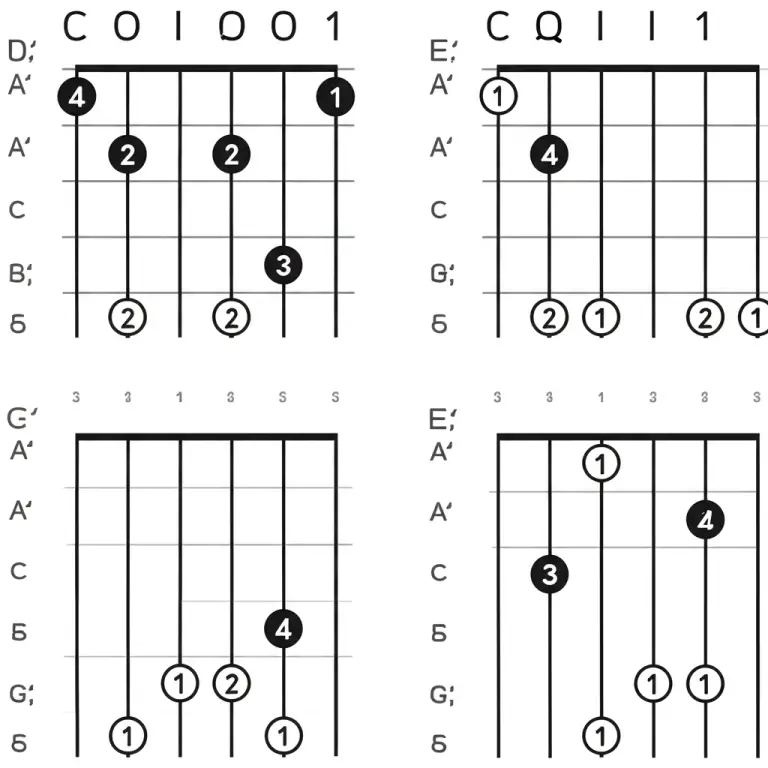
The same fingering geometry does not guarantee the same chord name. Here are common standard ukulele shapes in G–C–E–A:

| Chord | Common ukulele shape, fourth to first string | Guitar comparison |
|---|---|---|
| C | 0–0–0–3 | Not the standard open guitar C shape |
| F | 2–0–1–0 | Compact ukulele voicing |
| G | 0–2–3–2 | Different geometry from guitar G |
| Am | 2–0–0–0 | Very compact |
| Dm | 2–2–1–0 | Compact triadic shape |
| Em | 0–4–3–2 | Requires a stretch on smaller necks |

The phrase **“use the same chords”** can mean two different things:

1. Play the same **harmonic chord names** in a new instrument-specific shape.
2. Reuse the same **physical fingering shape**, which may produce another chord.

The first is dependable. The second is where many guitarists step on the rake.

## [Tuning Comparison by Ukulele Size](#tuning-comparison-by-ukulele-size)

| Size | Most common tuning | High-G availability | Low-G suitability | Guitarist friendliness |
|---|---|---|---|---|
| Soprano | G–C–E–A | Excellent | Limited by scale and string design | Moderate |
| Concert | G–C–E–A | Excellent | Very good | Good |
| Tenor | G–C–E–A | Excellent | Excellent | Very good |
| Baritone | D–G–B–E | Rarely relevant | Usually unnecessary | Excellent |

# [🔧 How to Tune a Ukulele Correctly](#how-to-tune-a-ukulele-correctly)

Accurate tuning is less mysterious than it sounds. The real trick is tuning **up to pitch**, checking the instrument under playing pressure, and understanding whether your fourth string is high-G or low-G.

## [Using a Clip-On Tuner or Smartphone App](#using-a-clip-on-tuner-or-smartphone-app)

A chromatic tuner listens for the note and tells you whether it is sharp or flat. Reliable choices include the [Korg official tuner range](https://www.korg.com/us/products/tuners/), [Fender Tune](https://www.fender.com/apps/fender-tune), and [Snark tuners](https://snarktuners.com/).

A clip-on tuner is often preferable in a noisy room because it detects vibration through the headstock rather than relying entirely on air-borne sound.

### Step-by-step tuning method

1. **Confirm the intended tuning.** Is the instrument high-G, low-G, D tuning, or baritone?
2. **Pluck one open string at a time.**
3. **Tune below the target pitch first.**
4. **Raise the pitch slowly** until the tuner centers.
5. **Stretch the string gently** along its length after installation.
6. **Retune all strings**, then repeat the cycle.
7. **Play several chords**, especially near the nut.
8. **Check again after strumming**, because pressure and string movement can reveal instability.

## [Tuning a High-G Ukulele Step by Step](#tuning-a-high-g-ukulele-step-by-step)

Target the notes from the fourth string to the first:

```text
G4 – C4 – E4 – A4
``

1. Select chromatic mode.
2. Tune the fourth string to **G**, verifying it is the high-G octave.
3. Tune the third string to **C**.
4. Tune the second string to **E**.
5. Tune the first string to **A**.
6. Play a C, F, and G7 chord.
7. Recheck each string.

A tuner that displays only note names may not make the octave obvious. If the G sounds surprisingly deep, you may have a low-G setup. If it sounds close to the pitch area of the A string, it is likely high-G.

## [Tuning a Low-G Ukulele Step by Step](#tuning-a-low-g-ukulele-step-by-step)

The note names remain **G–C–E–A**, but the G is lower:

```text
G3 – C4 – E4 – A4
``

Low-G strings are thicker and may require a different nut slot. Switching between high-G and low-G can therefore be more than a string swap, particularly if the string binds or the intonation changes.

A good low-G setup should:

- Seat the string cleanly in the nut
- Avoid buzzing
- Maintain stable tuning
- Intonate acceptably up the neck
- Preserve comfortable action

## [Tuning by Ear with a Reference Pitch](#tuning-by-ear-with-a-reference-pitch)

Electronic tuners are convenient, but ear training matters. Use a reliable reference such as:

- A piano
- A digital keyboard
- A pitch pipe
- A tuning fork
- A calibrated tuner
- A fellow instrument already tuned to concert pitch

Tune one string, then use intervals to tune the others. This method works best when you understand whether you are matching octaves, unisons, or fretboard equivalents.

For example, on a standard ukulele:

- The **C string at the fourth fret** produces E.
- The **E string at the third fret** produces G.
- The **C string at the seventh fret** produces G.
- The **E string at the fifth fret** produces A.

These relationships help you hear whether the instrument is internally consistent.

## [How to Check Intonation After Tuning](#how-to-check-intonation-after-tuning)

Tuning open strings does not guarantee every fret is accurate.

1. Tune the open string.
2. Play the 12th-fret harmonic.
3. Play the fretted 12th-fret note with normal pressure.
4. Compare the tuner readings.
5. Repeat on each string.
6. If the fretted note is consistently sharp or flat, ask a qualified repair technician to inspect the bridge position, saddle, nut, and action.

Do not “fix” serious intonation issues by cranking tuners randomly. The tuner is a messenger, not the villain.

# [🎯 Guitar Tuning Fundamentals for Ukulele Players](#guitar-tuning-fundamentals-for-ukulele-players)

Guitarists already understand tuning mechanics: turn the machine head, listen for beats, use a reference, and recheck after playing. The mental adjustment is learning that ukulele string relationships are not simply the guitar’s first four or last four strings unless you are discussing a baritone.

## [The Guitar’s E–A–D–G–B–E Arrangement](#the-guitars-e-a-d-g-b-e)

Standard guitar tuning provides useful octave and fretboard relationships:

- The fifth fret of the low E equals open A.
- The fifth fret of A equals open D.
- The fifth fret of D equals open G.
- The fourth fret of G equals open B.
- The fifth fret of B equals open high E.

Ukulele tuning uses its own reference points:

- C string, fourth fret = E
- E string, third fret = G
- E string, fifth fret = A
- C string, seventh fret = G

The result is not harder; it is simply a different map.

## [Why Guitar Tuning Is Less Symetrical](#why-guitar-tuning-is-less-symetrical)

The G-to-B major third is the reason guitar chord diagrams often change shape across that boundary. Ukulele chord forms are also shaped by their intervals, but the smaller string set makes the visual patterns feel more concentrated.

A guitarist who blindly transfers a six-string scale pattern may encounter:

- Unexpected chord names
- Missing bass notes
- Awkward stretches
- Duplicate pitches
- High-G octave surprises

The solution is not to abandon guitar knowledge. It is to transfer **interval thinking**, not just finger choreography.

## [How Guitarists Can Adapt to Ukulele Tuning](#how-guitarists-can-adapt-to-ukulele-tuning)

Start with the following sequence:

1. Memorize **G–C–E–A** aloud.
2. Learn the open-string sound of each note.
3. Practice C, F, G, Am, Dm, and G7.
4. Strum quarter notes while naming the chord.
5. Play scales one string.
6. Add movable shapes only after the open position feels automatic.
7. Compare high-G and low-G versions of the same arrangement.

Our favorite test is to play a familiar guitar song using only three ukulele chords. The reduced bass forces you to listen to rhythm, articulation, and vocal support instead of hiding behind a six-string wall of sound.

# [🎹 Ukulele Chord Shapes Compared with Guitar Chords](#ukulele-chord-shapes-compared-with-guitar-chords)

## [Which Guitar Chords Transfer Directly](#which-guitar-chords-transfer-directly)

The most direct transfer occurs with:

- **Baritone ukulele D–G–B–E**
- **Tenor guitar in DGBE**
- Guitar arrangements that intentionally use only the top four strings

A guitarist can often play familiar top-four chord fragments on a baritone ukulele. But even here, the smaller body, shorter scale, and synthetic strings change the attack.

For standard G–C–E–A ukulele, learn chord names separately. The good news: many shapes are compact and physically approachable.

## [Why Familiar Guitar Shapes Sound Different](#why-familiar-guitar-shapes-sound-different)

Chord shapes are recipes. The strings are ingredients. Change the string notes and you have a different dish.

A guitar open C chord includes C, E, G, C, E, often with a low C or low E depending on fingering. A standard ukulele C chord is commonly:

```text
G – C – E – C
``

It is still C major, but the voicing is smaller and brighter.

On high-G ukulele, the top G may sit above C rather than below it. That alters the chord’s spread and gives strumming a little “pop” on the front edge.

## [Transposing Guitar Chords for Ukulele](#transposing-guitar-chords-for-ukulele)

Suppose a guitar song uses:

```text
G – D – Em – C
``

You can:

1. Use a ukulele chord chart and play the same **chord names**.
2. Transpose the song to a ukulele-friendly key.
3. Use a capo if the vocal range requires it.
4. Retain the guitar’s concert key while choosing ukulele voicings.

The instrument does not need to reproduce the exact guitar voicing to preserve the song’s harmony. In a band, that difference can be an advantage: guitar supplies the bass, while ukulele adds high rhythmic color.

## [Common Chord Shape Mistakes](#common-chord-shape-mistakes)

❌ Assuming every guitar shape transfers by fingering
❌ Confusing high-G and low-G chord diagrams
❌ Calling a shape “wrong” because the voicing differs
❌ Ignoring muted strings
❌ Pressing too hard and pulling notes sharp
❌ Using a low-G chart on a high-G instrument without checking the arrangement

✅ Learn the chord’s **notes and function**
✅ Check the diagram’s string order
✅ Listen to the open strings
✅ Practice slow transitions
✅ Compare the chord to a reference recording

# [🎵 Navigating the Ukulele Fretboard](#navigating-the-ukulele-fretboard)

## [Ukulele Note Layout for Guitar Players](#ukulele-note-layout-for-guitar-players)

The fretboard repeats chromatically:

```text
A → A♯/B♭ → B → C → C♯/D♭ → D → D♯/E♭ → E → F → F♯/G♭ → G → G♯/A♭
``

The challenge is not the twelve-note system. It is remembering which open note begins each string.

Use landmarks:

- 3rd fret
- 5th fret
- 7th fret
- 10th fret
- 12th fret octave

Guitarists should resist treating the ukulele as a partial guitar. The top-four relationship is real, but standard G–C–E–A requires a new reference map.

## [Finding Octaves, Intervals, and Root Notes](#finding-octaves-intervals-and-root-notes)

Practice these exercises:

### Exercise 1: One-string note naming

Pick a string and name every note from the open position to the 12th fret.

### Exercise 2: Root-note hunt

Choose C, then locate every C on the fretboard.

### Exercise 3: Interval singing

Play C, then sing:

- Major second: D
- Major third: E
- Perfect fourth: F
- Perfect fifth: G
- Major sixth: A

### Exercise 4: Chord-tone awareness

Play C major and identify C, E, and G rather than memorizing only the fingering.

This approach transfers well to guitar, bass, mandolin, and other fretted instruments. Our [Bass Guitars category](https://www.guitarbrands.org/category/bass-guitars/) explores the same root-and-interval thinking at a lower register.

## [Reading Ukulele Tablature and Chord Diagrams](#reading-ukulele-tablature-and-chord-diagrams)

Ukulele diagrams may display strings in an orientation that differs from your physical viewpoint. Check:

- Is the diagram showing the headstock at the top?
- Is the fourth string on the left or right?
- Is the tuning listed?
- Is the G string high or low?
- Are muted and open strings marked?

A tab line for a high-G ukulele may produce a different melodic contour from the same numbers on low-G. The fret numbers are identical; the open-string octave is not.

## [Using a Low-G String for Guitar-Style Melodies](#using-a-low-g-string-for-guitar-style-melodies)

Low-G is especially useful for:

- Travis-style patterns
- Bass-and-melody arrangements
- Classical repertoire
- Walking bass lines
- Fingerstyle blues
- Solo instrumental playing

High-G often wins for:

- Island-style strumming
- Fast rhythmic patterns
- Group singalongs
- Traditional ukulele arrangements
- Bright pop accompaniment

Neither is superior. They are different voices. Calling one “better” is like calling a trumpet better than a cello because both play melodies.

# [🔢 9 Practical Ways Ukulele Tuning Differs from Guitar Tuning](#9-practical-ways-ukulele-tuning-differs-from-guitar-tuning)

## [1. The Ukulele Has Four Strings](#1-the-ukulele-has-four-strings)

Four strings mean fewer open pitches, fewer simultaneous chord tones, and a smaller physical playing area. That reduces some complexity but increases the importance of choosing efficient voicings.

✅ Easier string identification
✅ Faster basic chord learning
❌ Less bass range
❌ Fewer options for extended guitar voicings

## [2. Standard Ukulele Tuning Uses a Rentrant High-G String](#2-standard-ukulele-tuning-uses-a-rentrant-high-g-string)

High-G tuning places the fourth string’s pitch above the C string. This creates a bright re-entrant texture.

It also means a scale may not ascend smoothly across the strings. For fingerstyle, that can be either a delightful sparkle or an unexpected banana peel.

## [3. Ukulele Tuning Is Centered on G–C–E–A](#3-ukulele-tuning-is-centered-on-g-c-e-a)

G–C–E–A is the standard reference for soprano, concert, and tenor ukulele. It is not the guitar’s E–A–D–G arrangement.

The notes are closely related to common guitar chord harmony, but their order and register produce different shapes.

## [4. Guitar Strings Cover a Wider Pitch Range](#4-guitar-strings-cover-a-wider-pitch-range)

Standard guitar extends substantially lower than standard ukulele. That lower range supports:

- Bass roots
- Power chords
- Alternating-bass patterns
- Full six-string arrangements
- Greater dynamic weight

A ukulele can imply bass through chord choice and rhythm, but it does not reproduce a guitar’s low E with standard tuning.

## [5. Ukulele Chord Shapes Are Usually More Compact](#5-ukulele-chord-shapes-are-usually-more-compact)

A basic ukulele C chord may require one finger at the third fret. A guitar C chord uses a more involved multi-string shape.

This makes ukulele immediately approachable, but advanced harmony still demands knowledge. Smaller does not mean musically shallow.

## [6. Ukulele Chords May Use Different Voicings](#6-ukulele-chords-may-use-different-voicings)

The same chord name can sound different because the note order changes. That is an advantage in ensemble playing: you can avoid competing with the guitar’s bass register.

## [7. Baritone Ukulele Tuning Closely Matches the Guitar](#7-baritone-ukulele-tuning-closely-matches-the-guitar)

D–G–B–E corresponds to the guitar’s highest four strings. This is the easiest bridge for guitarists who want familiar shapes without carrying a full-size instrument.

## [8. Ukulele Strings Require Different Tension and Gauges](#8-ukulele-strings-require-different-tension-and-gauges)

Ukulele strings are not miniature guitar strings. Brands such as [Aquila](https://aquilacorde.com/en/), [D’Addario](https://www.daddario.com/), and [Worth Strings](https://www.worthstrings.com/) offer sets designed for specific ukulele sizes and tunings.

Always match:

- Instrument size
- Tuning
- High-G or low-G setup
- String material
- Manufacturer recommendations

## [9. Transposing Between Instruments Is Often Necessary](#9-transposing-between-instruments-is-often-necessary)

A song arranged for guitar may need:

- New chord diagrams
- A capo
- A different key
- A bass note substitution
- A low-G setup
- A simplified rhythm pattern

The song remains the song. The instrument changes its accent.

# [🪕 Ukulele Strings, Tension, and Setup](#ukulele-strings-tension-and-setup)

## [High-G vs. Low-G String Sets](#high-g-vs-low-g-string-sets)

Do not buy “a ukulele string set” without checking the intended configuration. A high-G set may contain a thin fourth string; a low-G set uses a thicker wound or fluorocarbon string.

| Consideration | High-G set | Low-G set |
|---|---|---|
| Fourth string | Thin, high octave | Thick, lower octave |
| Strumming | Crisp and percussive | Rounder and fuller |
| Fingerstyle | Sparkling, nonlinear | Bass-friendly, linear |
| Nut compatibility | Usually standard | May require slot adjustment |
| Traditional sound | Strong match | More modern/guitar-like |

## [Can You Put Guitar Strings on a Ukulele?](#can-you-put-guitar-strings-on-a-ukulele)

Usually, **not as a casual experiment**. Guitar strings may create inappropriate tension, fail to fit the nut, damage the bridge, or produce poor intonation.

A purpose-built steel-string ukulele or tenor guitar is different. It is engineered for the tension and load of steel strings. Examples include instruments from [Pono](https://ponoguitars.com/), [Kala](https://kalabrand.com/), and specialty builders.

The safe rule:

✅ Use a ukulele-specific set
✅ Follow the manufacturer’s tuning guidance
✅ Ask a luthier before changing string material
❌ Do not assume “same note” means “same tension”
❌ Do not install a random guitar set because the package is nearby

## [How String Material Changes Tone](#how-string-material-changes-tone)

### Nylon

- Soft feel
- Warm attack
- Moderate sustain
- Traditional ukulele character

### Fluorocarbon

- Clearer articulation
- Often slightly brighter response
- Stable feel once settled
- Popular for modern ukulele setups

### Wound low-G

- Stronger bass presence
- More linear melodic response
- Can feel different under the fingers
- May require a properly fitted nut slot

### Steel

- Brighter, louder, more projecting
- Higher mechanical demands
- Usually belongs on purpose-built instruments

## [When to Replace Ukulele Strings](#when-to-replace-ukulele-strings)

Replace strings when they:

- Sound dull despite accurate tuning
- Feel rough or sticky
- Develop visible damage
- Refuse to intonate
- Lose tuning stability
- Show corrosion or unwinding

Replacement frequency depends on sweat, playing hours, climate, string type, and storage. Wipe strings after playing and store the instrument away from severe heat and humidity.

## [Bridge, Nut, and Intonation Considerations](#bridge-nut-and-intonation-considerations)

Changing string gauge can affect:

- Nut friction
- Action
- Neck relief
- Saddle seating
- Intonation
- Tuning stability

A string that is too large may bind in the nut, causing the pitch to jump sharp when tuning. A string that is too small may rattle or sit loosely. If the instrument requires filing, shimming, or bridge relocation, use a qualified repair technician.

# [🎼 Alternative Tunings for Different Musical Styles](#alternative-tunings-for-different-musical-styles)

## [Low-G for Fingerpicking and Arrangements](#low-g-for-fingerpicking-and-arrangements)

Low-G is our first recommendation for guitarists who want:

- Familiar bass movement
- More linear scales
- Fingerstyle independence
- Solo arrangements
- Folk and classical repertoire

It will not sound like a miniature dreadnought. The body still determines projection and resonance. But it makes the instrument’s pitch layout more intuitive.

## [D-Tuning for a Brighter Traditional Sound](#d-tuning-for-a-brighter-traditional-sound)

Traditional D tuning is commonly written:

```text
A – D – F♯ – B
``

Compared with G–C–E–A, every string is raised by a whole step. The result is brighter tension and a higher overall register, assuming the string set is designed for it.

Never raise tuning beyond the string maker’s recommendation. “It worked for one uke online” is not a luthier’s certificate.

## [Open-C and Other Experimental Tunings](#open-c-and-other-experimental-tunings)

Open tunings can support:

- Drone-based accompaniment
- Slide guitar-inspired playing
- Modal composition
- Ambient textures
- Simplified one-finger harmony

Before experimenting, write down the notes and interval structure. A tuning that looks exotic may simply be:

- Repeated roots
- Perfect fifths
- Suspended fourths
- Octave doubling
- A major or minor open chord

## [Choosing a Tuning for Strumming, Jazz, Blues, or Classical Playing](#chosing-a-tuning-for-strumming-jazz-blues-or-classical-playing)

| Style | Recommended starting tuning | Why |
|---|---|---|
| Traditional strumming | High-G G–C–E–A | Classic attack and rhythmic sparkle |
| Pop accompaniment | High-G or low-G | Choose by arrangement and vocal range |
| Fingerstyle folk | Low-G G–C–E–A | Better bass-to-melody movement |
| Classical | Low-G or specialty setup | More linear melodic control |
| Blues | Low-G or baritone D–G–B–E | Stronger bass possibilities |
| Jazz | Low-G tenor or baritone | More useful extended voicings |
| Experimental | Open or DADA-style tuning | Drones and suspended textures |

The featured video’s open-tuning philosophy is persuasive: a tuning is not only a maintenance setting; it can become a compositional tool.

# [🎤 How Tuning Changes Ukulele Tone and Playability](#how-tuning-changes-ukulele-tone-and-playability)

## [Rentrant Tuning and the Classic Ukulele Sound](#rentrant-tuning-and-the-classic-ukulele-sound)

Re-entrant tuning places a high note where many instruments would place a low note. In a strum, that high note arrives early and gives the chord a crisp upper edge.

That is the secret behind much of the recognizable ukulele sound. It is not just the small body. It is the **ordering of pitches**.

## [Low-G Tuning and a Fuller Bass Response](#low-g-tuning-and-a-fuller-bass-response)

Low-G makes:

- Descending scales more natural
- Arpeggios more guitar-like
- Bass notes more audible
- Solo arrangements more complete
- Thumb-led patterns more predictable

The trade-off is a subtle reduction in the traditional high-G “bounce.” If your entire arrangement depends on that repeated upper G, low-G may sound like the drummer forgot their tambourine.

## [Scale Length, Neck Feel, and Fret Spacing](#scale-length-neck-fel-and-fret-spacing)

Tuning alone does not determine playability. Consider:

- Scale length
- Nut width
- String spacing
- Neck profile
- Action height
- String tension
- Fret size

A baritone ukulele may share DGBE with a guitar’s top four strings but feel much easier because its scale is shorter and its strings are softer. Conversely, a steel-string tenor guitar in DGBE may feel closer to a compact guitar than a baritone ukulele.

The [Ukulele Underground discussion](https://forum.ukuleleunderground.com/threads/tenor-guitar-vs-baritone-ukulele.140279/) repeatedly emphasizes this distinction: **tuning alone does not define the instrument.**

## [How Tuning Influences Singing and Song Keys](#how-tuning-influences-singing-and-song-keys)

Tuning changes the instrument’s voicing, not necessarily the song’s key. You can play a C chord in high-G, low-G, or baritone tuning, but the chord’s texture and register will differ.

Use:

- A capo to raise the key
- Transposition to fit your voice
- A low-G arrangement for bass support
- High-G for rhythmic brightness
- Baritone for lower accompaniment

# [🧑 🎓 Learning Ukulele After Playing Guitar](#learning-ukulele-after-playing-guitar)

## [Skills That Transfer Immediately](#skills-that-transfer-imediately)

Guitarists bring valuable skills:

- Pick and fingerstyle coordination
- Chord-transition discipline
- Rhythm and meter
- Muting
- Dynamics
- Ear training
- Song form
- Basic harmony

Your fretting hand may initially overeach. Your strumming hand will probably adapt faster than your chord vocabulary.

## [New Techniques You Need to Learn](#new-techniques-you-need-to-learn)

Focus on:

1. High-G versus low-G awareness
2. Ukulele-specific chord diagrams
3. Thumb placement on a narrower neck
4. Softer fretting pressure
5. Four-string muting
6. Compact movable shapes
7. Re-entrant fingerstyle patterns

## [A Simple Practice Routine for Guitarists](#a-simple-practice-routine-for-guitarists)

### Minutes 1–3: Tune and name strings

Say **G–C–E–A** aloud.

### Minutes 4–8: Open chords

Practice C, F, G, Am, Dm, and G7.

### Minutes 9–13: Rhythm

Use downstrokes, then:

```text
D – D – D – D
D – D U – U D U
``

### Minutes 14–18: Fretboard

Name notes one string.

### Minutes 19–25: Song application

Play a song with only two or three chords while recording yourself.

The recording exposes timing issues that feel invisible while you are busy staring at your fingers.

## [Avoiding Guitar Muscle Memory Traps](#avoiding-guitar-muscle-memory-traps)

❌ Reaching automatically for a guitar C shape
❌ Assuming the lowest-looking string is the lowest pitch
❌ Pressing as hard as you do on steel guitar
❌ Strumming six imaginary strings
❌ Reading a guitar tab without adapting string count
❌ Treating high-G as a defective low-G

✅ Learn the instrument in its own tuning
✅ Use a light fretting touch
✅ Listen before correcting
✅ Mark high-G or low-G on every chart

# [🧑 🏫 Learning Guitar After Playing Ukulele](#learning-guitar-after-playing-ukulele)

## [What Ukulele Players Already Understand](#what-ukulele-players-already-understand)

Ukulele players already know:

- Basic chord function
- Rhythm accompaniment
- Fretboard movement
- Chord diagrams
- Tuning discipline
- Singing while playing
- The value of relaxed fretting

That is a strong foundation. Guitar adds range, tension, and physical spread rather than replacing what you learned.

## [Adjusting to Six Strings and Wider Stretching](#adjusting-to-six-strings-and-wider-stretching)

Expect:

- Wider fret spacing
- Higher string tension
- More demanding barre chords
- Greater right-hand accuracy requirements
- Additional bass-string muting
- More complex chord voicings

Start with a comfortable acoustic guitar, such as a smaller-bodied model from [Taylor](https://www.taylorguitars.com/), [Yamaha](https://usa.yamaha.com/products/musical_instruments/guitars_basses/ac_guitars/index.html), or [Martin](https://www.martinguitar.com/). Our [Acoustic Guitars category](https://www.guitarbrands.org/category/acoustic-guitars/) covers body sizes and setup choices that can make this transition friendlier.

## [Building Guitar Chord Vocabulary](#building-guitar-chord-vocabulary)

Start with:

- C
- G
- D
- Em
- A
- E
- Am
- F
- Dm

Then add:

- Seventh chords
- Sus2 and sus4 chords
- Barre chords
- Movable triads
- Power chords
- Drop-D shapes

Do not rush into six-string complexity just because the instrument offers six strings. A clean three-chord performance beats a heroic battle with F barre chord every time.

# [🧰 Ukulele Tuning Problems and Troubleshooting](#ukulele-tuning-problems-and-troubleshooting)

## [Why a Ukulele Will Not Stay in Tune](#why-a-ukulele-will-not-stay-in-tune)

Common causes include:

- New strings still stretching
- Slipping friction tuners
- Strings improperly tied
- Nut binding
- Temperature changes
- Humidity shifts
- Excessive tuning changes
- Poor-quality or damaged tuners

New synthetic strings can take time to stabilize. Tune repeatedly over several sessions rather than judging the instrument after ten minutes.

## [Fixing Sharp or Flat Notes](#fixing-sharp-or-flat-notes)

If the open string is correct but fretted notes are wrong:

1. Check fretting pressure.
2. Check whether the string is seated properly.
3. Compare the 12th-fret harmonic and fretted note.
4. Inspect action height.
5. Verify the correct string gauge.
6. Seek professional setup help if the issue persists.

If all fretted notes are sharp near the nut, excessive action may be forcing the string too far downward.

## [New String Stretching and Tuning Stability](#new-string-stretching-and-tuning-stability)

After installing strings:

1. Tune accurately.
2. Gently stretch each string.
3. Retune.
4. Repeat several times.
5. Play chords and bends lightly.
6. Retune again.

Avoid aggressive pulling. A ukulele bridge is smaller than a guitar bridge, and enthusiasm is not a substitute for restraint.

## [Diagnosing Buzzing, Dead Notes, and Poor Intonation](#diagnosing-buzzing-dead-notes-and-por-intonation)

| Symptom | Possible cause | First response |
|---|---|---|
| Buzz on open string | Nut slot or loose hardware | Inspect nut and tuners |
| Buzz at one fret | Uneven fret | Have a technician inspect |
| Dead note | Poor fret contact or setup | Test neighboring frets |
| Sharp notes at 12th fret | Saddle/action issue | Professional setup |
| String slips | Poor winding or tuner | Restring carefully |
| Rattling sound | Loose brace or hardware | Stop tightening randomly; inspect |

## [When to Visit a Qualified Luthier](#when-to-visit-a-qualified-luthier)

Consult a technician when:

- The neck appears warped
- The bridge is lifting
- The instrument needs a nut slot altered
- You want to convert high-G to low-G permanently
- Intonation is consistently poor
- A steel-string conversion is under consideration
- The instrument develops cracks or structural noise

# [✅ Best Tuners, Apps, and Accessories for Accurate Tuning](#best-tuners-apps-and-accessories-for-accurate-tuning)

## [Clip-On Tuners vs. Chromatic Tuner Apps](#clip-on-tuners-vs-chromatic-tuner-apps)

| Tool | Strengths | Limitations |
|---|---|---|
| Clip-on tuner | Works in noisy rooms, fast, portable | Can misread vibration if poorly attached |
| Smartphone app | Convenient, visual, often inexpensive | Microphone affected by room noise |
| Pedal tuner | Excellent for amplified instruments | Less useful for purely acoustic practice |
| Pitch pipe | Builds ear training | Requires more experience |
| Tuning fork | Extremely stable reference | Limited to one pitch |

We like a clip-on tuner for rehearsals and a phone app for quiet practice. Keep a physical tuner in the case anyway. Batteries enjoy dying five minutes before soundcheck.

## [Useful Ukulele Tuning Tools](#useful-ukulele-tuning-tools)

- [Korg clip-on tuners](https://www.korg.com/us/products/tuners/)
- [Fender Tune app](https://www.fender.com/apps/fender-tune)
- [Snark tuners](https://snarktuners.com/)
- [D’Addario string sets](https://www.daddario.com/)
- [Aquila ukulele strings](https://aquilacorde.com/en/)
- Spare batteries
- String winder
- Microfiber cloth
- Small screwdriver for tuner hardware

## [How to Tune Quietly Before a Performance](#how-to-tune-quietly-before-a-performance)

1. Mute the strings between checks.
2. Use a clip-on tuner.
3. Tune before plugging in.
4. Tune again after connecting to the amplification system.
5. Check the first chord of every song.
6. Keep the tuner accessible during the set.

If the stage environment is loud, a microphone-based phone app may struggle. A vibration-sensitive tuner is safer.

## [Tuning Tips for Recording and Live Shows](#tuning-tips-for-recording-and-live-shows)

Before recording:

- Let the instrument acclimate to the room.
- Replace old strings early enough for them to settle.
- Tune at the session’s reference pitch.
- Check every take.
- Avoid changing tuning repeatedly without rechecking intonation.

Before a live show:

- Carry a spare string set.
- Mark high-G or low-G on the case.
- Bring a backup tuner.
- Check tuning after stage lights warm the instrument.
- Retune after aggressive strumming.

# [🎶 Playing the Same Song on Ukulele and Guitar](#playing-the-same-song-on-ukulele-and-guitar)

## [Matching Chords Across Both Instruments](#matching-chords-across-both-instruments)

The easiest approach is to keep the **same chord names** and use instrument-specific shapes.

For example:

```text
Guitar song: C – G – Am – F
Ukulele shapes: C – G – Am – F
``

The harmony remains intact, but the register changes. Guitar supplies low-end authority; ukulele supplies a lighter rhythmic layer.

## [Keeping the Original Key](#keeping-the-original-key)

A standard ukulele can play the original key without being tuned to the guitar. You simply use the correct ukulele shapes.

If the vocal range is uncomfortable:

- Use a capo
- Transpose chord names
- Choose a different tuning
- Select a low-G tenor or baritone
- Adjust the melody rather than forcing the singer

## [Using a Capo on Guitar and Ukulele](#using-a-capo-on-guitar-and-ukulele)

A capo raises every open string by the same number of semitones. It does not convert a standard guitar into a standard ukulele by itself.

A guitar’s highest four strings at the fifth fret become G–C–E–A, but the full six-string instrument still contains two additional strings. Removing strings, changing tension, or using a capo should be approached carefully.

## [When to Use a Transposition Chart](#when-to-use-a-transposition-chart)

Use a chart when:

- The original key is uncomfortable
- You are accompanying a singer
- The ukulele arrangement lacks a useful open chord
- You want to avoid difficult barre shapes
- You are moving between standard and baritone ukulele

Transposition changes note names, not the instrument’s physical tuning. Keep those two ideas separate.

# [🌎 Ukulele Tuning Traditions Around the World](#ukulele-tuning-traditions-around-the-world)

## [Hawaian Ukulele Tuning Practices](#hawaian-ukulele-tuning-practices)

The ukulele is inseparable from Hawaiian musical history, but modern players use several tuning approaches. High-G G–C–E–A remains the familiar standard for many traditional and popular contexts.

The [Smithsonian ukulele collection](https://americanhistory.si.edu/collections/object-groups/ukulele) provides useful historical context without reducing the instrument to a novelty prop. Its musical identity developed through cultural exchange, adaptation, and local innovation.

## [Modern Pop, Folk, and Classroom Tuning](#modern-pop-folk-and-classroom-tuning)

Modern educators often choose G–C–E–A because:

- Chord charts are widely available
- Beginner songs use simple shapes
- Replacement strings are easy to find
- Group instruction is straightforward
- Most method books assume it

Professional performers may choose low-G, baritone, or custom tunings for arrangement depth.

## [Regional Preferences and Instrument Sizes](#regional-preferences-and-instrument-sizes)

Soprano remains strongly associated with the classic ukulele sound, while concert and tenor models offer more space and projection. Baritone instruments appeal to guitarists because of DGBE.

The best tuning is partly cultural, partly practical, and partly personal. The instrument on your lap is more honest than an internet argument about which tuning is “correct.”

# [❓ Frequently Asked Ukulele and Guitar Tuning Questions](#frequently-asked-ukulele-and-guitar-tuning-questions)

## [Is a Ukulele Tuned Like the Top Four Guitar Strings?](#is-a-ukulele-tuned-like-the-top-four-guitar-strings)

**A baritone ukulele usually is: D–G–B–E.** Standard soprano, concert, and tenor ukules usually are not; they use G–C–E–A.

## [Can a Guitarist Use the Same Chords on Ukulele?](#can-a-guitarist-use-the-same-chords-on-ukulele)

You can use the same **chord names**, but generally not the same physical shapes on a standard ukulele. Baritone ukulele offers the most direct guitar-shape relationship.

## [Is Ukulele Tuning Easier Than Guitar Tuning?](#is-ukulele-tuning-easier-than-guitar-tuning)

Tuning four strings is mechanically simpler than tuning six. However, high-G’s re-entrant arrangement can make the note layout less intuitive for guitarists.

## [Should I Choose High-G or Low-G Tuning?](#should-i-choose-high-g-or-low-g-tuning)

Choose **high-G** for traditional strumming and bright rhythmic texture. Choose **low-G** for fingerstyle, melody, bass movement, and a more guitar-like layout.

## [Can You Tune a Ukulele to Guitar Notes?](#can-you-tune-a-ukulele-to-guitar-notes)

Yes, within safe tension limits. Baritone ukulele already uses the highest four guitar notes. Standard ukules can be retuned, but the string set and instrument setup must support the target pitches.

## [Why Does My Ukulele Sound Out of Tune at Higher Frets?](#why-does-my-ukulele-sound-out-of-tune-at-higher-frets)

Likely causes include intonation, high action, incorrect string gauge, nut or saddle problems, temperature changes, or excessive fretting pressure. Compare the open string, 12th-fret harmonic, and fretted 12th-fret note.

## [Which Instrument Is Easier to Learn?](#which-instrument-is-easier-to-learn)

The ukulele usually offers a gentler physical start because it has fewer strings, softer tension, and compact chord shapes. Guitar offers broader range and more complete bass support but demands more stretching and coordination.

# [🏁 Conclusion: Which Tuning Is Right for You?](#conclusion-which-tuning-is-right-for-you)

**The tuning of a ukulele compares to guitar tuning through relationships, not identity.** A standard guitar uses E–A–D–G–B–E. A standard soprano, concert, or tenor ukulele uses G–C–E–A, often with a high-G re-entrant fourth string. A baritone ukulele uses D–G–B–E, matching the guitar’s highest four strings.

Our recommendations are straightforward:

- **Choose high-G G–C–E–A** for classic ukulele strumming, bright accompaniment, and traditional texture.
- **Choose low-G G–C–E–A** for fingerstyle, solo arrangements, folk, blues, and guitarists who want a linear bass-to-treble layout.
- **Choose a baritone ukulele** if you want the closest common ukulele tuning to guitar.
- **Choose a purpose-built tenor guitar** when you want steel-string volume, projection, and sustain, accepting greater tension and a potentially narrower neck.
- **Do not convert a random guitar with improvised strings**. The [Turn a Guitar into a Ukulele discussion](https://forum.ukuleleunderground.com/threads/turn-a-guitar-into-a-ukulele.157635/) is useful for ideas, but experimentation must respect string tension and instrument construction.

The unresolved mystery from the opening is now solved: the ukulele sounds “easy” not because it is merely a trimmed-down guitar, but because its **four-string layout, shorter scale, higher register, and re-entrant tuning** create a different musical machine. Once you understand that, tuning stops being a trap and becomes a palette. And yes, as the featured video insists, **tuning is fun**. 🎶

# [🔗 Recommended Links](#recommended-links)

For further reading and shopping, begin with our [Guitar Brands Showcase](https://www.guitarbrands.org/category/guitar-brands-showcase/), [Guitar Brand Guides](https://www.guitarbrands.org/category/guitar-brand-guides/), [Acoustic Guitars](https://www.guitarbrands.org/category/acoustic-guitars/), and [Guitar Buying Guide](https://www.guitarbrands.org/category/guitar-buying-guide/).

👉 **CHECK PRICE on:**

- **Kala Concert Ukulele:** [Amazon](https://www.amazon.com/s?k=Kala+concert+ukulele&tag=bestbrands0a9-20) | [Guitar Center](https://www.guitarcenter.com/search?Ntt=Kala%20concert%20ukulele) | [Kala Official Website](https://kalabrand.com/)
- **Kala Tenor Ukulele:** [Amazon](https://www.amazon.com/s?k=Kala+tenor+ukulele&tag=bestbrands0a9-20) | [Sweetwater](https://www.sweetwater.com/store/search?s=Kala%20tenor%20ukulele) | [Kala Official Website](https://kalabrand.com/)
- **Pono Baritone Ukulele:** [Amazon](https://www.amazon.com/s?k=Pono+baritone+ukulele&tag=bestbrands0a9-20) | [Guitar Center](https://www.guitarcenter.com/search?Ntt=Pono%20baritone%20ukulele) | [Pono Official Website](https://ponoguitars.com/)
- **Martin 0XK Concert Ukulele:** [Amazon](https://www.amazon.com/s?k=Martin+0XK+concert+ukulele&tag=bestbrands0a9-20) | [Guitar Center](https://www.guitarcenter.com/search?Ntt=Martin%200XK%20ukulele) | [Martin Official Website](https://www.martinguitar.com/)
- **Aquila Ukulele Strings:** [Amazon](https://www.amazon.com/s?k=Aquila+ukulele+strings&tag=bestbrands0a9-20) | [Guitar Center](https://www.guitarcenter.com/search?Ntt=Aquila%20ukulele%20strings) | [Aquila Official Website](https://aquilacorde.com/en/)
- **D’Addario Ukulele Strings:** [Amazon](https://www.amazon.com/s?k=D%27Addario+ukulele+strings&tag=bestbrands0a9-20) | [Sweetwater](https://www.sweetwater.com/store/search?s=D%27Addario%20ukulele%20strings) | [D’Addario Official Website](https://www.daddario.com/)
- **Korg Clip-On Tuner:** [Amazon](https://www.amazon.com/s?k=Korg+clip+on+tuner&tag=bestbrands0a9-20) | [Guitar Center](https://www.guitarcenter.com/search?Ntt=Korg%20clip-on%20tuner) | [Korg Official Website](https://www.korg.com/us/products/tuners/)
- **Snark Clip-On Tuner:** [Amazon](https://www.amazon.com/s?k=Snark+ukulele+tuner&tag=bestbrands0a9-20) | [Guitar Center](https://www.guitarcenter.com/search?Ntt=Snark%20tuner) | [Snark Official Website](https://snarktuners.com/)
- **Taylor Acoustic Guitars:** [Amazon](https://www.amazon.com/s?k=Taylor+acoustic+guitar&tag=bestbrands0a9-20) | [Guitar Center](https://www.guitarcenter.com/search?Ntt=Taylor%20acoustic%20guitar) | [Taylor Official Website](https://www.taylorguitars.com/)
- **Yamaha Acoustic Guitars:** [Amazon](https://www.amazon.com/s?k=Yamaha+acoustic+guitar&tag=bestbrands0a9-20) | [Sweetwater](https://www.sweetwater.com/store/search?s=Yamaha%20acoustic%20guitar) | [Yamaha Official Website](https://usa.yamaha.com/products/musical_instruments/guitars_basses/ac_guitars/index.html)

**Recommended books:**

- [The Ukulele Handbook on Amazon](https://www.amazon.com/s?k=The+Ukulele+Handbook&tag=bestbrands0a9-20)
- [Ukulele for Dummies on Amazon](https://www.amazon.com/s?k=Ukulele+for+Dummies&tag=bestbrands0a9-20)
- [Hal Leonard Ukulele Method on Amazon](https://www.amazon.com/s?k=Hal+Leonard+Ukulele+Method&tag=bestbrands0a9-20)
- [Guitar Fretboard Workbook on Amazon](https://www.amazon.com/s?k=Guitar+Fretboard+Workbook&tag=bestbrands0a9-20)

# [💬 FAQ](#faq)

### [How does the number of strings impact tuning complexity between ukules and guitars?](#how-does-the-number-of-strings-impact-tuning-complexity-between-ukules-and-guitars)

A ukulele has four strings, so it has fewer individual strings to tune and fewer open pitches to memorize. A guitar has six strings and a wider range, which adds mechanical and musical complexity.

However, **fewer strings do not eliminate tuning concepts**. High-G ukulele introduces re-entrant pitch order, while guitar tuning includes the irregular G-to-B major third. For basic maintenance, ukulele is simpler. For fretboard understanding, each instrument presents its own puzzle.

### [Are there alternative tunings for ukules similar to guitar alternate tunings?](#are-there-alternative-tunings-for-ukules-similar-to-guitar-alternate-tunings)

Yes. Ukulele players use low-G, D tuning, open tunings, and experimental arrangements such as DADA. These serve purposes similar to guitar’s drop D, open G, open D, and DADGAD.

The difference is that a ukulele’s shorter scale and lighter strings limit safe pitch changes. Use a string set intended for the tuning and avoid raising pitch beyond manufacturer guidance.

### [How does the tuning affect the sound and playability of ukules compared to guitars?](#how-does-the-tuning-affect-the-sound-and-playability-of-ukules-compared-to-guitars)

Tuning changes pitch range, chord voicing, string tension, and melodic layout. High-G creates a bright, percussive ukulele texture. Low-G supplies more bass and makes scale movement more linear. Baritone tuning sounds lower and feels more familiar to guitarists.

Guitar tuning offers lower bass notes and fuller chord possibilities because the instrument has six longer strings, usually with greater tension.

### [What are the challenges when switching from guitar tuning to ukulele tuning?](#what-are-the-challenges-when-switching-from-guitar-tuning-to-ukulele-tuning)

The main challenges are:

- Memorizing G–C–E–A
- Abandoning automatic guitar chord shapes
- Adjusting to a narrow fretboard
- Understanding high-G re-entrant order
- Using lighter fretting pressure
- Adapting arrangements to four strings

The fastest solution is to learn ukulele chords as their own system while transferring rhythm and harmony skills from guitar.

### [Can guitar tuning techniques be applied to tuning a ukulele?](#can-guitar-tuning-techniques-be-aplied-to-tuning-a-ukulele)

Yes. Use a chromatic tuner, tune from below the target note, stretch new strings gently, and recheck after playing. Guitarists should be especially careful about string gauge and tension because ukulele strings and bridges are smaller.

### [How does the string arrangement differ between a ukulele and a guitar?](#how-does-the-string-arrangement-differ-between-a-ukulele-and-a-guitar)

A guitar uses six strings: E–A–D–G–B–E. A standard ukulele uses four: G–C–E–A. In high-G tuning, the G may be higher in pitch than the C, creating re-entrant order. A baritone ukulele uses D–G–B–E and is typically linear.

### [What are the standard tunings for a ukulele versus a guitar?](#what-are-the-standard-tunings-for-a-ukulele-versus-a-guitar)

- Soprano, concert, tenor ukulele: **G–C–E–A**
- Baritone ukulele: **D–G–B–E**
- Guitar: **E–A–D–G–B–E**

The ukulele’s fourth string may be high-G or low-G, so note names alone do not tell the complete octave arrangement.

### [How is ukulele tuning different from standard guitar tuning?](#how-is-ukulele-tuning-different-from-standard-guitar-tuning)

Ukulele tuning uses four strings and generally occupies a higher register. Standard guitar tuning uses six strings and extends much lower. The baritone ukulele shares the guitar’s highest four notes, but soprano, concert, and tenor ukules use G–C–E–A instead of D–G–B–E.

### [Can you use guitar chords on a ukulele?](#can-you-use-guitar-chords-on-a-ukulele)

You can use guitar **chord names**, but standard ukulele chord shapes are usually different. Baritone ukulele is the closest match for direct guitar-shape transfer because it uses D–G–B–E.

### [Why is a ukulele tuned higher than a guitar?](#why-is-a-ukulele-tuned-higher-than-a-guitar)

Its shorter scale, smaller body, lighter strings, and musical tradition support a higher register. Higher tuning helps the compact instrument project a clear, bright tone without requiring guitar-length strings.

### [What are the standard tunings for soprano, concert, tenor, and baritone ukules?](#what-are-the-standard-tunings-for-soprano-concert-tenor-and-baritone-ukules)

- **Soprano:** G–C–E–A, commonly high-G
- **Concert:** G–C–E–A, high-G or low-G
- **Tenor:** G–C–E–A, high-G or low-G
- **Baritone:** D–G–B–E, usually linear

The instrument size does not automatically determine high-G or low-G. String choice and player preference do.

### [How do you convert guitar chords to ukulele chords?](#how-do-you-convert-guitar-chords-to-ukulele-chords)

Keep the same chord names, then learn the corresponding ukulele shapes. Do not copy the guitar fingering unless the ukulele tuning supports it, particularly on baritone ukulele.

For a more advanced conversion, identify the guitar chord’s essential notes, keep the root and third where practical, and omit or substitute bass notes unavailable on four strings.

### [Is learning ukulele easier than learning guitar because of its tuning?](#is-learning-ukulele-easier-than-learning-guitar-because-of-its-tuning)

Ukulele often feels easier initially because it has fewer strings, lower physical resistance, and compact beginner chords. But tuning is only one factor. Advanced ukulele fingerstyle, jazz harmony, intonation, and rhythmic control can be demanding.

### [Can a ukulele be tuned like the highest four strings of a guitar?](#can-a-ukulele-be-tuned-like-the-highest-four-strings-of-a-guitar)

Yes, that is the usual baritone ukulele tuning: D–G–B–E. A soprano, concert, or tenor ukulele can potentially be tuned differently with suitable strings, but do not assume its scale, nut, and bracing are designed for baritone tension.

# [📚 Reference Links](#reference-links)

- [Smithsonian Institution: Ukulele Collection](https://americanhistory.si.edu/collections/object-groups/ukulele)
- [Acoustical Society of America](https://acousticalsociety.org/)
- [National Institute of Standards and Technology: Frequency](https://www.nist.gov/pml/time-and-frequency-division/popular-links/time-frequency-z)
- [Fender Tune App](https://www.fender.com/apps/fender-tune)
- [Fender String Maintenance Guide](https://www.fender.com/articles/maintenance/how-to-change-guitar-strings)
- [Korg Tuners](https://www.korg.com/us/products/tuners/)
- [Snark Tuners](https://snarktuners.com/)
- [Aquila Corde Ukulele Strings](https://aquilacorde.com/en/)
- [D’Addario Strings](https://www.daddario.com/)
- [Kala Brand Music](https://kalabrand.com/)
- [Pono Guitars](https://ponoguitars.com/)
- [Martin Guitar](https://www.martinguitar.com/)
- [Taylor Guitars](https://www.taylorguitars.com/)
- [Yamaha Acoustic Guitars](https://usa.yamaha.com/products/musical_instruments/guitars_basses/ac_guitars/index.html)
- [Ukulele Underground: Tenor Guitar vs. Baritone Ukulele](https://forum.ukuleleunderground.com/threads/tenor-guitar-vs-baritone-ukulele.140279/)
- [Ukulele Underground: Turn a Guitar into a Ukulele](https://forum.ukuleleunderground.com/threads/turn-a-guitar-into-a-ukulele.157635/)
- [NYC Guitar School: Applying Guitar Knowledge to Ukulele](https://nycguitarschool.com/applying-your-guitar-knowledge-to-ukulele/)
- [Guitar Brands™ Ukulele Guide](https://www.guitarbrands.org/ukulele/)
- [Guitar Brands™ Acoustic Guitars](https://www.guitarbrands.org/category/acoustic-guitars/)
- [Guitar Brands™ Guitar Buying Guide](https://www.guitarbrands.org/category/guitar-buying-guide/)