Support our educational content for free when you purchase through links on our site. Learn more
What Is Regular Ukulele Tuning? 🎵

What is regular tuning for ukulele? For most soprano, concert, and tenor ukules, it’s G–C–E–A, read from the fourth string to the first. The common setup uses a high G string, giving the ukulele its bright, familiar sound.
That high G is a little musical plot twist: it sits higher in pitch than the C string below it, rather than following a simple low-to-high sequence. We’ve seen players chase the wrong note because they expected the strings to climb neatly—so knowing whether your uke uses high-G or low-G tuning saves time and keeps those chords sweet.
Key Takeaways
- Standard ukulele tuning is usually G–C–E–A on soprano, concert, and tenor ukules.
- High-G tuning is re-entrant: the G string is higher than the C string.
- Low-G uses the same note names but tunes the G string an octave lower.
- Baritone ukules are commonly tuned D–G–B–E, so check your instrument before following a chord chart.
- Tune each time you play, especially after changing strings or moving between different temperatures.
Table of Contents
- ⚡️ Quick Tips and Facts: Regular Ukulele Tuning at a Glance
- 🎵 What Is Regular Tuning for a Ukulele?
- The Standard G–C–E–A Tuning Notes
- What Does High-G, or Re-entrant Tuning, Mean?
- 📜 How G–C–E–A Became the Standard Ukulele Tuning
- 🎼 Ukulele Tuning by Size: Soprano, Concert, Tenor, and Baritone
- Which Ukulele Sizes Usually Use G–C–E–A?
- Why Baritone Ukules Are Tuned Differently
- 🔄 Common Ukulele Tunings and When to Use Them
- Standard High-G Tuning
- Low-G Linear Tuning
- Baritone D–G–B–E Tuning
- Alternate Tunings for Different Sounds and Song Keys
- 🎸 How to Tune a Ukulele to G–C–E–A
- Tune with a Clip-On or Electronic Tuner
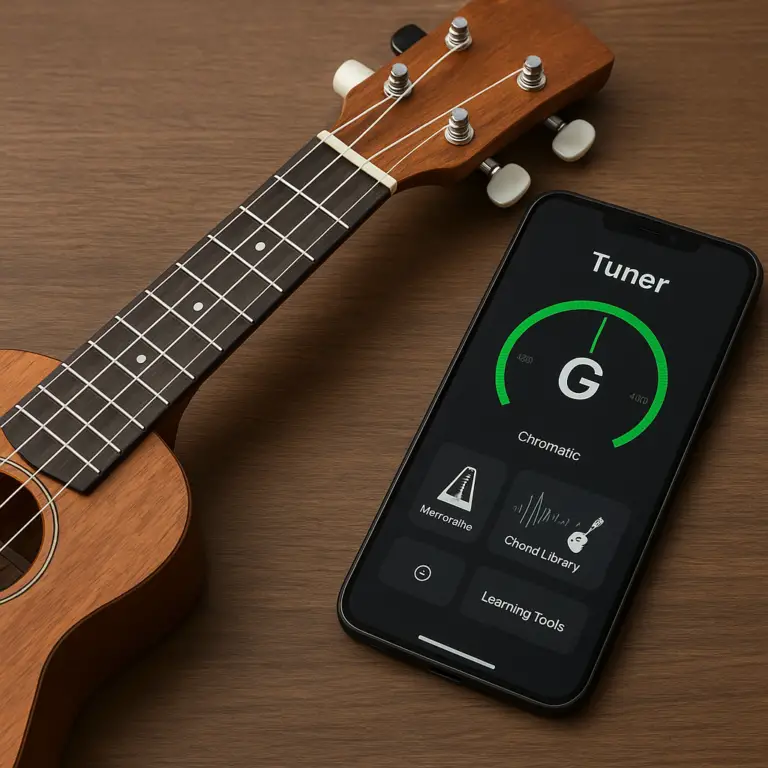
- Tune with a Tuning App or Online Ukulele Tuner
- Tune by Ear Using a Reference Note
- Check Your Tuning with Chords
- 🔢 Ukulele String Order, Numbers, and Tuning Notes
- Which String Is String 1 on a Ukulele?
- How to Read a Tuner Display and Tune Each String
- 🧰 Ukulele Tuning Tools: Tuners, Apps, and Pitch Pipes
- 🎶 How Often Should You Tune a Ukulele?
- 🪕 Why a Ukulele Goes Out of Tune
- New Strings Stretching and Settling In
- Temperature, Humidity, and Handling
- Loose Tuners, Nut Slots, and Setup Issues
- 🛠️ Ukulele Tuning Problems and How to Fix Them
- A String Keeps Slipping Out of Tune
- The Tuner Shows the Wrong Note or Octave
- A String Sounds Buzzing, Sharp, or Flat
- 🎼 Choosing High-G or Low-G Ukulele Strings
- Can You Change a High-G Ukulele to Low-G?
- When a Low-G Setup May Need a Wider Nut Slot
- 🎤 Does Regular Ukulele Tuning Work with a Capo?
- ❓ Ukulele Standard Tuning FAQs
- Is G–C–E–A the Same as Standard Ukulele Tuning?
- Is the G String Higher or Lower Than the C String?
- Can You Tune a Ukulele Like a Guitar?
- Can You Play Chords If Your Ukulele Is Slightly Out of Tune?
- ✅ Ukulele Tuning Checklist for a Clear, In-Tune Sound
- Conclusion
- Recommended Links
- Reference Links
⚡️ Quick Tips and Facts: Regular Ukulele Tuning at a Glance
If you want the short answer to what regular ukulele tuning is, it’s G–C–E–A, read from the fourth string to the first. But there’s a small twist: on the most common setup, the G string is a high G, so the strings don’t rise or fall in pitch in a simple staircase. 🎵
| Quick fact | What to know |
|---|---|
| Standard tuning | G–C–E–A, from string 4 to string 1 |
| Common shorthand | gCEA; lowercase g often signals high-G tuning |
| Most common ukulele sizes using it | Soprano, concert, and tenor |
| Common alternate setup | Low-G, which replaces the high G with a lower-pitched G |
| Baritone tuning | Usually D–G–B–E, like the highest four strings of a guitar |
| Best everyday habit | Check tuning each time you play |
| Reliable tuning approach | Use a chromatic tuner, then fine-tune by listening and checking chords |
- ✅ Standard G–C–E–A is the default assumed by many beginner chord charts and song arrangements.
- ✅ Tune up to the target note when possible; if a string is sharp, lower it below the target and bring it back up.
- ❌ Don’t assume every ukulele uses the same tuning. Size, string set, and musical preference can change the answer.
We’ll unpack the high-G surprise shortly. First, let’s make sure the note names and string order are crystal clear.
🎵 What Is Regular Tuning for a Ukulele?
Regular, standard, or conventional tuning usually means G–C–E–A on soprano, concert, and tenor ukules. The names are written from the fourth string to the first string—in playing position, that’s from the string nearest your face or chest down toward the floor.
The UkeBuddy ukulele tuner describes standard tuning as gCEA and identifies it as the most common setup. The lowercase g is a useful clue: it often means the fourth string is tuned to a G in the higher octave, creating the ukulele’s familiar bright, slightly “bouncy” sound.
| String number | String position while holding the uke | Standard note |
|---|---|---|
| 4 | Closest to your face or chest | G |
| 3 | Next down | C |
| 2 | Next down | E |
| 1 | Closest to the floor | A |
A useful caution: tuning names are often written from string 4 to string 1, but a tuner app may list strings in another order or display a note without telling you which string you’re plucking. Check one string at a time and compare its note to the table.
The Standard G–C–E–A Tuning Notes
The notes are G, C, E, and A. In high-G tuning, the G note sits above the C string in pitch, even though the G string is physically closest to your face. That’s why “G–C–E–A” isn’t a simple low-to-high sequence.
Here’s a pitch reference using scientific pitch notation for the common high-G setup:
| String | Note | Typical octave in high-G tuning |
|---|---|---|
| 4 | G4 | High G |
| 3 | C4 | Lowest-pitched open string |
| 2 | E4 | |
| 1 | A4 | Highest-pitched open string |
Octave labels can vary between tuner apps and devices, so focus first on the note name and then verify that your ukulele sounds in the expected register. A tuner showing “G” alone may not tell you whether it has recognized the intended octave.
What Does High-G, or Re-entrant Tuning, Mean?
In re-entrant tuning, the strings don’t follow a straightforward low-to-high or high-to-low pitch order. With high-G ukulele tuning, the third string (C) is lower than the fourth string (G). Strum a C chord and that high G adds the bright, familiar ukulele shimmer.
By contrast, linear tuning orders the strings more conventionally by pitch. Low-G tuning replaces the high G with a lower G, giving you extra low notes and a fuller, more guitar-like range.
- High G: bright, classic ukulele sound; widely used in standard songbooks.
- Low G: broader lower range; helpful for melodies and fingerpicking.
- Neither is universally “better.” They’re different musical choices, and the strings must match the intended tuning.
📜 How G–C–E–A Became the Standard Ukulele Tuning
The ukulele developed in Hawai‘i from Portuguese stringed instruments brought to the islands in the late 19th century. Its tuning and playing traditions evolved over time, and modern G–C–E–A became the familiar reference point for many contemporary ukulele players.
The Smithsonian’s National Museum of American History and the Library of Congress provide historical collections and materials related to the instrument’s cultural history. Tuning practices have never been completely uniform: historical and regional approaches include different pitch levels and string arrangements.
That context explains why you may encounter both high-G and low-G, or find older references to A–D–F♯–B tuning. They aren’t necessarily errors; they may reflect a different instrument, musical tradition, or preferred pitch. For modern beginner materials, though, G–C–E–A is usually the safest starting assumption unless the chart says otherwise.
🎼 Ukulele Tuning by Size: Soprano, Concert, Tenor, and Baritone
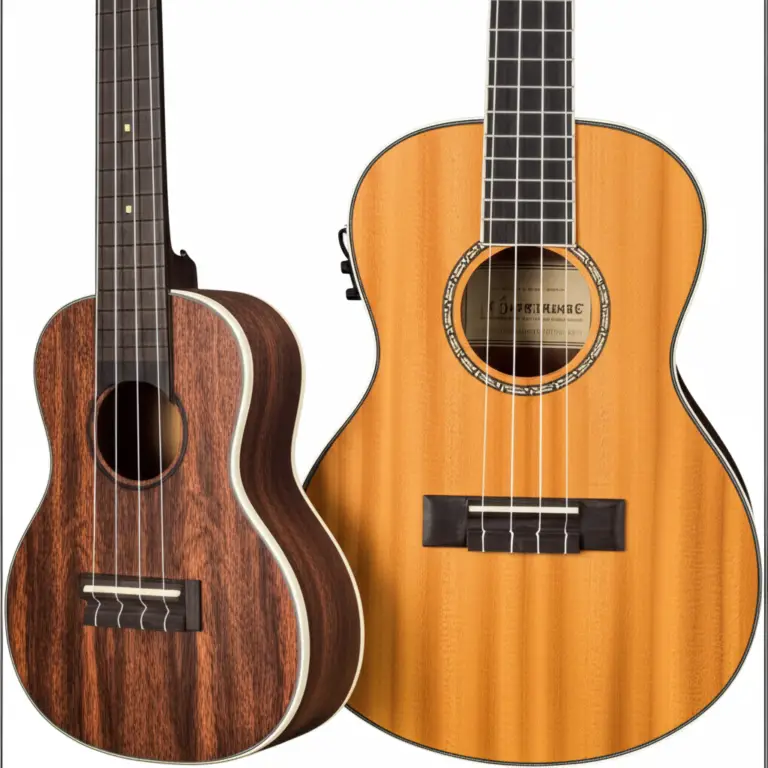
Ukulele size affects feel, scale length, and tone, but it doesn’t automatically dictate a unique tuning. Soprano, concert, and tenor ukules commonly use G–C–E–A; baritones commonly use D–G–B–E.
| Ukulele size | Common tuning | Notes and considerations |
|---|---|---|
| Soprano | G–C–E–A | Classic compact uke sound; high-G is especially common |
| Concert | G–C–E–A | Slightly larger body and fret spacing; often high-G or low-G |
| Tenor | G–C–E–A | Frequently available in either high-G or low-G |
| Baritone | D–G–B–E | Lower register; matches guitar strings 4–1 |
These are common conventions, not laws. Always check the instrument maker’s string and tuning guidance, especially if you’ve bought a used uke or changed its strings.
Which Ukulele Sizes Usually Use G–C–E–A?
Soprano, concert, and tenor ukules are the usual home of standard G–C–E–A. Tenor instruments may be sold with either a high-G or low-G fourth string, so look closely at the included strings and product specifications.
When you shop for strings, match the set to both the scale length and the tuning you want. A high-G set and a low-G set aren’t interchangeable by assumption: their fourth strings are designed for different pitches and may have different construction.
Why Baritone Ukules Are Tuned Differently
A baritone ukulele is commonly tuned D–G–B–E, from the fourth string to the first. Those are the same pitches as the highest four strings of a standard-tuned guitar, which makes guitar chord shapes and fingerings easier to transfer.
The trade-off? A baritone won’t sound or behave exactly like a soprano, concert, or tenor tuned to G–C–E–A. If you use a G–C–E–A chord chart on a D–G–B–E baritone, the shapes produce different chord names. Match your chart to your tuning, or you may wonder why your cheerful C chord has gone on holiday.
🔄 Common Ukulele Tunings and When to Use Them
Standard G–C–E–A is the most familiar starting point, but it isn’t the only useful setup. Alternate tunings can suit a different instrument size, vocal range, musical style, or arrangement.
| Tuning | Often used on | Why choose it? |
|---|---|---|
| High-G G–C–E–A | Soprano, concert, tenor | Classic re-entrant sound and broad songbook compatibility |
| Low-G G–C–E–A | Often concert or tenor | Lower notes and a more linear range |
| D–G–B–E | Baritone | Guitar-like top-four-string tuning |
| A–D–F♯–B | Some small ukules or traditional arrangements | Higher, brighter pitch |
| F–A♯–D–G | Selected arrangements | Lower overall pitch than G–C–E–A |
Alternative tunings can be valuable, but they can also make standard chord diagrams confusing. Confirm the tuning before using a chart or playing along with other musicians.
Standard High-G Tuning
High-G G–C–E–A is the default choice for many ukulele lessons, songbooks, and beginner chord charts. The high fourth string gives strummed chords their characteristic sparkle.
If you’re learning with friends, joining a ukulele group, or following online tutorials, high-G often makes it easier to play the same chord shapes as everyone else. It’s also the tuning assumed by many general-purpose ukulele tuners unless you select another option.
Low-G Linear Tuning
Low-G keeps the same note names—G–C–E–A—but tunes the fourth string an octave lower. The result is a wider pitch range and a more ordered low-to-high string layout.
Low-G can be a good fit if you:
- Play melodic fingerstyle arrangements.
- Want more low notes for accompaniment.
- Prefer a fuller sound on a concert or tenor uke.
- Need a broader range for a particular arrangement.
Its drawbacks are practical: some chord voicings and arrangements sound different, and the thicker low-G string may not fit a nut slot cut for a thinner high-G string. Choose a string set specifically designed for your instrument and tuning.
Baritone D–G–B–E Tuning
D–G–B–E is the common baritone tuning. Its guitar-like layout makes it convenient for players moving between ukulele and guitar, but the instrument’s size and lower register still shape its tone and feel.
Use baritone-specific charts when possible. Guitar chord shapes may transfer, but the chord names and musical context depend on which strings and pitches you’re playing.
Alternate Tunings for Different Sounds and Song Keys
The UkeBuddy tuner lists A–D–F♯–B as a D tuning and F–A♯–D–G as a lower tuning option. These can raise or lower the overall pitch to suit an arrangement, instrument, or singer.
Before retuning, check that your strings are suitable for the target notes and don’t force a string far beyond its intended pitch. If you’re accompanying a singer, it may be simpler to transpose the chords or use a capo than to change the instrument’s tuning—unless the sound of the alternate tuning is part of the goal.
🎸 How to Tune a Ukulele to G–C–E–A
A chromatic tuner is the simplest reliable option for most players. The first YouTube video demonstrates tuning with a chromatic tuner app, including checking the note and bringing the display into its in-tune zone. The presenter also recommends tuning each time you pick up the instrument and approaching the target from below.
Tune with a Clip-On or Electronic Tuner
A clip-on tuner detects vibrations through the instrument, which is handy in a noisy room or around other players. Models from Snark and D’Addario are popular examples; a chromatic model can recognize notes beyond a single preset tuning.
- Clip the tuner to the headstock. Make sure it sits securely and can be read comfortably.
- Select chromatic mode if the tuner offers multiple instrument presets. Confirm any calibration setting is at the expected standard, usually A=440 Hz.
- Pluck only the fourth string and let it ring without touching nearby strings.
- Read the note and direction. If it shows a note other than G, adjust slowly toward G.
- Repeat for strings 3, 2, and 1, targeting C, E, and A.
- Bring each string up to pitch from slightly below. If you overshoot, loosen the string below the target note, then tune upward again.
- Strum a few chords and recheck. A final pass catches small shifts caused by tuning the other strings.
Avoid cranking a peg quickly. Small adjustments are safer, more controlled, and less likely to send the string sailing into an accidental audition for the ceiling.
Tune with a Tuning App or Online Ukulele Tuner
Phone apps use the microphone to detect pitch, so quiet surroundings help. The first video’s presenter uses the free BOSS Chromatic Tuner app as an example and points out that microphone-based tuning works best when the instrument is close to the phone and background noise is low.
You can also use the microphone-based UkeBuddy tuner. Its interface can guide you through different tunings, but always select the intended setup before you begin.
For a cleaner reading:
- Tune away from fans, televisions, and other instruments.
- Hold the ukulele close enough for the microphone to hear it clearly.
- Pluck one string at a time with a consistent touch.
- Let the note ring briefly, then damp it before moving on.
- If the app jumps between notes, check that no other string is still vibrating.
A phone app is convenient and often free; a clip-on tuner is generally less sensitive to room noise. Neither removes the need to listen. The display gets you close, while your ears help catch an instrument that sounds wrong despite a confident green light.
Tune by Ear Using a Reference Note
Tuning by ear takes practice, but it’s useful when your battery dies or your tuner wanders off into the gig bag’s mysterious sock dimension. Use a trusted reference note from a piano, tuning fork, another instrument, or a tuner that plays tones.
- Find a reference pitch for one string—often A.
- Match the corresponding ukulele string by adjusting the peg gradually.
- Use a reliable reference or a demonstrated relative-tuning method to tune the remaining strings.
- Check familiar chords against the reference instrument.
Relative tuning can make the strings agree with each other while the whole uke remains sharp or flat. For accurate pitch, at least one string needs a known external reference.
Check Your Tuning with Chords
After using a tuner, strum an open C chord and a few familiar shapes. Listen for wavering, unpleasant beats, or a chord that sounds noticeably sour. Then pluck each open string individually.
This isn’t a replacement for a tuner, especially for beginners, but it catches practical issues such as a string slipping or a microphone app reading the wrong string. If you’re playing with others, check tuning again just before you start; a chord that sounds fine alone can expose a mismatch in a group.
🔢 Ukulele String Order, Numbers, and Tuning Notes
Ukulele string numbering can feel backward at first. String 1 is the A string, closest to the floor when you hold the instrument in playing position. String 4 is the G string, nearest your face or chest.
| String number | Note in standard tuning | Position when holding the uke |
|---|---|---|
| 4 | G | Top edge, nearest your face |
| 3 | C | Below the G string |
| 2 | E | Below the C string |
| 1 | A | Bottom edge, nearest the floor |
Which String Is String 1 on a Ukulele?
String 1 is the A string, the one closest to the floor in a normal playing position. The numbering runs from the floor-side string back toward your face: A, E, C, G.
You may see tuning written G–C–E–A because it is traditionally named from string 4 to string 1. If you see a diagram, check its orientation: some images show the fretboard from the player’s perspective, others from the front.
How to Read a Tuner Display and Tune Each String
Most tuners show a note name plus a needle, meter, or color. A centered needle or green indicator usually means the detected pitch is close to the target. The display may also show whether the note is sharp (too high) or flat (too low).
- Pluck one string at a time.
- Confirm the displayed note is the note you intended.
- Adjust the peg in tiny movements.
- Stop when the display settles near the center.
- Listen to the string after the tuner says it’s in tune.
A tuner can identify a pitch, but it can’t always tell you whether you meant to tune that string to a different octave or alternate tuning. You supply the musical context.
🧰 Ukulele Tuning Tools: Tuners, Apps, and Pitch Pipes
There’s no single best tuner for everyone. Pick the tool that suits where and how you play.
| Tool | Best for | Strengths | Limitations |
|---|---|---|---|
| Clip-on tuner | Practice rooms, groups, and noisy spaces | Reads instrument vibration; portable | May be affected by poor placement or vibration from other strings |
| Phone tuning app | Beginners and home practice | Convenient; often includes reference tones | Microphone readings can be disturbed by noise |
| Online tuner | Quick home tuning | No separate hardware needed | Requires a microphone and a quiet room |
| Pitch pipe or reference instrument | Ear training | Builds pitch recognition | Requires matching notes by ear |
| Piano or keyboard | Home reference | Clear, stable pitches | Not portable for most players |
For everyday playing, a dependable chromatic clip-on or a well-reviewed app is enough. If you’re comparing instruments and accessories, our Guitar Buying Guide and Guitar Brand Guides offer more buying and brand context.
🎶 How Often Should You Tune a Ukulele?
Check tuning every time you play, and again during a long session if the room or instrument temperature changes. Ukulele strings are light and responsive; a small shift is easy to hear once you start strumming chords.
The presenter in the first video makes the same practical recommendation: tune whenever you pick up the instrument. It’s a quick habit, not a ceremony. In a group, tune before you play together so everyone’s chords line up.
Tune again after:
- Installing new strings.
- Transporting the ukulele.
- Moving between warm and cool environments.
- Changing between high-G and low-G setups.
- Noticing a chord sounds sour or a string slips.
🪕 Why a Ukulele Goes Out of Tune
A ukulele can drift out of tune because of string stretch, temperature changes, peg movement, or setup problems. New strings are especially prone to settling, and even a well-made instrument may need frequent checking.
New Strings Stretching and Settling In
Fresh strings need time and gentle playing to stabilize. They may go flat repeatedly during the first few sessions as they settle into their final tension.
After restring:
- Tune accurately.
- Play gently for a few minutes.
- Retune.
- Repeat as needed over the first several sessions.
Avoid pulling aggressively on the strings. Gentle, patient retuning is kinder to both the strings and the instrument.
Temperature, Humidity, and Handling
Changes in temperature can affect the instrument and strings, shifting pitch. Hard cases, direct sunlight, heaters, and a quick dash from a cold car into a warm room can all leave a uke needing a fresh tune.
Let the instrument acclimate before fine-tuning. If your ukulele is made of solid wood, stable humidity matters for its overall health as well as its tuning; follow the maker’s care guidance. For more instrument-care and brand discussions, browse our Acoustic Guitars coverage.
Loose Tuners, Nut Slots, and Setup Issues
If a string repeatedly slips even after it has settled, inspect the tuner and string winding. A loose tuner screw, poorly secured string, or nut slot that binds can cause tuning trouble.
A low-G string may be thicker than a high-G string. If it catches in a nut slot designed for a thinner string, tuning may feel jumpy or the string may ping as it releases. Don’t widen the slot yourself unless you have the right tools and experience; a repair technician can assess the fit safely.
🛠️ Ukulele Tuning Problems and How to Fix Them
Start with simple checks before assuming the ukulele is broken: confirm the intended tuning, mute other strings, and make sure the tuner is in chromatic mode.
A String Keeps Slipping Out of Tune
Check whether the string is properly wound around the tuning post and whether the tuner hardware is secure. New strings may need repeated tuning as they settle. If an older string suddenly slips, look for a damaged string, loose peg, or winding that has loosened.
Tune upward toward the pitch where possible. If the string keeps dropping despite careful winding and retuning, have the tuner and nut checked.
The Tuner Shows the Wrong Note or Octave
A microphone tuner may hear a neighboring string, a room sound, or an overtone rather than the fundamental pitch. The app may also be set for a different tuning.
- Mute the other strings with your fingers.
- Move closer to the microphone or use a clip-on tuner.
- Check that the target is G, C, E, or A for the string you’re tuning.
- Confirm whether your fourth string is high-G or low-G.
- Don’t tighten a string blindly just because the display looks unfamiliar.
A String Sounds Buzzing, Sharp, or Flat
First tune the open string, then play it again without pressing a fret. If the open string is correct but fretted notes sound off, the issue may involve intonation, string condition, or setup rather than basic tuning.
A buzz can come from a loose string, fret contact, or hardware vibration. If it persists across multiple strings or appears after a string change, a qualified repair technician can identify the cause.
🎼 Choosing High-G or Low-G Ukulele Strings
High-G and low-G both use the note G, but at different octaves. The choice changes the instrument’s pitch range and character, so pick based on the music you want to play—not on the idea that one setup is universally superior.
| Feature | High-G | Low-G |
|---|---|---|
| Fourth-string pitch | Higher G | Lower G |
| String arrangement | Re-entrant | More linear |
| Sound | Bright, classic uke character | Fuller lower register |
| Common use | Strumming and standard song charts | Fingerstyle, melody, extended range |
| Main consideration | Familiar default for many tutorials | May require a suitable string and nut fit |
Can You Change a High-G Ukulele to Low-G?
Often, yes—especially on a tenor or concert uke—but use a low-G string designed for your instrument’s scale length. Some players switch back and forth; others keep a dedicated low-G uke to avoid changing strings.
After the change, retune carefully and expect some chord voicings or arrangements to sound different. The chord shapes remain familiar, but the altered fourth-string octave changes the notes in certain passages.
When a Low-G Setup May Need a Wider Nut Slot
Some low-G strings are thicker than the high-G strings they replace. If the string binds in the nut slot, tuning can jump, slip, or produce a ping sound.
A technician can tell whether the slot needs adjustment. Don’t force a thick string into a narrow slot; that can damage the string or affect tuning stability.
🎤 Does Regular Ukulele Tuning Work with a Capo?
Yes. Tune the ukulele to its normal setup first, then place the capo where needed. A capo raises the pitch of every open string by the same number of semitones, changing the key while preserving familiar chord shapes.
A capo can also press strings sharp if it’s too tight or poorly positioned. Place it just behind the fret and use only enough pressure to hold the strings cleanly. If a chord sounds off after adding the capo, check the capo position and retune only if needed.
✅ Ukulele Tuning Checklist for a Clear, In-Tune Sound
Before you play, run through this quick routine:
- ✅ Confirm the intended tuning: high-G G–C–E–A, low-G, or another setup.
- ✅ Check the string order: 4 = G, 3 = C, 2 = E, 1 = A in standard tuning.
- ✅ Tune one string at a time and mute the others.
- ✅ Use small peg movements; tune up to the target when possible.
- ✅ Recheck each string after the first pass.
- ✅ Strum familiar chords and listen for sour notes.
- ✅ Retune after changing strings, travelling, or switching tuning.
- ❌ Don’t use a G–C–E–A chart for a baritone in D–G–B–E without accounting for the different tuning.
The key takeaway is simple: regular ukulele tuning usually means G–C–E–A, but the octave of the G string—and the size of the instrument—matter. Once you know whether your uke is high-G, low-G, or baritone-tuned, the rest becomes a quick, repeatable routine.