Support our educational content for free when you purchase through links on our site. Learn more
Ukulele Fretboard Logic for Guitarists 🎸

Ukulele fretboard logic for guitarists is mostly familiar music theory on a four-string map, not a complete restart. Learn the open strings, understand G–C–E–A tuning, account for high-G re-entrant tuning, and your guitar knowledge becomes a genuine shortcut.
The first hurdle is visual: a guitar’s six-string layout feels spacious, while a ukulele compresses the same musical ideas into four strings and a shorter neck. The second hurdle is auditory: on a high-G ukulele, the physically upper string may sound higher than the C string, so chord shapes can behave like tiny musical plot twists.
We have watched guitarists confidently grab a familiar shape, strum it, and then stare at the instrument as if it had changed its name overnight. The fingers were fine; the tuning was the culprit. Once you identify the notes behind each shape, chords, scales, melodies, and transposition become far less mysterious.
A useful starting fact: every fret raises pitch by one semitone, and the 12th fret repeats the open-string note one octave higher. That rule works on both guitar and ukulele, making your existing interval knowledge more valuable than any collection of memorized diagrams.
Key Takeaways
- Start with G–C–E–A: Memorize the ukulele’s open strings before adapting guitar chord or scale patterns.
- Understand high-G versus low-G tuning: High-G creates traditional ukulele sparkle; low-G offers a more linear, guitar-like pitch layout.
- Learn notes, not only shapes: Knowing roots, thirds, and fifths makes transposition and improvisation much easier.
- Use the 12th fret as your anchor: It repeats the open-string note one octave higher.
- Build chords from intervals: Guitar shapes cannot always transfer directly because ukulele tuning and string count are different.
- Practice one-string scales first: They reveal the fretboard’s note sequence without letting familiar guitar boxes do all the thinking.
- Track roots through chord progressions: Root-note exercises connect theory to songs quickly.
- Choose fretboard geometry by feel: Radius, neck width, action, string gauge, and setup all affect comfort more than one specification alone.
- High-G and low-G are both valid: Choose high-G for traditional strumming or low-G for fingerstyle, melody, and bass movement.
Table of Contents
- ⚡️ Quick Tips and Facts: Ukulele Fretboard Logic for Guitarists
- 🧭 Ukulele and Guitar Fretboard Relationship: The Musical Background
- Tuning Differences: G–C–E–A vs. E–A–D–G–B–E
- Why Ukulele Shapes Feel Familiar but Sound Different
- High-G and Low-G Ukulele Tuning Explained
- 🎸 The Core Fretboard Logic Guitarists Already Know
- Chromatic Notes and the Twelve-Fret Octave
- Intervals, Semitones, and Whole Steps
- Octave Patterns Across Ukulele Strings
- Natural Notes, Sharps, Flats, and Enharmonic Spelling
- 🗺️ 12 Essential Ukulele Fretboard Patterns for Guitarists
- 1. Memorize the Open-String Notes
- 2. Learn the Natural Notes on Every String
- 3. Use the Fifth-Fret Reference Method
- 4. Mark the Seventh- and Twelfth-Fret Landmarks
- 5. Apply the Circle of Fifths
- 6. Find Octaves with Movable Shapes
- 7. Locate Root Notes Before Building Chords
- 8. Connect Major Scale Positions
- 9. Map Minor Pentatonic and Major Pentatonic Notes
- 10. Track Chord Tones Through Progressions
- 11. Recognize Repeating Intervals and Shape Families
- 12. Turn Fretboard Knowledge into Musical Phrases
- 🎼 Translating Guitar Chords to Ukulele Chord Shapes
- Why Guitar Chord Diagrams Cannot Be Transferred Directly
- Common Guitar-to-Ukulele Chord Equivalents
- Major, Minor, Seventh, and Suspended Chords
- Bare Chords and Movable Ukulele Shapes
- Chord Inversions and Smooth Voice Leading
- 🔢 Ukulele Scales and Modes Made Simple
- Major Scale Fretboard Mapping
- Minor Scale and Natural Minor Positions
- Major and Minor Pentatonic Boxes
- Blues Scale Notes and Bending Ideas
- Dorian, Mixolydian, and Other Modes
- Playing Scales Horizontally and Vertically
- 🎵 Ukulele Music Theory for Guitar Players
- Intervals on a Four-String Fretboard
- Triads and Four-Note Chords
- Arpeggios and Chord-Tone Targeting
- Key Signatures and Transposition
- Nashville Number System Applications
- 🎤 Playing Melodies, Riffs, and Solos on Ukulele
- Finding a Melody by Ear
- Single-Note Navigation Across the Neck
- Double-Stops, Slides, Hammer-Ons, and Pull-Offs
- Ukulele Lead Guitar Techniques
- How High-G and Low-G Change Your Soloing
- 🥁 Rhythm, Strumming, and Fretboard Awareness
- Chord-Based Strumming Patterns
- Muted Strums, Percussive Hits, and Groove
- Syncopation and Fingerstyle Patterns
- Using Fretboard Knowledge to Improve Rhythm Playing
- 🧠 Ear Training and Visual Fretboard Memorization
- See the Note, Hear the Interval, Play the Sound
- Fretboard Memory Exercises for Guitarists
- Random-Note and One-String Drills
- Learning Notes Without Relying on Stickers
- 🏋️ 15 Practical Ukulele Fretboard Exercises
- 1. Name Every Note on One String
- 2. Find All Instances of One Pitch
- 3. Play the Chromatic Scale with Note Names
- 4. Locate Every Root in a Chord Progression
- 5. Play Scales in Thirds
- 6. Practice One Scale in Multiple Keys
- 7. Connect Open Chords to Movable Shapes
- 8. Build Triads on the Top Three Strings
- 9. Play Arpeggios Over a Backing Track
- 10. Transpose a Familiar Guitar Riff
- 11. Improvise Using Only Chord Tones
- 12. Use a Metronome for Fretboard Recall
- 13. Practice with Eyes Closed
- 14. Create a Four-String Fretboard Map
- 15. Record and Review Your Progress
- 🛠️ Best Tools for Learning Ukulele Fretboard Logic
- Fretboard Charts and Note-Name Diagrams
- Tuners, Metronomes, and Chord Apps
- Interactive Fretboard Trainers
- Ukulele Tab, Standard Notation, and Guitar Tablature
- 🌐 Better Online Ukulele Fretboard Lessons and Learning Resources
- How to Choose a High-Quality Online Lesson
- What to Look for in Video Fretboard Tutorials
- Books, Courses, and Structured Practice Programs
- Reliable Music Theory and Instrument Resources
- ⚠️ Common Fretboard Mistakes Guitarists Make on Ukulele
- Assuming Guitar Shapes Will Sound the Same
- Ignoring Rentrant Tuning
- Memorizing Shapes Without Understanding Notes
- Confusing Transposition with Tuning
- Overlooking Intonation and String Gauge
- 🎯 Applying Fretboard Logic to Real Songs
- Analyzing a Pop Chord Progression
- Transposing Songs for Your Vocal Range
- Creating Ukulele Arrangements from Guitar Parts
- Building Intro, Verse, Chorus, and Solo Sections
- 📚 Fretboard Logic for Different Ukulele Sizes
- Soprano, Concert, and Tenor Ukulele Differences
- Baritone Ukulele and D–G–B–E Guitar Tuning
- Scale Length, Fret Spacing, and Playability
- ✅ A 30-Day Ukulele Fretboard Practice Plan
- Week 1: Open Strings and Natural Notes
- Week 2: Intervals, Octaves, and Chord Roots
- Week 3: Scales, Triads, and Arpeggios
- Week 4: Songs, Improvisation, and Transposition
- ❓ FAQ: Ukulele Fretboard Logic for Guitarists
- Is Ukulele Fretboard Logic the Same as Guitar?
- Can Guitarists Read Ukulele Tabs Easily?
- How Long Does It Take to Memorize the Ukulele Fretboard?
- Should I Learn Chords or Notes First?
- Does a Low-G Ukulele Make Fretboard Patterns Easier?
- Can I Use Guitar Scales on Ukulele?
- Why Do Ukulele Chords Sound Different from Guitar Chords?
- What Music Theory Book Should I Study After Learning Fretboard Logic?
- 🏁 Conclusion
- 🔗 Recommended Links
- 📖 Reference Links
⚡️ Quick Tips and Facts: Ukulele Fretboard Logic for Guitarists
If you already play guitar, ukulele fretboard logic is familiar music theory wearing a smaller, sunnier outfit. The biggest adjustment is not learning an entirely new system. It is understanding how G–C–E–A tuning, four strings, and re-entrant high-G tuning rearrange the patterns you already know.
Our ukulele guide covers the instrument more broadly; here, we focus on the neck itself: notes, intervals, chords, scales, and practical navigation.
The fastest route from guitar knowledge to ukulele fluency
- Memorize the open strings: G, C, E, A.
- Learn the natural notes on each string through the 12th fret.
- Remember that every fret raises pitch by one semitone.
- Use the 12th fret as the octave reference.
- Find roots before memorizing chord shapes.
- Treat ukulele chord shapes as four-note voicings, not miniature guitar chords.
- Practice scales in one key, then move the same interval pattern.
- Compare high-G and low-G tuning before judging a pattern as “wrong.”
The Open Music Theory resources explain the same underlying principles: pitch relationships, intervals, and scales do not belong to one instrument. The instrument merely gives those ideas a particular layout.
Ukulele fretboard facts at a glance
| Feature | Standard ukulele | Guitar | Why it matters |
|---|---|---|---|
| Common tuning | G–C–E–A | E–A–D–G–B–E | Open-string note locations change |
| Number of strings | 4 | 6 | Fewer simultaneous notes, simpler mapping |
| Common tuning type | Re-entrant high-G or linear low-G | Usually linear | High-G changes octave order |
| Semitone movement | 1 fret | 1 fret | This logic is identical |
| Octave location | 12 frets above an open string | 12 frets above an open string | The octave rule transfers directly |
| Common neck width | Narrower | Wider | Fretboard distances feel compressed |
| Common scale length | Shorter | Longer | Frets sit closer together |
| Typical role | Rhythm, melody, fingerstyle | Rhythm, melody, bass, harmony | Ukulele arrangements often omit bass notes |
The crucial note-name rule
The chromatic note sequence is:
A – A♯/B♭ – B – C – C♯/D♭ – D – D♯/E♭ – E – F – F♯/G♭ – G – G♯/A♭
There is no sharp or flat between B and C, and there is no sharp or flat between E and F. This is true on guitar, ukulele, piano, and other equal-tempered Western instruments. The first video linked as #featured-video emphasizes this point while demonstrating how the frets and string names reveal every note on the neck.
“The frets, the strings, and the name of the string…”
“In music, we have 12 notes…”
“Learning the notes on the neck of the ukulele is going to help you learn songs faster…”
That final idea is exactly right. A chord chart tells you where to put your fingers. Fretboard logic tells you what you are playing and why it works.
Three facts that save guitarists hours
- A fret is a semitone, regardless of instrument size.
- The 12th fret repeats the open-string note one octave higher.
- A familiar shape may create a different chord name because the strings are tuned differently.
That last point causes the most early confusion. A guitar player may see a shape that resembles an open guitar chord, use it on ukulele, and hear something completely different. The fingers were not “wrong.” The tuning changed the musical identity of the shape.
🧭 Ukulele and Guitar Fretboard Relationship: The Musical Background

Tuning Differences: G–C–E–A vs. E–A–D–G–B–E
Standard soprano, concert, and tenor ukules are commonly tuned G–C–E–A, while a standard guitar is tuned E–A–D–G–B–E. The ukulele’s top string is often a high G, creating the characteristic re-entrant layout.
| Instrument | Lowest-sounding string to highest-sounding string | Tuning pattern |
|---|---|---|
| Guitar | E–A–D–G–B–E | Mostly perfect fourths, with a major third between G and B |
| Low-G ukulele | G–C–E–A | Linear ascending tuning |
| High-G ukulele | G above middle C–C–E–A | Re-entrant tuning |
| Baritone ukulele | D–G–B–E | Same pitch classes as the guitar’s highest four strings |
The Kala official ukulele guide and Fender’s tuning resources both identify G–C–E–A as the standard ukulele tuning. For guitarists, the key is to stop thinking “the ukulele is a guitar with two strings removed.” It is more accurate to think of it as a four-string instrument with its own interval map.
Why G–C–E–A feels unexpectedly familiar
The C, E, and A strings form intervals that guitarists recognize from many chord and scale relationships. Once you learn the open-string names, the fretboard becomes orderly:
- C string: C at open position
- E string: E at open position
- A string: A at open position
- G string: G at open position, often sounding above the C string in high-G tuning
The tuning is not random. It gives easy access to common C, F, G, Am, and Dm harmony, which helps explain why many beginner ukulele songs live comfortably in C major.
Why the high-G string changes visualization
On a low-G ukulele, the strings ascend from low G to C, E, and A. On a high-G ukulele, the G string is physically the fourth string but sounds higher than the C string.
This creates a useful distinction:
- Physical order: the string’s position on the instrument
- Pitch order: the string’s actual low-to-high sound
A guitar player who automatically hears the lowest physical string first may initially misread an arpeggio. We have made this mistake ourselves: the hand knows the pattern, the ear expects bass, and the high-G string cheerfully jumps into the upper register like it has an appointment.
Why Ukulele Shapes Feel Familiar but Sound Different
Chord shapes are created by intervals between strings, not by finger choreography alone. When tuning changes, the same visual shape produces different intervals.
For example, a guitar’s open C major chord is commonly fingered:
- Low E string: muted
- A string: 3rd fret
- D string: 2nd fret
- G string: open
- B string: 1st fret
- High E string: open
A ukulele has only four strings, tuned differently, so the guitar fingering cannot simply be transplanted. The ukulele C major chord is often:
- G string: open
- C string: open
- E string: open
- A string: 3rd fret
That shape is musically simple because it contains C, E, and G, the three notes of a C major triad.
| Concept | Guitarist’s instinct | Better ukulele approach |
|---|---|---|
| Chord shape | Memorize finger placement | Identify the chord tones |
| Scale pattern | Copy a box | Rebuild intervals from the new tuning |
| Open string | Background reference | A named pitch and structural chord tone |
| High-G string | Expect low bass | Treat it as an upper chord or melody note |
| Barre chord | Use familiar guitar pressure | Use compact four-string voicings |
High-G and Low-G Ukulele Tuning Explained
High-G re-entrant tuning
High-G tuning is the traditional ukulele sound. The G string is thinner and tuned high, producing:
- Bright, percussive rhythm
- Compact chord voicings
- A “jumping” arpeggio effect
- Less conventional bass movement
✅ Best for: strumming, traditional ukulele texture, ensemble rhythm, and crisp chord work.
Low-G linear tuning
Low-G tuning replaces the high G with a lower, often wound string. The notes ascend in pitch from G to C to E to A.
✅ Best for: fingerstyle, single-note melodies, bass movement, scale practice, and guitarists who want a more linear fretboard.
❌ Potential drawback: the instrument may sound less traditionally “ukulele-like,” and some chord voicings lose the sparkle created by re-entrant tuning.
The choice is not merely cosmetic. It changes how you visualize arpeggios, how you arrange melodies, and how chord inversions sound. A player coming from guitar often adapts faster to low-G, but high-G teaches valuable awareness of string order versus pitch order.
🎸 The Core Fretboard Logic Guitarists Already Know
Chromatic Notes and the Twelve-Fret Octave
Every fret raises a note by one semitone. Twelve semitones create an octave.
If the open C string is:
- Open: C
- 1st fret: C♯/D♭
- 2nd fret: D
- 3rd fret: D♯/E♭
- 4th fret: E
- 5th fret: F
- 6th fret: F♯/G♭
- 7th fret: G
- 8th fret: G♯/A♭
- 9th fret: A
- 10th fret: A♯/B♭
- 11th fret: B
- 12th fret: C
The Musicians Union and Yamaha’s music education resources provide useful general explanations of pitch, notation, and fret-based instruments, but you can verify the rule directly with a tuner: play the open string, play the 12th fret, and compare the note names.
Step-by-step note-finding method
- Name the open string.
- Move one fret at a time through the chromatic sequence.
- Skip accidentals only between B–C and E–F.
- Use the fret marker at the 12th fret as your reset point.
- Repeat the note names aloud while playing.
Do not rush this exercise. The goal is not to recite a chart like a musical parot. The goal is to connect visual location, physical movement, and audible pitch.
Intervals, Semitones, and Whole Steps
An interval measures the distance between two notes.
| Distance | Semitones | Example |
|---|---|---|
| Minor second | 1 | C to C♯ |
| Major second | 2 | C to D |
| Minor third | 3 | C to E♭ |
| Major third | 4 | C to E |
| Perfect fourth | 5 | C to F |
| Tritone | 6 | C to F♯ |
| Perfect fifth | 7 | C to G |
| Minor sixth | 8 | C to A♭ |
| Major sixth | 9 | C to A |
| Minor seventh | 10 | C to B♭ |
| Major seventh | 11 | C to B |
| Octave | 12 | C to C |
These distances explain chord construction:
- Major triad: root, major third, perfect fifth
- Minor triad: root, minor third, perfect fifth
- Dominant seventh: root, major third, perfect fifth, minor seventh
- Major seventh: root, major third, perfect fifth, major seventh
A guitarist already knows this framework. The ukulele simply presents the intervals on four strings instead of six.
Octave Patterns Across Ukulele Strings
Octave shapes depend on the tuning interval between strings. On a standard ukulele, adjacent strings are not all tuned at the same interval:
- G to C: perfect fourth
- C to E: major third
- E to A: perfect fourth
That major third between C and E means an octave shape that works across one string pair may need adjustment across another. This is similar to the guitar’s G-to-B tuning break.
Practical octave exercise
Choose the note C:
- Play open C on the C string.
- Find C at the 12th fret on the C string.
- Find C on the G string by moving to the 5th fret.
- Find C on the E string at the 8th fret.
- Find C on the A string at the 3rd fret.
You have now located C in multiple regions without memorizing the entire fretboard at once.
Natural Notes, Sharps, Flats, and Enharmonic Spelling
A note such as C♯ can also be called D♭. These are enharmonic equivalents: the same pitch under equal temperament, but with different theoretical spelling.
Use the spelling that fits the key:
- In D major, use C♯.
- In A♭ major, use D♭.
- In F major, use B♭.
- In G major, use F♯.
For basic fretboard mapping, you can think in either sharps or flats. For chord analysis, melody writing, and reading standard notation, spelling matters.
A practical rule:
Use sharps when moving upward chromatically and flats when moving downward, unless the key signature tells you otherwise.
This is not an absolute rule in advanced harmony, but it is a useful starting point.
🗺️ 12 Essential Ukulele Fretboard Patterns for Guitarists
1. Memorize the Open-String Notes
Say them in physical order:
G – C – E – A
Then say them from lowest sounding pitch in low-G tuning:
G – C – E – A
For high-G tuning, notice that the physical order is not the same as the pitch order. This small distinction is the first major ukulele-specific hurdle.
Write the open-string names on a card. Test yourself before picking up the instrument. Then reverse the exercise: point to a string and name its open note instantly.
2. Learn the Natural Notes on Every String
Start with natural notes only. Avoid trying to memorize every sharp and flat simultaneously.
C string natural notes
| Fret | Note |
|---|---|
| 0 | C |
| 2 | D |
| 4 | E |
| 5 | F |
| 7 | G |
| 9 | A |
| 11 | B |
| 12 | C |
Repeat the process for G, E, and A strings. Notice that the pattern of whole steps and half steps remains:
Whole – Whole – Half – Whole – Whole – Whole – Half
That is the major-scale interval pattern.
3. Use the Fifth-Fret Reference Method
The fifth fret is a useful landmark because it reveals familiar interval relationships:
- G string, 5th fret = C
- C string, 5th fret = F
- E string, 5th fret = A
- A string, 5th fret = D
These notes create a chain of fourths: G to C, C to F, E to A, and A to D. The E-to-A relationship is especially useful for guitarists because guitar tuning includes similar fourth-based movement.
Use the fifth fret as a launchpad, not a substitute for learning the whole neck.
4. Mark the Seventh- and Twelfth-Fret Landmarks
The seventh fret often gives you the fifth of the open-string key:
- G string, 7th fret = D
- C string, 7th fret = G
- E string, 7th fret = B
- A string, 7th fret = E
The 12th fret repeats the open note one octave higher. Together, the 5th, 7th, and 12th frets create a practical visual skeleton.
✅ Learn these landmarks first.
❌ Do not depend forever on decorative fret markers.
5. Apply the Circle of Fifths
The circle of fifths organizes key relationships:
C → G → D → A → E → B → F♯/G♭ → D♭ → A♭ → E♭ → B♭ → F → C
It helps you understand:
- Key signatures
- Dominant-tonic movement
- Common chord progressions
- Transposition
- Relative major and minor relationships
The Berklee Online music theory resources explain the circle as a map of tonal relationships. On ukulele, it is especially helpful for moving common song progressions into comfortable keys.
6. Find Octaves with Movable Shapes
An octave is the same note at a higher or lower register. Practice finding:
- C on the C string and A string
- G on the G string and E string
- A on the A string and E string
- E on the E string and C string
Because of the C-to-E major-third tuning interval, do not assume one octave shape works everywhere. Check the note names.
7. Locate Root Notes Before Building Chords
A chord shape becomes more useful when you know where its root notes are.
For a C major chord, identify:
- C as the root
- E as the major third
- G as the perfect fifth
Then ask:
- Which string contains the lowest physical root?
- Is the root doubled?
- Is the chord in root position or an inversion?
- Is high-G adding a repeated upper note?
This approach turns chord diagrams into harmony rather than finger gymnastics.
8. Connect Major Scale Positions
The C major scale contains:
C – D – E – F – G – A – B
On ukulele, practice it first across one string. Then play it across adjacent strings.
One-string C major example on the A string
- 3rd fret: C
- 5th fret: D
- 7th fret: E
- 8th fret: F
- 10th fret: G
- 12th fret: A
- 14th fret: B
- 15th fret: C
This exercise feels less glamorous than a fast scale run, but it reveals the fretboard’s logic. Later, when a melody lands on the 10th fret of the A string, you will know it is G rather than merely “that one high note.”
9. Map Minor Pentatonic and Major Pentatonic Notes
The minor pentatonic formula is:
1 – ♭3 – 4 – 5 – ♭7
In A minor:
A – C – D – E – G
The major pentatonic formula is:
1 – 2 – 3 – 5 – 6
In C major:
C – D – E – G – A
These scales share the same notes when C major and A minor are compared. That relationship is valuable for songwriting and improvisation.
10. Track Chord Tones Through Progressions
Take a common progression:
C – G – Am – F
Identify the chord tones:
| Chord | Root | Third | Fifth | Optional seventh |
|---|---|---|---|---|
| C | C | E | G | B |
| G | G | B | D | F |
| Am | A | C | E | G |
| F | F | A | C | E |
Now play only roots. Then roots and thirds. Finally, add fifths or sevenths. This reveals why certain melody notes sound stable while others create tension.
11. Recognize Repeating Intervals and Shape Families
Rather than memorizing dozens of unrelated shapes, classify them:
- Major triad
- Minor triad
- Dominant seventh
- Major seventh
- Minor seventh
- Suspended chord
- Diminished triad
The same quality can appear in several inversions. The fingering changes, but the interval formula remains.
12. Turn Fretboard Knowledge into Musical Phrases
Every drill should lead to music. After practicing a scale:
- Create a two-note phrase.
- Repeat it with a different ending.
- Add a slide or hammer-on.
- Resolve to the root.
- Play it over a chord loop.
- Record the result.
This is where fretboard logic stops being a geography lesson and starts becoming musicianship.
🎼 Translating Guitar Chords to Ukulele Chord Shapes
Why Guitar Chord Diagrams Cannot Be Transferred Directly
A guitar chord diagram represents six strings tuned E–A–D–G–B–E. A ukulele diagram represents four strings tuned G–C–E–A. Even when both instruments play a C major chord, their voicings may differ in:
- Bass note
- Note doubling
- Octave
- Inversion
- String spacing
- Register
This is why a guitar chord chart can be useful for theory, but not always for direct fingering.
Common Guitar-to-Ukulele Chord Equivalents
| Chord | Common ukulele fingering, G–C–E–A | Notes |
|---|---|---|
| C | 0003 | C–E–G–C |
| F | 2010 | A–C–F–A |
| G | 0232 | G–D–G–B |
| Am | 200 | A–C–E–A |
| Dm | 2210 | A–D–F–A |
| Em | 0432 | B–E–G–B |
| A | 210 | A–C♯–E–A |
| E7 | 1202 | G♯–D–E–B, depending on voicing and spelling context |
Fingerings can vary by tuning, instrument, and arrangement. Before trusting a chart, verify the notes with a reliable tuner or chord reference such as Ukulele Tricks or the Kala chord library.
Major, Minor, Seventh, and Suspended Chords
Major chords
Formula: 1–3–5
Example, C major:
- C: root
- E: major third
- G: perfect fifth
Minor chords
Formula: 1–♭3–5
Example, A minor:
- A: root
- C: minor third
- E: perfect fifth
Dominant seventh chords
Formula: 1–3–5–♭7
Dominant sevenths create forward motion, particularly when resolving down a fifth or up a fourth.
Suspended chords
- Sus2: 1–2–5
- Sus4: 1–4–5
Suspended chords avoid the major or minor third, creating an open sound. On ukulele, they are excellent for adding movement without changing the whole progression.
Bare Chords and Movable Ukulele Shapes
A ukulele barre chord uses one finger to press multiple strings at one fret. Because the neck is narrower than a guitar neck, some shapes feel easier, but the shorter scale can make intonation and excess pressure more noticeable.
Barre-chord checklist
- Place the finger close behind the fret.
- Use the side of the index finger if needed.
- Relax the thumb.
- Test each string individually.
- Avoid squeezing harder than necessary.
- Check whether the nut, action, and setup are making the chord harder than it should be.
The discussion at Ukulele Underground makes a valuable point: neck width, action, radius, tuning, and technique work together. Radius alone does not determine whether a barre chord feels comfortable.
Chord Inversions and Smooth Voice Leading
An inversion places a chord tone other than the root in the lowest-sounding position. On a high-G ukulele, “lowest-sounding position” requires special care because the G string may sound higher than the C string.
Voice leading means moving between chords with minimal note movement. For example, instead of jumping between distant shapes:
- Find a C chord near the nut.
- Find a G chord with shared notes.
- Find an Am shape with one or two common tones.
- Choose an F voicing that keeps the top note smooth.
This produces a more connected arrangement than simply selecting the first chord shape in a chart.
🔢 Ukulele Scales and Modes Made Simple
Major Scale Fretboard Mapping
The major scale formula is:
Whole – Whole – Half – Whole – Whole – Whole – Half
In scale degrees:
1 – 2 – 3 – 4 – 5 – 6 – 7
To map any major scale:
- Choose the root.
- Apply the interval formula.
- Find each note one string.
- Connect the notes across strings.
- Identify chord tones within the scale.
For G major:
G – A – B – C – D – E – F♯
The F♯ is essential. Playing F natural would change the key and create a different harmonic environment.
Minor Scale and Natural Minor Positions
Natural minor formula:
1 – 2 – ♭3 – 4 – 5 – ♭6 – ♭7
A natural minor:
A – B – C – D – E – F – G
Relative major and minor keys share the same notes. A minor is the relative minor of C major, so the same fretboard notes can sound completely different depending on which note feels like home.
Major and Minor Pentatonic Boxes
Pentatonic scales remove two notes from the seven-note major or minor scale.
A minor pentatonic
- A
- C
- D
- E
- G
C major pentatonic
- C
- D
- E
- G
- A
Use the root as anchor. If you know the location of A notes, you can immediately orient the A minor pentatonic pattern.
Blues Scale Notes and Bending Ideas
The blues scale adds a flat fifth to the minor pentatonic:
1 – ♭3 – 4 – ♭5 – 5 – ♭7
A minor blues:
A – C – D – E♭ – E – G
Ukulele bends are more subtle than guitar bends because of string tension, scale length, and string gauge. Try:
- Half-step bends
- Slides into chord tones
- Grace notes
- Vibrato after the note
- Double-stop slides
Do not force wide bends. Short-scale instruments can punish enthusiasm with a note that shoots sharp before you have finished the phrase.
Dorian, Mixolydian, and Other Modes
Modes are rotations or tonal interpretations of the major scale:
| Mode | Formula | Character |
|---|---|---|
| Ionian | 1–2–3–4–5–6–7 | Major |
| Dorian | 1–2–♭3–4–5–6–♭7 | Minor with bright sixth |
| Phrygian | 1–♭2–♭3–4–5–♭6–♭7 | Dark, tense |
| Lydian | 1–2–3–♯4–5–6–7 | Bright, floating |
| Mixolydian | 1–2–3–4–5–6–♭7 | Dominant, rootsy |
| Aeolian | 1–2–♭3–4–5–♭6–♭7 | Natural minor |
| Locrian | 1–♭2–♭3–4–♭5–♭6–♭7 | Unstable, diminished |
A mode only sounds modal if the harmony establishes its tonal center. Playing Dorian notes over a C major chord will not automatically sound like Dorian. Emphasize D and F, and use a D minor or Dm7 vamp.
Playing Scales Horizontally and Vertically
- Vertical playing: move across strings within a small fret region.
- Horizontal playing: move up and down one string or along the neck.
- Diagonal playing: combine both approaches.
Guitarists often know vertical box patterns well but may become trapped inside them. Ukulele rewards horizontal awareness because a short neck makes position shifts manageable.
Practice one scale in three ways:
- Across one string.
- Across all four strings in one position.
- Along the neck using two-octave fragments.
🎵 Ukulele Music Theory for Guitar Players
Intervals on a Four-String Fretboard
Intervals are the bridge between theory and fretboard movement. Learn to recognize:
- Root to major third
- Root to minor third
- Root to perfect fifth
- Root to minor seventh
- Root to octave
For each root note, play the interval and sing it before moving on. Singing exposes whether you actually hear the distance or merely remember a finger placement.
Triads and Four-Note Chords
A triad contains three notes:
- Root
- Third
- Fifth
The fourth ukulele string often doubles one chord tone or adds a seventh. This explains why ukulele chords can sound complete despite having only four strings.
Triad qualities
| Triad | Formula | Example |
|---|---|---|
| Major | 1–3–5 | C–E–G |
| Minor | 1–♭3–5 | A–C–E |
| Diminished | 1–♭3–♭5 | B–D–F |
| Augmented | 1–3–♯5 | C–E–G♯ |
Arpeggios and Chord-Tone Targeting
An arpeggio plays chord tones one at a time. Over a C major chord, use C, E, and G. Over F major, use F, A, and C.
A reliable improvisation method:
- Play the root on beat one.
- Add the third on beat two.
- Add the fifth on beat three.
- Resolve back to the root.
- Add passing scale tones later.
This sounds musical immediately because the notes belong to the harmony.
Key Signatures and Transposition
Transposition means moving music to another key while preserving interval relationships.
To transpose a progression:
- Identify the original key.
- Write the chord degrees.
- Choose the new key.
- Rebuild the chords from the same degrees.
- Check the vocal range and ukulele register.
Example:
C – G – Am – F
Degrees: I – V – vi – IV
In G major:
G – D – Em – C
The progression is the same structurally, but every chord has moved.
Nashville Number System Applications
The Nashville Number System describes chords by scale degree rather than letter name.
| In C major | Number |
|---|---|
| C | 1 |
| Dm | 2m |
| Em | 3m |
| F | 4 |
| G | 5 |
| Am | 6m |
| Bdim | 7° |
This system is useful when a singer asks, “Can we move it down?” You do not need to rewrite theory from scratch. You simply shift the number pattern into a new key.
🎤 Playing Melodies, Riffs, and Solos on Ukulele
Finding a Melody by Ear
Use a small search area:
- Hum the first note.
- Find it on the A string.
- Compare nearby frets.
- Determine whether the next note moves up or down.
- Identify the interval.
- Repeat in short phrases.
Do not begin by hunting across the entire neck. The melody usually moves in steps or small skips.
Single-Note Navigation Across the Neck
Choose a target note, such as G. Find it:
- Open G string
- 3rd fret on E string
- 7th fret on C string
- 10th fret on A string
- 12th fret on G string
Then connect those locations with a melody. This creates a mental map based on one note in multiple places, which is more useful than memorizing isolated fret numbers.
Double-Stops, Slides, Hammer-Ons, and Pull-Offs
Double-stops
Play two notes together. Useful combinations include:
- Thirds
- Sixths
- Root-and-fifth shapes
- Melody note plus drone
Slides
Slide into a target note from one or two frets below. Keep the pressure steady and listen for the destination pitch.
Hammer-ons
Pick the first note, then sound the second by striking the string with a fretting finger.
Pull-offs
Sound a higher note, then pull the finger away to reveal the lower note.
On ukulele, clean articulation depends heavily on setup. If notes buzz, check relief, fret condition, action, and string tension before blaming your technique.
Ukulele Lead Guitar Techniques
Guitarists can adapt familiar lead techniques:
- Alternate picking
- Economy picking
- Legato
- Tremolo
- Vibrato
- Rakes
- Palm muting
- Hybrid picking
The reduced number of strings creates more space. Use that space musically. A ukulele solo often sounds strongest when it leaves room rather than attempting to imitate a saturated electric-guitar lead.
How High-G and Low-G Change Your Soloing
High-G tuning gives you a repeated upper-register note that can create:
- Banjo-like rolls
- Bright chord attacks
- Unexpected melodic jumps
- Compact chord-melody voicings
Low-G tuning offers:
- More predictable ascending scales
- Lower bass notes
- Easier guitar-style arpeggios
- Fuller fingerstyle arrangements
Neither is inherently superior. The right choice depends on whether your arrangement needs traditional rhythmic sparkle or linear melodic range.
🥁 Rhythm, Strumming, and Fretboard Awareness
Chord-Based Strumming Patterns
Start with a steady quarter-note pulse. Then add:
- Down-up eighth notes
- Accented beats
- Muted backbeats
- Syncopated upstrokes
- Dynamic changes
Use fretboard awareness to choose chord voicings that keep the top note moving smoothly. A strumming pattern becomes more expressive when the harmony has direction.
Muted Strums, Percussive Hits, and Groove
Muted strums create rhythmic punctuation. Lightly release fretting-hand pressure without lifting completely, then strum the strings.
Practice:
- Count “1 and 2 and 3 and 4 and.”
- Play open chords on quarter notes.
- Add muted upstrokes between beats.
- Accent beats 2 and 4.
- Remove accents and rebuild them gradually.
Syncopation and Fingerstyle Patterns
A common fingerstyle pattern might assign:
- Thumb: G or C string
- Index: E string
- Middle: A string
- Ring: melody or repeated top note
On high-G tuning, the thumb may not provide the lowest pitch. That is normal. Follow the arrangement’s intended rhythm and register rather than forcing every thumb stroke to sound like a bass note.
Using Fretboard Knowledge to Improve Rhythm Playing
Fretboard theory improves rhythm playing by helping you:
- Select alternate chord voicings
- Add passing chords
- Create bass movement
- Use sus chords intentionally
- Build introductions and turnarounds
- Avoid unnecessary hand jumps
If you know where the root, third, and fifth are inside a chord shape, you can alter one note without randomly poking at the chord until something works.
🧠 Ear Training and Visual Fretboard Memorization
See the Note, Hear the Interval, Play the Sound
Effective learning connects three systems:
- Visual: where the note sits.
- Physical: how the movement feels.
- Auditory: what the note or interval sounds like.
If you memorize only the visual pattern, the knowledge may disappear when the key changes. If you connect all three, transposition becomes much easier.
Fretboard Memory Exercises for Guitarists
Try this five-minute routine:
- Minute 1: name open strings.
- Minute 2: find every C.
- Minute 3: play a C major scale.
- Minute 4: identify roots in C–G–Am–F.
- Minute 5: improvise using only chord tones.
Keep the instrument in your hands. Memory improves when recall is paired with movement and sound.
Random-Note and One-String Drills
Use a random note generator or a deck of note cards. Draw one note and find it on every string.
Then reverse the drill:
- Pick a fret.
- Name the note.
- Play it.
- Check with a tuner or fretboard app.
One-string drills are particularly useful because they remove the distraction of shape memory.
Learning Notes Without Relying on Stickers
Fretboard stickers can help children or absolute beginners, but they may encourage visual dependence. If you use them:
- Remove them gradually.
- Cover half the neck.
- Test note recall without looking.
- Replace labels with small landmark dots.
- Practice away from the instrument by visualizing the strings.
A good target is instant recognition of every natural note through the 12th fret, followed by quick accidentals.
🏋️ 15 Practical Ukulele Fretboard Exercises
1. Name Every Note on One String
Choose the C string. Say every note from open to 12th fret. Repeat without looking at a chart.
2. Find All Instances of One Pitch
Choose E. Locate every E through the 12th fret. Play them in ascending pitch order where possible.
3. Play the Chromatic Scale with Note Names
Play one fret at a time while speaking each note aloud. This connects pitch naming to hand movement.
4. Locate Every Root in a Chord Progression
For C–G–Am–F, find each root before playing the chord. Then identify a third and fifth for every chord.
5. Play Scales in Thirds
In C major, play:
- C–E
- D–F
- E–G
- F–A
- G–B
- A–C
- B–D
This builds interval recognition and finger independence.
6. Practice One Scale in Multiple Keys
Use the major-scale pattern in C, G, F, and D. Say the altered notes aloud, especially F♯ in G major and B♭ in F major.
7. Connect Open Chords to Movable Shapes
Play an open C chord, then locate another C voicing higher up the neck. Compare the chord tones and top notes.
8. Build Triads on the Top Three Strings
Use the C, E, and A strings to build major and minor triads. Move one note at a time to hear how the quality changes.
9. Play Arpeggios Over a Backing Track
Use a C–Am–F–G loop. Improvise with only chord tones first. Add scale tones only after the chord changes feel clear.
10. Transpose a Familiar Guitar Riff
Take a short riff, identify its intervals, then recreate those intervals on ukulele. Do not rely on the original fret numbers.
11. Improvise Using Only Chord Tones
Limit yourself to three notes per chord. Restrictions often produce better phrasing than a giant scale dumped across the neck.
12. Use a Metronome for Fretboard Recall
Set a comfortable tempo. Name one note per beat, then two notes per beat. Accuracy comes before speed.
13. Practice with Eyes Closed
Start with open strings and simple scales. Stop immediately if your hand becomes tense or your intonation drifts.
14. Create a Four-String Fretboard Map
Draw four horizontal lines and label every natural note through the 12th fret. Then mark roots in your favorite keys.
15. Record and Review Your Progress
Record a scale, chord progression, and short improvisation once a week. Listen for:
- Hesitation
- Uneven rhythm
- Unclear bends
- Weak chord changes
- Notes that fail to resolve
🛠️ Best Tools for Learning Ukulele Fretboard Logic
Fretboard Charts and Note-Name Diagrams
A good fretboard chart should show:
- String names
- Fret numbers
- Natural notes
- Accidentals
- 12th-fret octave
- High-G or low-G orientation
Use charts as reference material, not as a permanent crutch.
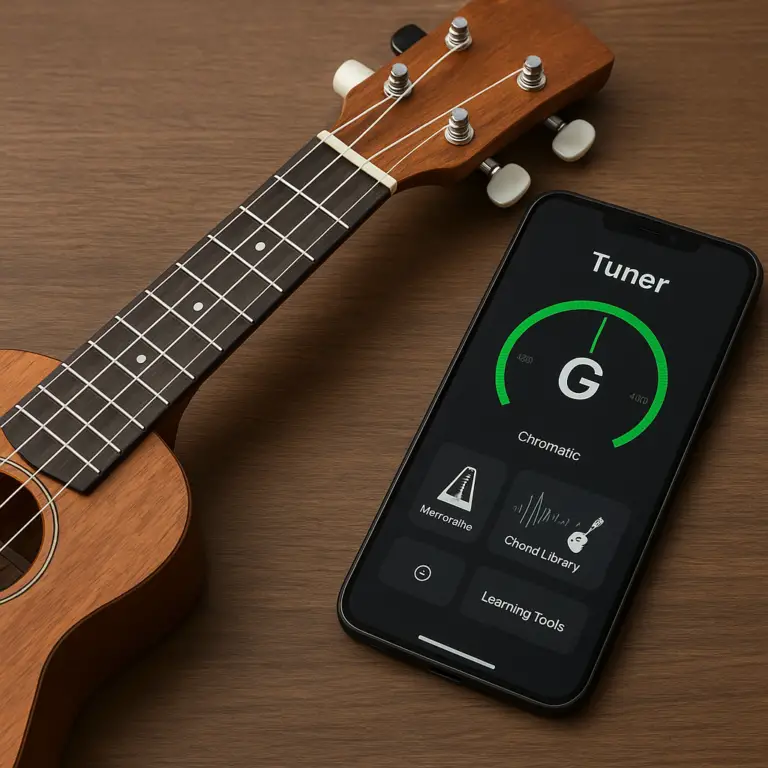
Tuners, Metronomes, and Chord Apps
Useful tools include:
A tuner validates pitch. A metronome validates time. Neither replaces listening, but both expose mistakes that enthusiasm can hide.
Interactive Fretboard Trainers
Interactive trainers can randomize:
- Notes
- Strings
- Frets
- Intervals
- Scales
- Chord tones
Choose one that lets you select ukulele tuning, especially high-G versus low-G. A guitar-only trainer may produce technically correct but instrumentally misleading exercises.
Ukulele Tab, Standard Notation, and Guitar Tablature
Ukulele tablature
Shows string and fret locations. Fast to read, but it may not explain note names or harmony.
Standard notation
Shows pitch and rhythm independently of fingering. More demanding, but excellent for transposition and melody.
Guitar tablature
Useful when analyzing the original arrangement, but it must be adapted to ukulele tuning and range.
The strongest players use all three formats selectively.
🌐 Better Online Ukulele Fretboard Lessons and Learning Resources
How to Choose a High-Quality Online Lesson
Look for lessons that:
- Name the tuning clearly
- Explain note locations
- Demonstrate slowly and at normal speed
- Include exercises
- Show both high-G and low-G differences
- Connect theory to songs
- Encourage ear training
Be cautious when a lesson teaches only shape memorization. It may help you play one song quickly, but it does not necessarily build transferable knowledge.
The Lessonface page for Robert Parrish was inaccessible during review because it displayed “Please enable cookies” behind Cloudflare protection. Since no lesson biography, curriculum, or ukulele information could be verified, we cannot treat that page as evidence about this topic. The visible Cloudflare error guidance explains the access issue, not the instructor’s teaching quality.
What to Look for in Video Fretboard Tutorials
The first video’s approach is useful because it begins with the 12 chromatic notes and then applies them to the strings and frets. That order makes sense:
- Learn the note set.
- Understand semitone movement.
- Apply it to open strings.
- Locate notes across the neck.
- Use the notes to learn songs faster.
A video that skips directly to colorful chord boxes may feel quicker but often leaves the guitarist wondering why the shapes work.
Books, Courses, and Structured Practice Programs
Recommended study materials include:
- Hal Leonard Ukulele Method
- Ukulele Aerobics by Chad Johnson
- Music Theory for Guitarists by Tom Kolb
- Fretboard Logic SE by Bill Edwards
- Berklee Online music theory courses
For guitarists, Fretboard Logic can provide a useful interval-based framework, but it should be adapted rather than copied mechanically. The ukulele’s tuning and re-entrant high-G string require instrument-specific application.
Reliable Music Theory and Instrument Resources
Useful references include:
- Musical U for ear training
- Open Music Theory for theory concepts
- Musicians Institute for practical guitar education
- Yamaha Music Education for instrument and theory resources
- Fender Play for structured guitar lessons
- Ukulele Underground for player discussions and setup perspectives
Use forum opinions as lived experience, not laboratory measurements. That distinction matters particularly with fretboard radius.
⚠️ Common Fretboard Mistakes Guitarists Make on Ukulele
Assuming Guitar Shapes Will Sound the Same
A shape is not a chord until the tuning confirms its intervals. Always identify the notes.
✅ Ask: “What notes am I playing?”
❌ Assume: “My fingers recognize this shape, so it must be the same chord.”
Ignoring Rentrant Tuning
High-G changes the pitch order. If you arrange a bass line or arpeggio as though the G string were the lowest note, the result may jump unexpectedly upward.
Memorizing Shapes Without Understanding Notes
Shape memory is efficient for songs but fragile during transposition. Learn at least the root and third of every chord you use.
Confusing Transposition with Tuning
Changing a song from C to D is transposition. Changing from high-G to low-G is a tuning change. They affect different aspects of performance.
Overlooking Intonation and String Gauge
Short scale length, string tension, nut slots, saddle height, and fret placement all influence pitch and comfort. If a note is sharp at the 7th fret, no amount of theoretical confidence will make it sound correct.
🎯 Applying Fretboard Logic to Real Songs
Analyzing a Pop Chord Progression
Use C–G–Am–F:
- Name the key: C major.
- Identify the degrees: I–V–vi–IV.
- Locate each root.
- Choose compact chord voicings.
- Add a melody using C major.
- Target chord tones on strong beats.
This method works across countless songs because it is based on function rather than a single chart.
Transposing Songs for Your Vocal Range
If a song sits too high:
- Identify the original key.
- Count the interval to the desired key.
- Move every chord by the same interval.
- Check whether the new key suits open ukulele shapes.
- Use a capo only if the resulting voicings remain practical.
A capo changes the sounding pitch while preserving familiar shapes, but it does not teach fretboard logic. Transposition without a capo teaches more, though it may require less convenient chords.
Creating Ukulele Arrangements from Guitar Parts
Guitar arrangements often contain bass, inner harmony, and melody simultaneously. On ukulele, prioritize:
- Melody
- Harmonic identity
- Rhythm
- Bass suggestion
You may omit the lowest guitar bass note and still preserve the chord if the root or a defining chord tone remains clear.
Building Intro, Verse, Chorus, and Solo Sections
Contrast creates arrangement interest:
- Intro: sparse single notes or harmonics
- Verse: light strumming or fingerstyle
- Chorus: fuller voicings and stronger dynamics
- Bridge: suspended or seventh chords
- Solo: pentatonic or chord-tone melody
- Outro: return to the opening motif
Fretboard knowledge lets you reuse a melodic idea in a new position rather than repeating the same four frets mechanically.
📚 Fretboard Logic for Different Ukulele Sizes
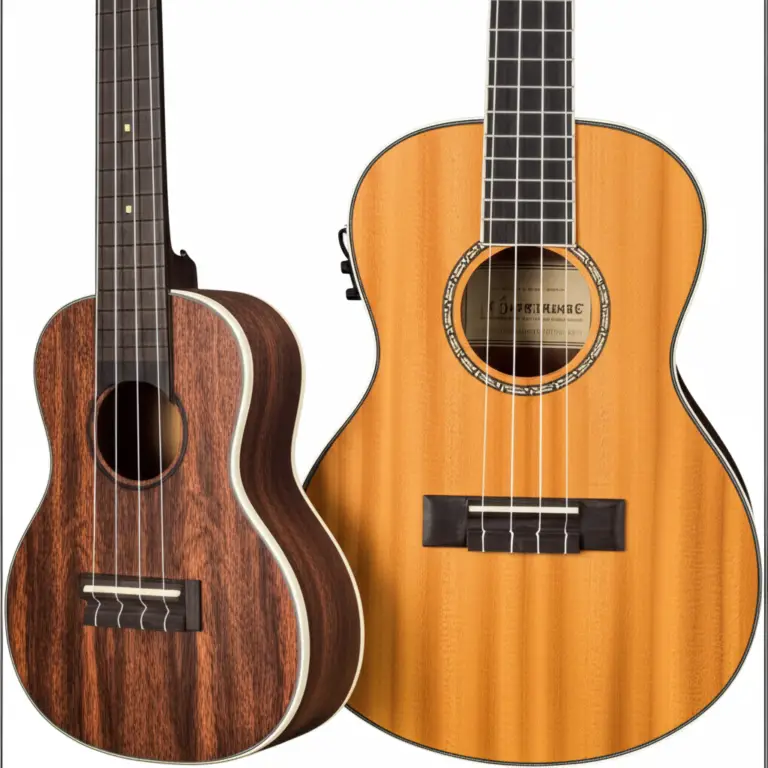
Soprano, Concert, and Tenor Ukulele Differences
| Size | General feel | Fretboard implication |
|---|---|---|
| Soprano | Compact, traditional | Closest fret spacing; chord shapes feel condensed |
| Concert | Slightly larger | More room for fretting fingers |
| Tenor | Longer scale and fuller projection | Easier single-note spacing for many guitarists |
The tuning may remain G–C–E–A across all three, so the note logic stays the same. What changes is the physical distance between notes and the available upper-fret range.
Baritone Ukulele and D–G–B–E Guitar Tuning
Baritone ukulele is commonly tuned D–G–B–E, matching the highest four strings of a guitar. This makes it the easiest ukulele format for many guitarists to approach physically.
However:
- Chord shapes transfer more directly.
- The pitch is lower than standard ukulele.
- Standard ukulele chord charts may not sound at the expected concert pitch.
- High-G versus low-G concepts do not apply in the same way.
For guitarists who want ukulele scale length and four-string simplicity without relearning every shape, baritone is a compelling bridge.
Scale Length, Fret Spacing, and Playability
Shorter scale length means closer frets, but not automatically easier playing. Finger comfort also depends on:
- Nut width
- Neck profile
- Action
- String tension
- Fret size
- Fretboard radius
- Setup quality
The Ukulele Underground radius discussion offers several player perspectives, including the observation that a 12-inch radius makes little practical difference across a narrow ukulele neck compared with the same radius on a wider guitar.
✅ A 30-Day Ukulele Fretboard Practice Plan
Week 1: Open Strings and Natural Notes
Daily, spend 10–15 minutes on:
- Open-string names
- Natural notes one string
- 12th-fret octaves
- Fifth- and seventh-fret landmarks
- One-string melodies
By the end of the week, you should identify natural notes through the 12th fret without a chart.
Week 2: Intervals, Octaves, and Chord Roots
Practice:
- Major and minor thirds
- Perfect fourths and fifths
- Octave locations
- Roots in C, G, F, and A
- Chord-tone identification
Play each interval and sing it. The ear is not optional decoration; it is your error detector.
Week 3: Scales, Triads, and Arpeggios
Work through:
- C major
- G major
- A natural minor
- A minor pentatonic
- Major and minor triads
- Arpeggios over a loop
Move from open position to at least the 7th fret.
Week 4: Songs, Improvisation, and Transposition
Choose two songs:
- Learn the chord progression.
- Locate every root.
- Play a melody fragment.
- Transpose the progression.
- Improvise using chord tones.
- Record the final arrangement.
At this stage, the unanswered question from the beginning has a practical answer: you do not need to relearn music from zero. You need to re-map familiar interval logic onto G–C–E–A tuning and decide whether high-G or low-G supports your musical goals.
⚠️ Ukulele Fretboard Geometry: Radius, Width, and Setup
Why Fretboard Radius Matters Less on Many Ukules
A radiused fretboard curves gently from one edge to the other. A flat fretboard does not. On a narrow ukulele neck, the physical difference may be subtle.
The Ukulele Underground discussion includes players comparing approximately 12-inch, 14-inch, and 16-inch radi, with some reporting little noticeable difference on a narrow neck. That does not make radius irrelevant, but it does mean neck width and action may matter more than the radius number alone.
Radiused vs. Flat Ukulele Fretboards
| Feature | Radiused fretboard | Flat fretboard |
|---|---|---|
| Barre chords | Often feels comfortable | May require more stretch |
| Strumming | Some players prefer it; others notice uneven contact | Uniform string plane |
| Fingerstyle | Depends heavily on setup and technique | Often predictable string access |
| Bending | Tight radi can cause choking if poorly set up | May feel consistent |
| Classical-style technique | Less familiar to some players | Familiar to flat-board players |
| Guitarist transition | Often resembles steel-string or electric guitar | Resembles classical guitar |
| Decision factor | Personal comfort and complete setup | Personal comfort and complete setup |
Compound Radius and Setup Details
A compound radius changes from more curved near the nut to flatter near the bridge. In theory, this can combine comfortable chord fretting with more room for bending and melodic work.
But the neck shape alone does not determine playability. Also inspect:
- Nut slot height
- Saddle shaping
- String gauge
- Neck relief
- Fret leveling
- Intonation
- Action at the 12th fret
One player may love a radiused Collings concert, while another prefers a flat classical-style instrument. Both experiences can be valid because their hands, techniques, and setups differ.
What Guitarists Should Test in a Store
Play the same five tests on each instrument:
- Full barre at the 5th fret.
- C–F–G chord changes.
- Fingerstyle arpeggio across all strings.
- Half-step bend on the A string.
- Fast alternating strum.
Then ask:
- Did the fretting hand relax?
- Did the picking hand strike all strings evenly?
- Did any bent notes choke?
- Did the neck feel too narrow?
- Did the instrument stay in tune?
The forum’s most trustworthy takeaway is not that one radius wins. It is that radius, neck width, action, tuning, string type, and technique must be judged together.
❓ FAQ: Ukulele Fretboard Logic for Guitarists

How does ukulele fretboard logic compare to guitar fretboard patterns?
The underlying logic is the same: every fret raises pitch by one semitone, the 12th fret repeats the open note one octave higher, and scales and chords are built from intervals.
The layout differs because the ukulele uses four strings tuned G–C–E–A rather than six strings tuned E–A–D–G–B–E.
The biggest adjustment
Guitarists must account for:
- Fewer strings
- Different open notes
- High-G re-entrant tuning
- Different chord voicings
- More compact fret spacing
Your guitar theory transfers. Your exact fingerings do not always transfer.
Read more about “Ukulele vs Guitar: 21 Key Differences You Must Know 🎸🎶 (2026)”
Can guitarists use their existing fretboard knowledge to learn ukulele?
Yes. Guitarists already understand frets, semitones, barre concepts, chord construction, scales, and rhythmic subdivision.
What transfers directly
- Chromatic note sequence
- Interval formulas
- Major and minor scale structure
- Triad construction
- Chord extensions
- Transposition
- Alternate picking and legato
What must be rebuilt
- Open-string note map
- Ukulele chord shapes
- High-G pitch order
- Four-string arpeggios
- Ukulele-specific voicings
A guitarist who learns note names instead of only chord diagrams usually adapts faster.
Read more about “15 Best Ukulele Brands for Guitar Players 🎸”
What are the main differences between ukulele and guitar tuning for fretboard navigation?
Standard ukulele tuning is G–C–E–A. Guitar tuning is E–A–D–G–B–E.
Both systems contain mostly fourth intervals, but the ukulele’s C-to-E major third changes some movable patterns. High-G tuning adds a second complication because the G string may sound higher than the C string.
Practical recommendation
Use low-G tuning if you want a more guitar-like ascending pitch layout. Use high-G if you want the traditional ukulele response and are willing to visualize physical string order separately from pitch order.
How do chord shapes change when moving from guitar to ukulele?
They change because the instruments have different numbers of strings and different tuning intervals.
The correct translation method
- Name the guitar chord tones.
- Decide which notes are essential.
- Select four notes available on G–C–E–A.
- Arrange them in a practical voicing.
- Check the root, third, and fifth.
- Listen for the desired inversion and register.
Do not copy a guitar shape by appearance. Copy the harmonic function.
Read more about “🎸 How Ukulele Tuning Compares to Guitar”
What is the easiest way for guitarists to learn ukulele scales?
Begin with one-string scales. This exposes the interval pattern without allowing familiar box shapes to hide the note names.
Recommended order
- C major one string
- A minor pentatonic one string
- C major across all strings
- G major with F♯
- A minor pentatonic in multiple positions
- Arpeggios over chord progressions
Say every note aloud, then play the same scale without speaking.
How can guitarists visualize notes and intervals on the ukulele fretboard?
Build the map in layers:
- Open strings
- Natural notes
- 5th, 7th, and 12th frets
- Octaves
- Roots
- Thirds and fifths
- Scale patterns
- Chord tones
A useful visualization drill
Choose one root, such as C:
- Find every C.
- Find every E near those C notes.
- Find every G near those E notes.
- Play C–E–G in different orders.
- Resolve each phrase to C.
This turns the fretboard into a network of interval relationships rather than a collection of isolated dots.
What ukulele fretboard exercises help guitarists adapt quickly?
The most effective exercises combine recall, sound, and movement:
- One-string note naming
- Find-all instances of one note
- Root tracking through chord progressions
- Major and minor triads
- Pentatonic improvisation
- High-G versus low-G arpeggio comparison
- Transposing a familiar guitar riff
- Playing with a metronome
- Recording and reviewing
The exercise we recommend most
Play C–G–Am–F, but before each chord:
- Say the chord name.
- Find its root on the A string.
- Play the chord.
- Improvise using only its chord tones.
- Resolve to the next chord’s root.
It is simple, musical, and brutally effective.
Does fretboard radius change ukulele fretboard logic?
No. Radius changes physical feel, not the note names or interval formulas.
What radius can influence
- Barre-chord comfort
- String access
- Bending feel
- Strumming consistency
- Perceived neck shape
The Ukulele Underground discussion contains conflicting player reports because radius interacts with action, neck width, tuning, string gauge, and technique. Trust the full setup and your own hands more than a single specification.
Should guitarists choose high-G or low-G ukulele tuning?
Choose high-G for traditional ukulele rhythm, bright chord texture, and re-entrant sparkle. Choose low-G for linear scales, bass movement, fingerstyle, and a more guitar-like response.
Our practical test
If your first project is strumming songs, start high-G. If your first project is fingerstyle, melody, or chord-melody arrangement, low-G may shorten the learning curve.
Read more about “Can Guitar Tabs Play on Ukulele? 🎸➡️🎶”
🏁 Conclusion

Ukulele fretboard logic is not a separate universe from guitar theory. It is the same musical language mapped onto four strings, G–C–E–A tuning, and a shorter neck.
Our recommendations
- Start with note names, not only chord diagrams.
- Learn the natural notes through the 12th fret.
- Treat the high-G string as a pitch-order challenge rather than a flaw.
- Use low-G when linear bass and scale movement matter most.
- Build chords from roots, thirds, and fifths.
- Practice one-string scales before relying on familiar shapes.
- Judge fretboard radius together with action, neck width, tuning, and setup.
- Use songs to test theory immediately.
The unresolved mystery from the opening is now solved: your guitar knowledge is not wasted on ukulele; it is the shortcut. You simply need to redraw the map.
🔗 Recommended Links
👉 CHECK PRICE on:
- Kala Ukules: Amazon | Guitar Center | Kala Official Website
- Cordoba Ukules: Amazon | Sweetwater | Cordoba Official Website
- Fender Ukules: Amazon | Fender Official Website
- Luna Ukules: Amazon | Guitar Center | Luna Official Website
- Ohana Ukules: Amazon | Ohana Official Website
- Collings Instruments: Collings Official Website
Recommended books
- Fretboard Logic SE by Bill Edwards
- Music Theory for Guitarists by Tom Kolb
- Ukulele Aerobics by Chad Johnson
- Hal Leonard Ukulele Method
More Guitar Brands™ resources
❓ FAQ: Ukulele Fretboard Logic for Guitarists

How does ukulele fretboard logic compare to guitar fretboard patterns?
The fundamental logic is identical. A fret raises pitch by one semitone, twelve frets equal an octave, and chords and scales are built from intervals.
The difference is the map. Ukulele has four strings tuned G–C–E–A, while guitar has six strings tuned E–A–D–G–B–E. High-G re-entrant tuning also means the ukulele’s physical string order does not always match its sounding pitch order.
Can guitarists use their existing fretboard knowledge to learn ukulele?
Absolutely. Your knowledge of chromatic notes, major and minor scales, chord construction, rhythm, and transposition transfers directly.
You must rebuild open-string note locations and chord shapes, but you do not need to relearn the concepts themselves.
What are the main differences between ukulele and guitar tuning for fretboard navigation?
Ukulele is usually G–C–E–A; guitar is E–A–D–G–B–E. Standard ukulele also commonly uses high-G re-entrant tuning, which places the G string above the C string in pitch.
Low-G tuning produces a more linear arrangement and often feels more intuitive to guitarists.
How do chord shapes change when moving from guitar to ukulele?
They change because four ukulele strings cannot reproduce every six-string guitar voicing. The tuning also changes the interval relationships between adjacent strings.
Translate chords by identifying their notes, selecting the essential chord tones, and building a practical four-string voicing.
What is the easiest way for guitarists to learn ukulele scales?
Start with one-string major and pentatonic scales. Then connect them across multiple strings. This helps you learn actual note names and intervals before relying on familiar guitar-style boxes.
Practice in C major, G major, and A minor pentatonic first.
How can guitarists visualize notes and intervals on the ukulele fretboard?
Memorize open strings, natural notes, and the 12th-fret octave. Then locate roots and add thirds, fifths, and sevenths around them.
A note map becomes genuinely useful when you can see a root, hear its interval relationships, and reach those notes without counting every fret.
What ukulele fretboard exercises help guitarists adapt quickly?
Use one-string note drills, find-all-the-notes exercises, root tracking, triad construction, pentatonic improvisation, and transposed guitar riffs.
The most efficient routine combines:
- Note naming
- Interval hearing
- Chord-tone playing
- Metronome practice
- Short musical applications
Should guitarists learn high-G or low-G ukulele first?
High-G is the traditional choice and works beautifully for rhythmic strumming. Low-G is often easier for guitarists who want linear scales, bass movement, and fingerstyle.
Neither tuning is universally better. Choose according to the music you want to play.
Does a radiused fretboard make a ukulele easier for guitarists?
Sometimes. A radius may feel comfortable for barre chords, while a flat board may suit players who prefer uniform string access for fingerstyle or classical techniques.
The practical effect is usually smaller on ukulele than on guitar because the neck is narrower. Action and setup may matter more.
Can guitarists use guitar tabs on ukulele?
You can use guitar tabs as source material, but the fret numbers and string assignments cannot be transferred directly. Identify the melody’s intervals or note names, then recreate it within the ukulele’s range.
Baritone ukulele is the exception: its D–G–B–E tuning matches the guitar’s highest four strings, so many shapes transfer more directly.
How long does it take to memorize the ukulele fretboard?
Many guitarists can become comfortable with open strings, landmarks, and natural notes in several weeks with consistent short practice sessions. Full automatic recall takes longer and depends on how often you use the notes musically.
Ten focused minutes daily usually beats one unfocused weekend marathon.
What should guitarists study after learning ukulele fretboard logic?
Study triads, chord inversions, interval ear training, major and minor pentatonic scales, functional harmony, and transposition.
For additional discussion, see the Facebook post about What guitar music theory book to study after Fretboard Logic?. The post requires Facebook access, so its contents should be treated as a discussion prompt rather than an independently verifiable source.
📖 Reference Links
- Kala Brand Music — ukulele tuning, chord, and instrument resources
- Fender Ukulele Resources — tuning guidance and ukulele education
- Cordoba Guitars — ukulele and acoustic instrument information
- Berklee Online: Circle of Fifths — key relationships and harmonic theory
- Open Music Theory — intervals, scales, harmony, and notation
- Fender Tune — tuner and practice utility
- Musical U — ear-training exercises
- Ukulele Underground Forum — player perspectives on fretboard radius, setup, and playability
- Lessonface Robert Parrish Page — access was limited by a security challenge; no instructional claims were verified
- Cloudflare 5xx Error Guidance — explanation of access and server-error pages
- Fretboard Logic — official information about Bill Edwards’ fretboard method
- Hal Leonard — music method books and educational publications
- Yamaha Music Education — general music and instrument education
- Facebook discussion: What guitar music theory book to study after Fretboard Logic? — related community discussion requiring Facebook login